Choosing the right Steel Sheet Pile for retaining walls starts with understanding the soil conditions behind the design. For technical evaluators, factors such as soil type, groundwater level, load requirements, and corrosion exposure directly affect section selection, stability, and service life. This article outlines the key geotechnical considerations and shows how reliable steel sheet pile solutions can support safer, more efficient retaining wall performance.
Why soil conditions are the first checkpoint for Steel Sheet Pile for retaining walls
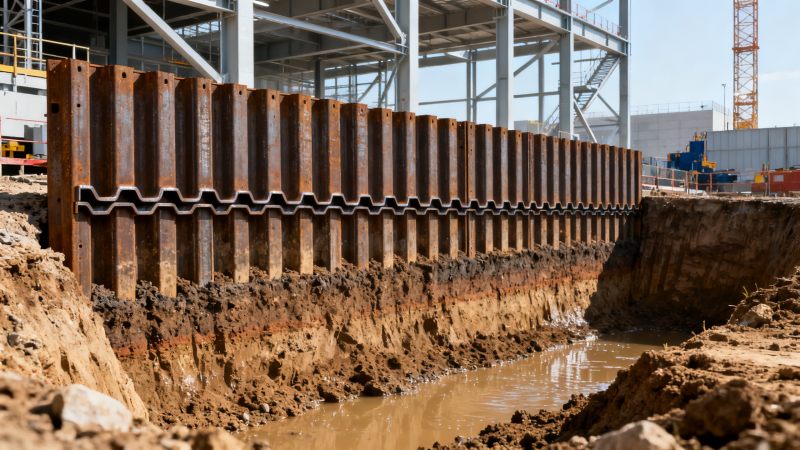
A retaining wall design can look adequate on paper and still underperform if the ground profile is misunderstood. For technical assessment teams, the most important question is not only which section is available, but whether the selected Steel Sheet Pile for retaining walls matches the in-situ soil behavior throughout installation and service life.
Steel sheet piles work by resisting earth pressure, water pressure, surcharge loads, and movement caused by changing site conditions. Their effectiveness depends on embedment depth, interlock continuity, stiffness, corrosion allowance, and the interaction between steel and surrounding soil. In loose or highly variable ground, a section that is theoretically strong enough may still face driving difficulties, excessive deflection, or reduced long-term durability.
This is why technical evaluators usually begin with geotechnical data review. Borehole logs, groundwater observations, shear strength values, unit weights, and chemical exposure indicators should be tied directly to pile profile selection, coating strategy, and construction method. In practical procurement, the right supplier is one that understands both steel manufacturing quality and the design implications of soil conditions.
- Granular soils may permit easier driving but can increase seepage concerns when interlock sealing is critical.
- Soft clays often demand greater embedment and closer attention to long-term deformation and staged loading.
- Mixed strata with cobbles or debris can create refusal risk, profile damage, or alignment deviation during installation.
- Aggressive groundwater chemistry may shorten service life unless steel grade, thickness, and surface protection are evaluated early.
Which soil properties matter most during technical evaluation?
When reviewing Steel Sheet Pile for retaining walls, evaluators should focus on a short list of geotechnical inputs that directly influence structural and construction decisions. These properties are more useful than broad site descriptions because they translate into measurable design and procurement consequences.
Key site variables to verify before section selection
- Soil classification: clay, silt, sand, gravel, fill, or mixed layers affect passive resistance, lateral pressure, and drivability.
- Groundwater level: hydrostatic pressure changes the net lateral load and may require water cut-off performance from interlocks.
- Undrained shear strength or friction angle: these values strongly influence bending moment demand and embedment calculations.
- Surcharge conditions: traffic, foundations, stored materials, or nearby equipment can increase wall demand significantly.
- Chemical exposure: pH, chlorides, sulfates, and stray current conditions affect corrosion rate and coating decisions.
The table below helps connect common soil conditions to the evaluation points that most often influence Steel Sheet Pile for retaining walls in real project reviews.
For procurement planning, this comparison is valuable because it turns ground data into specification language. It also reduces the risk of purchasing a pile profile based only on nominal dimensions while overlooking installation feasibility or durability exposure.
How different retaining wall scenarios change the sheet pile decision
Not all retaining walls face the same design pressure. A temporary excavation support system in urban clay is judged differently from a waterfront retaining line in corrosive soil. The same Steel Sheet Pile for retaining walls can therefore perform very differently depending on project function, construction sequence, and expected service life.
Common application scenarios
- Basement and foundation excavations where movement control is critical near adjacent structures.
- Road, railway, and bridge approaches where surcharge loads and differential soil conditions must be managed.
- Riverbank, flood control, and dam-related structures where seepage resistance and corrosion margin become important.
- Industrial or port-side retaining systems exposed to saline water, cyclic loading, and long service demands.
In many of these projects, technical evaluators also review surrounding steel needs beyond the sheet pile wall itself. Reinforcement, tie systems, foundations, beams, columns, and related structural materials must align in specification and delivery schedule. For broader construction supply planning, Wire rod can be relevant where rebars, civil engineering construction, bridges, roads, tunnels, foundations, walls, and slabs are part of the same project package.
Available in grades such as HRB335, HRB400, and HRB500, with common material options including Q195, Q235, Q345, ASTM A53 GrA, GrB, ST37, ST52, and 16Mn, this product range supports hot rolled or cold rolled processing and multiple surface treatments. For buyers managing mixed structural procurement, combining sheet pile review with related material checks can improve delivery coordination and reduce sourcing fragmentation.
What technical evaluators should compare before approving a supplier
The best purchasing decision is rarely based on price alone. Technical teams usually need confirmation that the proposed Steel Sheet Pile for retaining walls can be manufactured consistently, traced to the required standards, and delivered in a form suitable for the site method statement. A lower-cost offer may become expensive if it leads to delays, driving defects, or mismatched section properties.
The following table summarizes the main comparison points used when screening structural steel partners for retaining wall applications.
For global buyers, Hongteng Fengda addresses these priorities through modern manufacturing facilities, strict quality control, and supply support for standard specifications as well as OEM structural steel solutions. This is useful when a project requires not just one steel product, but a coordinated package aligned with international standards and dependable lead times.
How to select Steel Sheet Pile for retaining walls under tight project constraints
Technical evaluators are often balancing three pressures at the same time: design safety, procurement cost, and delivery schedule. The challenge is greater when soil data is incomplete or when multiple contractors are involved. A practical selection process can reduce decision delays and avoid re-specification during construction.
A practical review sequence
- Confirm whether the wall is temporary or permanent, since this affects corrosion allowance, coating need, and lifecycle expectations.
- Match geotechnical parameters to required stiffness and embedment rather than choosing by nominal pile size alone.
- Review installation method, especially in dense or obstructed soils where vibration, pressing, or pre-drilling may be needed.
- Check standard requirements and project approval documents early to avoid late-stage material substitution.
- Evaluate supplier responsiveness on custom lengths, bundled steel supply, and shipping schedule coordination.
For many international buyers, the advantage of working with an experienced structural steel manufacturer lies in supply integration. Hongteng Fengda serves customers across North America, Europe, the Middle East, and Southeast Asia with stable production capacity and quality management aligned to ASTM, EN, JIS, and GB. This matters when project success depends on reducing sourcing risk as much as controlling material cost.
Common mistakes in soil-based sheet pile evaluation
Many specification problems are not caused by poor steel quality, but by incomplete translation of site conditions into procurement requirements. Several recurring mistakes appear in retaining wall projects, especially when design, purchasing, and site teams review the job separately.
- Assuming one soil report represents the entire wall line, even when fill conditions vary sharply across the site.
- Ignoring groundwater fluctuations and specifying a section based only on dry-season observations.
- Focusing only on initial strength while underestimating long-term corrosion and deformation risks.
- Comparing quotations without checking tolerance, interlock condition, or compatibility with the intended installation method.
- Delaying supplier communication until after design freeze, which limits options for custom sections or lead-time optimization.
A disciplined technical review closes the gap between engineering assumptions and steel supply realities. That is especially important in international procurement, where shipment timing, documentation, and standard equivalence can all affect the final approval path.
FAQ: key questions about Steel Sheet Pile for retaining walls
How do soft clay conditions affect Steel Sheet Pile for retaining walls?
Soft clay usually reduces passive resistance and increases concern about long-term movement. Technical evaluators often look for greater embedment depth, stronger section modulus, careful excavation staging, and in some cases anchor support. The main risk is not only immediate stability, but gradual deformation under sustained load.
When is corrosion protection especially important?
Corrosion review becomes more important in marine sites, saline groundwater, industrial environments, and locations with fluctuating water tables. In these conditions, the decision may include corrosion allowance, protective surface treatment, or a more conservative section strategy. Buyers should request clear discussion of exposure assumptions before finalizing supply.
What should buyers ask a supplier before ordering?
Ask about dimensional tolerances, applicable standards, available section range, custom length capability, coating options, production lead time, and export documentation support. If the project involves mixed structural materials, also ask whether the supplier can coordinate related steel items to reduce interface risk.
Is lower price always a good sign in retaining wall procurement?
Not necessarily. A lower quotation may exclude surface treatment, tighter tolerances, or documentation expected by the project team. For Steel Sheet Pile for retaining walls, apparent savings can disappear if site driving issues, replacement material, or schedule slippage occurs later. Total project cost is a more reliable measure than unit price alone.
Why choose us for structural steel supply and project support
For technical evaluators, the most useful supplier is one that can support both specification accuracy and procurement reliability. Hongteng Fengda provides structural steel manufacturing and export support from China for global construction, industrial, and manufacturing projects, with product capabilities covering angle steel, channel steel, steel beams, cold formed steel profiles, and customized structural steel components.
If your project involves Steel Sheet Pile for retaining walls or related structural steel packages, you can contact us to discuss section selection logic, standard matching, custom processing needs, lead time planning, certification expectations, sample support, and quotation coordination. This is particularly valuable when your team must align soil conditions, design loads, compliance requirements, and delivery timing in one sourcing decision.
Share your drawings, soil report highlights, target standards, and project schedule. We can help you review feasible product options, compare supply paths, and prepare a practical steel sourcing plan that supports safer retaining wall performance and smoother project execution.
Please give us a message


Please enter what you want to find