Choosing the right Steel Rod for construction is more than a material decision—it directly affects safety, load capacity, and long-term project performance. For operators and project users, understanding when strength grade matters most can help prevent costly mistakes, improve structural reliability, and ensure every construction task meets both technical demands and international quality expectations.
In daily construction work, steel rod selection is often treated as a routine purchasing item, yet the wrong grade can lead to bending failure, poor weld performance, excessive deflection, or unnecessary material cost. For site operators, fabrication teams, and project users, the real question is not simply whether a rod is strong, but whether its strength grade matches the load path, service condition, and code requirement.
This matters even more in global supply chains. A project may involve ASTM, EN, JIS, or GB standards, with different yield strengths, chemical limits, and processing expectations. A professional structural steel partner with stable production capacity, quality control, and export experience can reduce sourcing risks, especially when multiple steel components must work together inside one structure.
Why Strength Grade in Steel Rod for Construction Cannot Be Treated as a Minor Detail
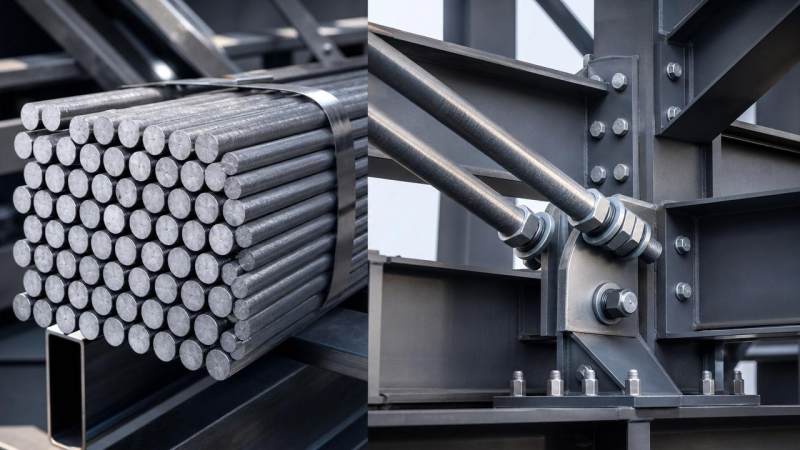
Steel Rod for construction performs more than one function on a job site. Depending on the design, it may resist tension, support anchoring, transfer load between members, reinforce concrete, or serve as a fabricated part in frames, brackets, or connection assemblies. In each case, strength grade directly influences how much force the rod can carry before yielding or failure.
For practical site use, operators usually care about 4 things first: whether the rod can carry the specified load, whether it can be bent or cut without cracking, whether it welds safely, and whether it will remain stable in outdoor or corrosive conditions for 10, 20, or even 50 years of service.
What Strength Grade Means in Real Job Conditions
Strength grade is generally linked to measurable properties such as yield strength and tensile strength. In simple terms, yield strength shows when steel starts to deform permanently, while tensile strength shows the maximum stress it can resist before fracture. A higher grade often provides more load capacity, but it may also change weldability, forming behavior, and cost.
For example, when a rod is used in lightly loaded support work, a lower or medium grade may be fully acceptable. But when the same rod is part of a bridge connection, heavy industrial platform, or seismic structure, grade selection becomes far more critical. Choosing too low a grade can create a safety issue; choosing too high a grade without process adjustment can cause fabrication problems.
When Grade Matters Most
There are at least 5 scenarios where Steel Rod for construction must be checked carefully instead of selected by habit or price alone.
- High-load structural joints where rods transfer major tensile force
- Dynamic service conditions such as machinery bases, bridges, or vibration zones
- Cold-region or low-temperature projects where toughness becomes important
- Welded assemblies that require controlled chemistry and reliable heat input
- Projects using mixed international standards across multiple suppliers
In these cases, strength grade affects not only load capacity but also fabrication sequence, inspection method, and acceptance criteria. That is why experienced buyers often review grade together with diameter tolerance, elongation, surface condition, and compliance standard rather than asking for “high strength” as a broad requirement.
Typical Risks from Wrong Grade Selection
Using a rod below requirement may cause early yielding, connection slip, deformation, or reduced safety margin. Using an unnecessarily high grade can also be inefficient. It may increase cost by 8%–20% in some sourcing situations, add processing difficulty, and require tighter welding control without creating real project value.
The table below shows how strength grade decisions usually affect site performance, fabrication, and procurement priorities.
The key takeaway is simple: strength grade should always match the actual structural duty. Site users who align grade with design load, environment, and fabrication method usually avoid the two most common mistakes—under-specification and over-specification.
How Operators and Buyers Should Evaluate Steel Rod for Construction
A reliable selection process does not need to be complicated, but it should be systematic. In most projects, 6 checkpoints are enough to prevent major procurement errors: standard compliance, grade level, size tolerance, weldability, corrosion protection, and supplier traceability.
Step 1: Confirm the Applicable Standard First
Before comparing prices, check which standard governs the project. A rod supplied under ASTM may not be directly interchangeable with one supplied under EN or JIS, even if dimensions look similar. The project drawing, local code, and engineer approval should define the acceptable equivalent grades.
This is particularly important for exporters and international buyers. Hongteng Fengda, as a structural steel manufacturer and exporter from China, supports projects requiring ASTM, EN, JIS, and GB compliance. That matters when procurement teams need one supplier capable of coordinating multiple product categories under consistent quality control.
Step 2: Match Grade to Load and Fabrication Method
If the rod will be cut, bent, threaded, or welded on site, the highest available grade is not always the best choice. A balanced selection often performs better than a purely strength-driven one. For many structural applications, medium to high grades provide a better mix of load capacity and manufacturability than extreme grades with limited forming tolerance.
As a working rule, operators should review 3 technical points together: the design force, the connection type, and the processing route. If even one of these is ignored, the selected Steel Rod for construction may pass initial inspection yet still cause delays during installation.
Step 3: Check the Full Structural System, Not Just the Rod
In real projects, steel rods do not work alone. They interact with beams, channels, plates, anchors, and fabricated frames. That is why buyers often reduce risk by sourcing compatible structural products from one experienced supplier, especially when tolerances and assembly coordination matter.
For example, where rod assemblies connect to heavy frame members, buyers may also specify H Section Beam products to ensure a stable structural path. Available in grades such as Q235, Q345B, Q460C, SS400, S275JR, S355JR, A572, and A992, these sections are commonly used in steel structures, shipbuilding, bridging, and automobile chassis applications.
Typical beam parameters include flange thickness from 8–64mm, web thickness from 5–36.5mm, flange width from 50–400mm, web width from 100–900mm, and length from 1m–12m or as required. For operators, that range helps when rod-supported joints must align with larger members during fabrication and installation.
Why System Compatibility Saves Time
When beams, rods, and connection components are sourced with compatible standards and documented material grades, field rework usually drops. In practical terms, fewer mismatched holes, fewer welding adjustments, and faster fit-up can shorten installation cycles by several days on medium-sized steel structure projects.
The comparison below can help buyers assess steel rod selection from a practical procurement perspective rather than from strength alone.
This approach makes procurement more efficient because it balances mechanical performance with real installation conditions. A rod that looks ideal on paper but causes difficult threading, poor weldability, or rust exposure is rarely the right commercial choice.
Common Mistakes, Field Risks, and Better Selection Practices
Many job-site problems come from assumptions made too early in procurement. The most common issue is treating all steel rods as interchangeable if the diameter appears correct. In reality, two rods of the same size can perform very differently based on grade, chemistry, processing route, and inspection records.
Mistake 1: Buying by Price per Ton Only
Unit price matters, but it should not be the sole decision factor. A lower-cost rod may increase total installed cost if it needs additional coating, causes welding delays, or fails inspection and must be replaced. On projects with tight schedules, a 7–15 day supply delay can cost more than the original material savings.
Mistake 2: Ignoring Environmental Exposure
Outdoor construction, coastal projects, and humid industrial areas demand more than basic strength. In these environments, galvanized or stainless options may be more appropriate for some components. If maintenance access is limited, corrosion resistance can become just as important as tensile capacity over the full service cycle.
Mistake 3: No Verification of Mill and Inspection Documents
Operators and buyers should request traceable documentation for heat number, grade, dimensions, and testing results. At a minimum, 3 records should be checked before installation: material certificate, dimensional inspection, and surface condition review. For critical applications, additional third-party inspection may also be justified.
A Practical 5-Point Acceptance Checklist
- Confirm grade and standard match the drawing
- Check diameter, straightness, and cut length against tolerance needs
- Inspect surface for rust scale, cracks, or transportation damage
- Verify suitability for welding, bending, or threading operations
- Review packing, marking, and traceability before storage and use
This checklist is especially useful when materials are shipped internationally. Suppliers with export experience can make a real difference here by controlling packaging, marking, and lead-time reliability. For buyers in North America, Europe, the Middle East, and Southeast Asia, consistent documentation and dependable shipment planning help reduce receiving errors and project interruption.
What a Reliable Structural Steel Supplier Should Offer
A dependable supplier is not only a steel producer but a coordination partner. That means stable production capacity, clear communication on standard equivalency, strict quality control, and support for customized or OEM structural steel components when the project requires non-standard fabrication.
Hongteng Fengda focuses on structural steel manufacturing and export, supplying angle steel, channel steel, steel beams, cold formed steel profiles, and customized structural steel components. For buyers who need Steel Rod for construction along with related structural members, working with a supplier experienced in international standards can simplify procurement across multiple items and reduce sourcing risk.
How to Make the Right Grade Decision for Long-Term Project Value
The best grade decision is rarely the highest grade and never the cheapest grade by default. It is the one that fits the design load, fabrication process, service environment, and compliance requirement at the same time. For most operators, that means asking a practical sequence of questions before ordering.
Ask These 4 Questions Before Purchase
- What load will the rod carry, and is that load static, dynamic, or fatigue-sensitive?
- Will the rod be welded, bent, threaded, or installed with tight fit-up tolerances?
- What environment will it face: indoor, outdoor, coastal, humid, or chemical exposure?
- Which standard and equivalent grade are officially accepted by the project documents?
If these 4 questions are answered clearly, most grade selection mistakes can be avoided early. This also improves communication between procurement teams, site operators, fabricators, and engineers, which is often where steel specification issues begin.
Long-Term Value Comes from Fit, Not from Specification Inflation
Over-specifying Steel Rod for construction may appear safe, but it can create hidden costs in processing, inventory, and sourcing lead time. Under-specifying is even riskier because it can affect safety and performance. The right path is a controlled balance supported by tested material, standard compliance, and coordination with the rest of the steel structure.
For projects that combine rods with beams, channels, angles, and custom steel components, supplier capability matters as much as product price. A manufacturer able to provide standard sections, OEM solutions, and consistent export service helps users control cost, reduce rework, and keep construction progress stable.
When strength grade matters most, the decision should be based on actual structural function, not assumption. Choosing the correct Steel Rod for construction improves safety, supports efficient fabrication, and protects long-term performance across industrial, commercial, and infrastructure projects. If you need reliable structural steel supply, compatible section products, or a customized sourcing solution, contact Hongteng Fengda to get product details, technical support, and a solution matched to your project requirements.
Please give us a message


Please enter what you want to find