Choosing the right steel plate for construction is not just about meeting a thickness requirement—it directly affects load capacity, weldability, durability, and project cost. For technical evaluators, understanding how thickness influences structural performance is essential to making reliable, standards-compliant decisions in demanding construction applications.
In practice, the selection of steel plate for construction is rarely a one-variable decision. Thickness must be assessed together with steel grade, section design, fabrication method, corrosion exposure, and the governing standard, whether ASTM, EN, JIS, or GB. A plate that appears sufficient on paper can still create welding distortion, weight penalties, or unnecessary procurement cost if the thickness is not aligned with the actual structural duty.
For technical evaluation teams working on industrial buildings, steel workshops, support frames, platforms, and heavy-duty roof systems, the goal is not to choose the thickest plate, but the most appropriate one. That often means balancing 4 key factors: structural safety, fabrication efficiency, service life, and total installed cost. This article explains how thickness choices change performance and how buyers can evaluate steel plate specifications more effectively.
How Thickness Changes the Performance of Steel Plate for Construction
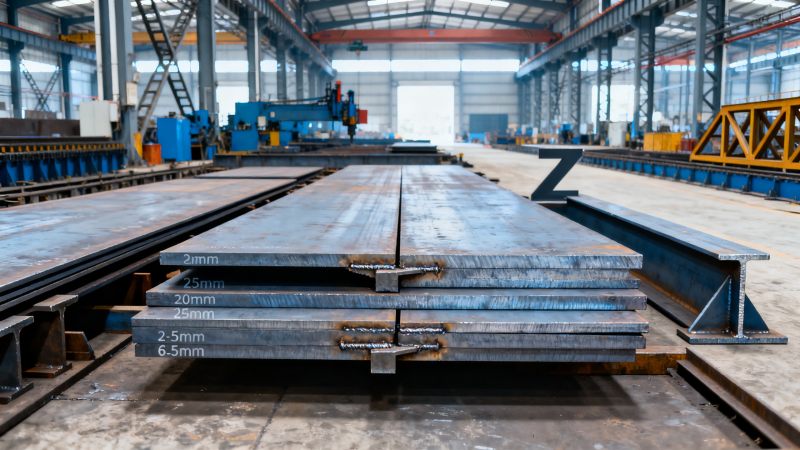
The performance of steel plate for construction changes significantly across different thickness ranges. In many building applications, the difference between 6 mm and 12 mm is not simply double the material section; it can influence bending resistance, local buckling behavior, welding heat input, cutting time, and transport weight. For technical evaluators, thickness is both a mechanical and a fabrication parameter.
Load Capacity and Stiffness
As thickness increases, section stiffness rises rapidly, which can reduce deflection in plates, base connections, gusset assemblies, and formed components. In structures subject to repeated loading, thicker plate may also improve fatigue resistance by lowering stress concentration at critical points. However, increased thickness also adds self-weight, which can raise dead loads on columns, foundations, and secondary framing.
For many common structural applications, plate thickness may fall within a 6–25 mm range, while heavier transfer members or connection details may require thicker sections. The correct value depends on span, support condition, load path, hole spacing, and whether the plate acts mainly in bending, shear, or bearing.
Weldability and Fabrication Efficiency
Thickness directly affects weld preparation, heat input, and distortion control. Plates in the lower range, such as 6–10 mm, are usually easier to cut, drill, and form, but may distort more easily during welding if the assembly is not restrained properly. Plates above 20 mm may require more careful groove preparation, multi-pass welding, and in some grades, preheating depending on carbon equivalent and ambient conditions.
Why Evaluators Should Watch Heat Input
Excessive heat input can reduce dimensional accuracy and slow production. If a project includes 50, 100, or more repeated welded nodes, even a small increase in welding time per joint can materially change fabrication lead time. This is why plate selection should support both design strength and production efficiency, especially in export-oriented supply chains where delivery windows may be 2–6 weeks.
Durability, Corrosion Allowance, and Service Environment
In corrosive or outdoor conditions, thickness may include a corrosion allowance beyond the minimum structural requirement. A plate used in a coastal plant, logistics warehouse, or open steel workshop may need either galvanizing, coating, or extra sacrificial thickness to maintain the target service life. Technical evaluators should compare expected exposure conditions over 10, 15, or 25 years rather than selecting purely by initial cost.
This is particularly important when steel plate for construction is part of roof support systems, wall beams, brackets, or machine-support structures exposed to moisture cycles. A thickness decision that saves material at purchase stage may increase maintenance frequency later.
The table below shows how common thickness ranges typically influence performance and fabrication considerations in structural steel work.
A useful takeaway is that there is no universal best thickness for steel plate for construction. The best choice is the one that meets design loads, maintains fabrication control within tolerance, and avoids unnecessary dead weight. In many projects, moving from one thickness class to another changes not only strength, but also the full economics of manufacturing and installation.
Selection Criteria Technical Evaluators Should Use
A disciplined evaluation process helps prevent under-specification and over-specification. For structural steel procurement, at least 5 checkpoints should be reviewed before confirming plate thickness: design load, span or unsupported length, steel grade, joint type, and environmental exposure. If one of these is ignored, the final selection may meet nominal thickness but fail in service efficiency or compliance practicality.
1. Match Thickness with Steel Grade
Thickness cannot be evaluated independently from grade. For example, Q235B, SS400, S235, or A36 may be adequate for general framing and non-critical members, while Q345B, S355, A572 Grade 50, or higher strength grades may allow a more efficient section under increased loads. That said, using a higher grade does not always reduce total cost if fabrication becomes more demanding or if supply continuity is weaker in a specific market.
2. Check Connection and Fabrication Method
Bolted plates, welded stiffeners, perforated profiles, and galvanized members all respond differently to thickness changes. A thin plate with multiple holes may lose effective net section quickly, while a thick welded plate may require more heat control and edge preparation. Technical evaluators should review whether the member is flame-cut, laser-cut, punched, drilled, or cold formed before approving the final specification.
3. Confirm Dimensional Tolerance and Fit-Up Needs
Tolerance matters as much as nominal size. In prefabricated steel construction, a tolerance of about ±1% can affect hole alignment, bracket positioning, and assembly speed, especially when repeated members arrive on site in batches. When thickness variation combines with long lengths such as 2–12 m components, poor fit-up can delay erection and trigger rework.
4. Evaluate Coating and Exposure Requirements
Galvanized or coated steel may offer better lifecycle performance in roof supports, wall beams, and exterior framing. However, coating choice should be checked against thickness, edge condition, and intended service life. Mill edge and slit edge options can influence finishing quality and downstream processing depending on the application.
The following table gives a practical decision framework for selecting steel plate for construction in common structural scenarios.
For technical evaluators, this framework helps reduce sourcing risk. Instead of approving plate based only on thickness, it links the material specification to the actual project context. That is especially valuable in cross-border procurement, where replacement or correction can add weeks to delivery.
Mid-Project Example: When Section Shape and Plate Thickness Work Together
In many construction systems, performance is determined not only by plate thickness but also by the geometry of the structural member. This is where formed profiles can improve efficiency. For purlins, wall beams, brackets, light roof systems, and mechanical support members, a Z-shaped section often delivers better material distribution than a flat plate alone.
A practical example is the Z-beam, used in large-scale steel structure workshops, purlin systems, wall beams, lightweight roof assemblies, brackets, mechanical columns, and light manufacturing frames. Available in materials such as Q235B, Q345B, Q420C, Q460C, SS400, SS540, S235, S275, S355, A36, and A572 grades, it supports a broad range of engineering and procurement preferences.
Its typical thickness range of 6–25 mm, length options from 2 m to 12 m or customized, and tolerance of about ±1% make it suitable for projects where repeated dimensional consistency matters. Mill edge or slit edge options can support different fabrication routes, while perforated and galvanized coated versions help reduce secondary processing steps on site.
Why This Matters in Technical Evaluation
If a project team is comparing flat steel plate for construction against a formed structural profile, the correct question is not only “Which is thicker?” but “Which section achieves the target strength and serviceability with lower fabrication complexity?” In many secondary structural applications, a shaped member can reduce weight while keeping adequate stiffness, especially when lengths are repetitive and connections are standardized.
For buyers sourcing from China, this integrated approach can also simplify vendor coordination. Manufacturers such as Hongteng Fengda support standard specifications and customized structural steel solutions with production aligned to ASTM, EN, JIS, and GB requirements. For global projects, that matters because technical evaluation often depends on both material capability and consistent export execution.
Common Mistakes When Specifying Steel Plate for Construction
Even experienced teams can make avoidable errors when choosing steel plate for construction. Most problems come from treating thickness as an isolated number instead of part of a full structural and manufacturing system. The following mistakes are common in workshop buildings, steel support frames, and industrial expansion projects.
Over-Specifying Thickness for “Safety Margin”
Adding 2 mm, 4 mm, or more without recalculating weight and fabrication impact can increase material consumption, lifting demand, and weld volume. In large-tonnage orders, even a modest thickness increase across hundreds of members can significantly affect transport and installation planning.
Ignoring Weld Sequencing and Distortion Control
A technically acceptable plate may still perform poorly in fabrication if the assembly method is not considered. Thin and long members can distort under uneven heat input, while thick members may require more controlled welding procedures. Evaluators should ask for fabrication recommendations, not only mill certificates.
Using Grade Substitution Without Full Review
Equivalent-looking grades do not always behave identically in yield level, toughness expectation, or supply consistency. Before substituting between Q345B, S355, or A572 Grade 50, the evaluation should confirm the project standard, connection design assumptions, and any welding procedure implications.
A Simple 6-Point Review Before Approval
- Confirm the governing code and standard set.
- Verify thickness against actual load path, not only nominal drawings.
- Review steel grade availability for the required delivery period.
- Check welding, drilling, perforation, or galvanizing compatibility.
- Validate tolerance and fit-up for repeated members.
- Assess corrosion protection for the intended service environment.
This review process is particularly useful when comparing multiple quotations. Lower quoted cost may reflect thinner material, fewer finishing operations, or looser tolerances. Without a technical comparison matrix, price-only decisions can create downstream project risk.
Procurement and Supply Considerations for Global Construction Projects
For international buyers, specifying steel plate for construction also means evaluating supplier capability. Technical compliance on paper is not enough. Buyers should verify production range, quality control process, standard coverage, customization capacity, and lead-time reliability. These factors become even more important when the order includes mixed products such as beams, channels, angle steel, cold formed profiles, and custom structural components.
What a Reliable Supplier Should Demonstrate
A strong supplier should be able to provide clear grade options, dimensional tolerance control, edge treatment choices, coating solutions, and inspection support. Certifications such as CE, SGS, BV, and ISO are relevant where required, but technical buyers should also review whether the manufacturer can maintain consistent quality across repeated lots and export schedules.
Hongteng Fengda serves buyers across North America, Europe, the Middle East, and Southeast Asia with structural steel manufacturing and export support. For technical evaluators, the practical value lies in combining stable production capacity with customized solutions, helping reduce sourcing risk, control cost, and keep project schedules on track.
Recommended Procurement Workflow
- Define application: purlin, wall beam, bracket, plate connection, or heavy support member.
- Set thickness range and acceptable grade alternatives.
- Confirm standard requirements such as ASTM, EN, JIS, or GB.
- Review fabrication details including holes, edges, coating, and welding.
- Request tolerance, inspection, and delivery confirmation before order release.
Using this 5-step process helps technical teams align design intent with manufacturing reality. It also improves communication between engineering, procurement, and supplier quality functions, which is critical when the project schedule allows little room for rework.
Final Guidance for Technical Evaluators
Thickness selection changes far more than a drawing note. It affects load performance, weldability, distortion control, corrosion strategy, transport weight, and long-term operating cost. The most effective steel plate for construction is the one that matches the real structural duty, fabrication method, and service environment with the least practical risk.
For projects involving steel workshops, industrial buildings, purlins, wall beams, support brackets, and customized structural members, technical evaluators should compare thickness together with grade, profile shape, coating, tolerance, and supplier capability. That approach leads to better compliance, steadier installation progress, and more predictable lifecycle value.
If you are reviewing specifications for steel plate for construction or related structural steel products, Hongteng Fengda can support standard and customized solutions for global projects. Contact us to get a tailored recommendation, discuss product details, or explore more structural steel options for your application.
Please give us a message


Please enter what you want to find