Steel manufacturing lead time can make or break project schedules, yet many buyers underestimate what causes delays. From raw material availability to production planning, quality checks, and export coordination, several factors can slow delivery more than expected. Understanding these bottlenecks helps reduce risk, control costs, and select a structural steel supplier that can support reliable, on-time execution. In steel projects, lead time is not just a factory number. It is the combined result of sourcing, rolling, cutting, welding, inspection, packaging, and shipping, and any weak point in that chain can extend delivery.
What does steel manufacturing lead time really include?
When people discuss steel manufacturing lead time, they often focus only on the production days inside the workshop. In reality, the timeline starts much earlier and ends much later. It usually includes raw material booking, mill scheduling, production slot confirmation, fabrication, surface treatment if required, dimensional inspection, document preparation, packing, and export logistics. For structural steel, even a small change in drawing approval or coating requirement can affect the whole sequence.
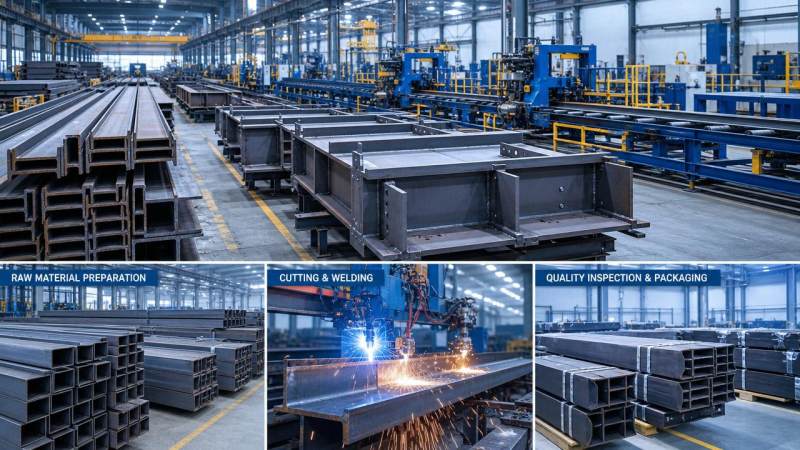
A standard order for angle steel, channel steel, steel beams, cold formed profiles, or custom structural components may look simple on paper, but each item can have different stock conditions, tooling needs, and quality control steps. Orders based on ASTM, EN, JIS, or GB standards may also require specific testing records and tolerance checks. That is why two products with similar weight can have very different delivery times.
A practical way to understand lead time is to divide it into three parts:
- Pre-production: quotation confirmation, drawing review, material allocation, and planning
- In-production: cutting, forming, welding, drilling, straightening, and inspection
- Post-production: packing, certification, customs documents, container booking, and shipment
If one of these stages is underestimated, the promised steel manufacturing lead time becomes unrealistic from the beginning.
What slows steel production most at the raw material stage?
The biggest early delay often comes from raw material availability. Structural steel production depends on coil, billet, slab, or finished section supply from upstream mills. If the required grade, thickness, or section size is not in stock, production cannot begin on time. This is especially common with non-standard sizes, special chemical compositions, or export orders that need traceable material certificates.
Volatility in steel prices also affects scheduling. During periods of fast market movement, some buyers wait too long to confirm orders, while some suppliers delay booking material until commercial terms are fully settled. That gap can add days or even weeks. In custom structural steel projects, one missing material item can hold the full batch because fabrication lines are usually planned around complete job lots rather than partial production.
Another issue is substitution risk. A supplier may have similar material available, but if the order requires exact compliance with ASTM, EN, JIS, or GB specifications, substitution is not always possible. Mechanical properties, thickness tolerance, coating compatibility, and welding performance all matter. Reliable lead time therefore depends not only on inventory volume, but on correct inventory matching.
To reduce delays at this stage, it helps to confirm these points early:
- Exact steel grade and applicable standard
- Section dimensions and tolerance requirements
- Quantity by item, not only total tonnage
- Testing, MTC, or third-party inspection requirements
- Whether split shipment is acceptable
How do planning, customization, and quality checks extend steel manufacturing lead time?
After raw materials are ready, the next major bottleneck is production planning. Steel factories do not run every order immediately. They sequence jobs by machine availability, material type, tooling changeover, urgency, and process flow. A highly customized order with punching, drilling, beveling, welding, or galvanizing can move slower than a standard item, even if its tonnage is smaller.
Drawing accuracy matters here. If shop drawings are incomplete, if hole positions conflict with section dimensions, or if welding details are revised after scheduling, the order may return to engineering review. This creates waiting time that is often hidden from the buyer, but it directly affects steel manufacturing lead time. In many projects, the delay is not caused by machine speed. It is caused by rework, clarification, or approval gaps.
Inspection is another necessary extension, not a avoidable one. Dimensional checks, weld inspection, coating verification, and document review all protect downstream installation and compliance. For export structural steel, quality control is especially important because replacement after shipment is expensive. Faster production without consistent QC usually increases risk, not efficiency.
This is also why mixed-product orders need realistic planning. For example, some projects combine structural steel sections with industrial mesh or screening materials. In such cases, integrating specifications early helps avoid fragmented scheduling. Products such as Stainless Steel Welded Mesh may be required for filters, sieves, chemical processing, mining, architecture, or residential applications, with grades such as SS 201, 304, 304L, 316, 316L, and 430. Technical range can vary widely, including diameter from 0.0008″ to 0.12″, mesh from 2 to 635 mesh, roll width up to 240″, and roll length up to 2000′. Because size, micron retention, and corrosion resistance must match end use, specification confirmation should happen before production windows are fixed.
In short, custom work increases value, but it also increases coordination points. The more interfaces in the order, the more disciplined the planning must be.
Why do packing and export logistics delay delivery after production is finished?
Many assume the order is complete once manufacturing ends. In export steel business, that is only part of the timeline. Packing method, bundle labeling, anti-rust protection, fumigation needs, loading plan, customs paperwork, and vessel booking all influence final delivery. Heavy or long steel sections may require special container loading arrangements, while fabricated components may need marked packing lists that match installation sequences.
Port congestion and container shortages can also add uncertainty. Even if the factory finishes on time, the cargo may wait for booking space. Shipping routes to North America, Europe, the Middle East, and Southeast Asia can have different transit reliability, seasonal pressure, and documentation expectations. A supplier with stable production but weak export coordination may still miss the project window.
Common post-production delay points include:
- Incomplete inspection records or certificate preparation
- Repacking due to loading or protection issues
- Container booking changes
- Export customs document corrections
- Shipment consolidation across multiple product lines
That is why dependable steel manufacturing lead time should always include dispatch readiness, not only factory completion.
How can lead time risks be evaluated before placing a steel order?
The best way to judge a lead time promise is to test how detailed it is. A vague answer such as “about three weeks” says very little. A reliable schedule should explain whether raw material is in stock, whether rolling or fabrication is outsourced, what inspection stages are included, and whether shipping space has to be booked separately. The more transparent the answer, the more credible the lead time.
It also helps to compare standard products and custom products differently. Standard angle steel or channel steel may have a shorter and more stable timeline because production routes are routine. Custom beams, cold formed profiles, or welded assemblies may need engineering review, jig preparation, and more frequent QC checkpoints. Comparing both with the same expectation often leads to disappointment.
A strong supplier should be able to explain these details clearly and adjust them if quantities, specifications, or shipping terms change.
What are the most common mistakes when trying to shorten steel manufacturing lead time?
One common mistake is pushing only for speed while ignoring accuracy. If specifications are incomplete, drawings are revised late, or standards are not aligned, rushing production usually creates rework. Another mistake is assuming all steel products have the same supply chain. Standard sections may move quickly, while custom fabricated items require more engineering and handling.
A third mistake is separating production from logistics. A fast factory with poor export planning still creates delivery risk. Finally, some decisions focus only on unit price and neglect schedule reliability. A lower quotation can become more expensive if delayed steel affects installation, labor planning, crane booking, or downstream manufacturing.
A more effective approach is to shorten the preventable delays, not the essential controls. That means confirming specifications early, aligning documentation, approving drawings quickly, and selecting a supplier with stable capacity, strict quality control, and export experience.
How can a structural steel supplier support more reliable lead times?
Reliable steel manufacturing lead time comes from process discipline. A capable structural steel supplier should combine material planning, modern manufacturing facilities, quality control, and coordinated export service. This is especially important for global projects where consistency matters as much as speed. Clear communication on standards, customization, production status, and shipment planning reduces uncertainty across the entire order cycle.
Hongteng Fengda, as a structural steel manufacturer and exporter from China, supports global construction, industrial, and manufacturing projects with angle steel, channel steel, steel beams, cold formed steel profiles, and customized structural steel components. With compliance to major international standards and service experience across North America, Europe, the Middle East, and Southeast Asia, the focus is not only on making steel products, but on delivering stable capacity, consistent quality, and dependable schedules.
If delivery timing is critical, the next practical step is to review product specifications, required standards, fabrication scope, inspection needs, and shipping terms together before order confirmation. That early alignment is often the fastest way to improve steel manufacturing lead time, avoid avoidable bottlenecks, and keep projects moving with fewer surprises.
Please give us a message


Please enter what you want to find