When evaluating steel h girders for long span buildings, technical review should go far beyond size and price. Structural performance depends on material consistency, dimensional accuracy, welding integrity, and standard compliance.
In long span projects, small deviations can create large structural consequences. Better checking at the sourcing stage helps reduce fabrication delays, installation issues, and lifecycle maintenance risks.
Basic Understanding of Steel H Girders in Long Span Design
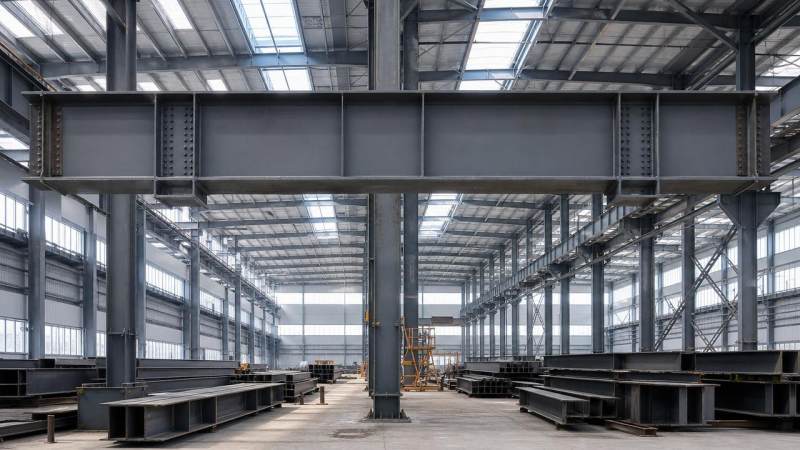
Steel h girders are primary load-carrying members used in roofs, industrial halls, logistics buildings, bridges, and wide clear-span structures. Their geometry allows efficient resistance to bending and vertical loads.
For long span buildings, steel h girders often work with purlins, columns, bracing systems, and connection plates. Their actual performance depends on both section capacity and system behavior.
The term may overlap with H-beams or built-up girders in practical sourcing discussions. However, project documents should clearly distinguish rolled sections, welded sections, and customized fabricated members.
Why long spans need stricter checking
- Deflection becomes more sensitive as span increases.
- Connection tolerances affect field assembly speed.
- Residual stress and welding quality influence stability.
- Material grade directly affects strength and ductility.
Current Industry Focus When Reviewing Steel H Girders
The market for structural steel is increasingly shaped by compliance, traceability, and fabrication readiness. Buyers now compare not only tonnage cost, but also downstream project impact.
Reliable structural steel suppliers typically support ASTM, EN, JIS, and GB requirements. This matters when projects involve multinational design teams or exported steel structures.
A practical example is Structural I Beam supply for industrial structures. Common grades include Q235, Q345, SS400, A36, and S235 series.
Typical dimensions may include 6-12 meter lengths, flange widths from 100mm to 400mm, and tolerance around ±1%. These details shape fit-up reliability in long span frames.
Core Technical Checks Before Approving Steel H Girders
The most important review points should be documented before order confirmation. This reduces ambiguity between design intent, fabrication practice, and delivered steel h girders.
1. Material grade and mechanical properties
Check yield strength, tensile strength, elongation, and impact performance where required. Long span buildings may need higher strength grades without sacrificing weldability.
Equivalent grade mapping should be verified carefully. Q345, S355, and A572-type discussions often require full comparison, not simple name substitution.
2. Section dimensions and tolerance control
Check web thickness, flange thickness, flange width, depth, straightness, and twist. Long members amplify tolerance problems during splicing and roof alignment.
Even when nominal dimensions meet drawings, poor section consistency can create connection gaps, shim requirements, or erection delays on site.
3. Welding quality for built-up members
If steel h girders are welded rather than hot rolled, inspect weld size, continuity, penetration, distortion control, and non-destructive testing records.
Poor welding can reduce fatigue resistance and increase residual stress. This is especially critical in crane buildings, high-cycle industrial halls, and vibration-sensitive structures.
4. Camber, deflection, and span behavior
Long span steel h girders should be checked against serviceability limits, not only ultimate strength. Excess deflection may affect roofing, cladding, drainage, and equipment operation.
If design requires pre-camber, fabrication tolerances and transport handling must be coordinated in advance. Otherwise, final geometry may deviate from expected performance.
5. Surface quality and corrosion preparation
Review rust grade, scale condition, edge preparation, and coating readiness. Surface defects can affect primer adhesion and shorten durability in humid or coastal environments.
Business Value of Better Steel H Girder Assessment
Thorough checking of steel h girders improves more than structural safety. It also supports smoother fabrication planning, easier inspection, and more predictable delivery schedules.
- Lower rework risk during cutting, welding, and assembly.
- Better consistency across repeated building modules.
- Reduced site delays caused by misalignment.
- Higher confidence in exported structural steel compliance.
Manufacturing capability is also part of the value equation. Suppliers with modern rolling or fabrication lines, strict QC, and stable production can support complex schedules more reliably.
In many industrial projects, steel sections must also support bending, welding, decoiling, punching, and cutting requirements. Processing compatibility should be reviewed with the base section data.
Typical Long Span Building Scenarios and Review Priorities
Different building uses create different priorities for steel h girders. A simple classification helps align technical review with actual service conditions.
Where hot rolled sections are preferred, an economic universal-mill product may be suitable. In some cases, a second review of Structural I Beam options helps compare section efficiency.
Practical Review Steps for Specifications and Orders
A disciplined review process can make steel h girders easier to approve and easier to use. The following sequence is practical for most long span building projects.
- Confirm design code and governing steel standard.
- Verify grade equivalency and mechanical property targets.
- Check section drawings against actual tolerance capability.
- Define welding, NDT, and inspection acceptance criteria.
- Review coating or galvanizing requirements.
- Request mill test certificates and traceability records.
- Align packing, loading, and delivery lengths with site conditions.
It is also useful to compare rolling capacity, fabrication support, and export experience. This helps avoid gaps between quoted specifications and delivered structural performance.
Companies with stable production and international standard familiarity can support projects across North America, Europe, the Middle East, and Southeast Asia with fewer execution risks.
Final Considerations for Reliable Selection
Steel h girders for long span buildings should be assessed as engineered structural components, not commodity pieces alone. Performance depends on grade, geometry, fabrication quality, and project compatibility.
A good specification review should connect technical requirements with fabrication reality. That approach improves safety, cost control, installation speed, and long-term building performance.
Before placing an order, prepare a clear checklist covering standards, tolerances, weld quality, mechanical properties, and coating expectations. Stronger early review leads to more dependable steel h girders on site.
Please give us a message


Please enter what you want to find