Steel channel sections play a critical role in load-bearing frames, where strength, dimensional accuracy, and compliance directly affect structural performance.
For technical evaluation, the right section must match load paths, connection methods, corrosion conditions, and fabrication efficiency.
As a China-based structural steel manufacturer and exporter, Hongteng Fengda supplies steel channel sections with stable quality, controlled tolerances, and international standard support.
This guide answers common questions about steel channel sections for load-bearing frames and helps improve specification accuracy.
What are steel channel sections and why are they used in load-bearing frames?
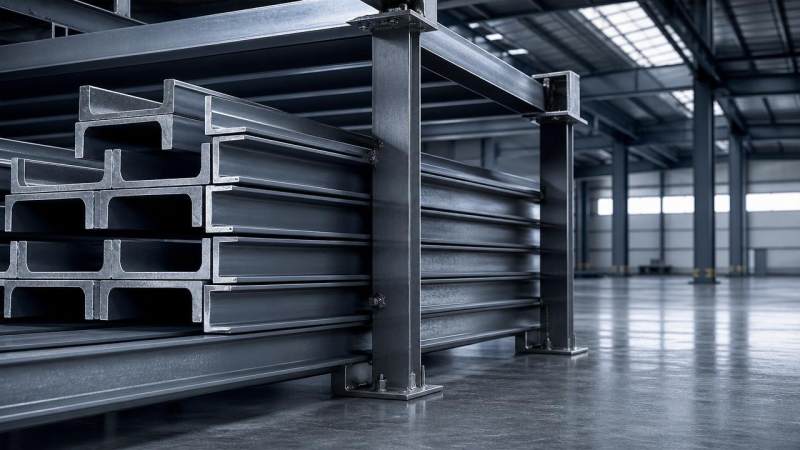
Steel channel sections are structural profiles with a web and two flanges, forming a C or U shaped cross section.
They are widely used in load-bearing frames because they provide good strength, practical connection surfaces, and efficient material usage.
In many steel structures, steel channel sections support secondary framing, edge members, bracing supports, and platform framing systems.
Compared with flat bars or simple plates, channel steel delivers higher bending resistance with less fabrication complexity.
This makes steel channel sections a common choice for industrial buildings, equipment frames, warehouse supports, and modular structures.
What advantages matter most in real projects?
- Good load distribution for moderate to heavy frame applications
- Convenient drilling, welding, bolting, and bracket installation
- Flexible use as single members or back-to-back assemblies
- Availability under ASTM, EN, JIS, and GB specifications
How do you choose steel channel sections for different frame loads?
Selection starts with structural demand, not only nominal size.
The section must satisfy bending strength, shear capacity, deflection limits, and connection requirements under actual service conditions.
For load-bearing frames, steel channel sections are often chosen after checking several practical variables.
Key selection factors
- Load type: static, impact, dynamic, or combined loading
- Span and support conditions
- Orientation of the channel section in the frame
- Steel grade and required yield strength
- Corrosion environment and coating system
- Fabrication method, including welding or bolted assembly
A deeper web can improve bending performance, while flange dimensions influence connection convenience and local stability.
If torsion or lateral instability is critical, engineers may pair steel channel sections or combine them with plates.
Dimensional consistency also matters, especially when frames are prefabricated and installed under strict site schedules.
Hongteng Fengda supports customized structural steel solutions with controlled production and reliable export delivery.
Where are steel channel sections most effective, and what related solutions may complement them?
Steel channel sections perform well in frame edges, equipment bases, mezzanine framing, rack structures, stair supports, and machinery platforms.
They are especially useful where compact geometry and simple connection surfaces improve assembly speed.
In some projects, frame systems connect to retaining or water control structures rather than standalone buildings.
For these conditions, related steel solutions may be considered alongside channels.
One practical example is Hot Rolled Steel Sheet Pile, used in retaining wall and water retaining wall applications.
Available as U Sheet Pile, it can be freely combined to create a continuous and tight barrier system.
Common material options include S275, S355, S390, S430, SY295, SY390, and ASTM A690.
Production standards include EN10248, EN10249, JIS5528, JIS5523, and ASTM, with Larssen locks and other interlock types.
Single length can exceed 80 meters, and dimensions can be customized for project needs.
Certified systems such as ISO9001, ISO14001, ISO18001, and CE FPC support traceable quality management.
When projects include both load-bearing frames and perimeter retention, coordinated sourcing can simplify planning and cost control.
How do steel channel sections compare with angles, I beams, and cold formed profiles?
Many structural decisions involve comparing steel channel sections with other common profiles.
The best choice depends on load direction, fabrication details, and overall frame layout.
Steel channel sections often sit between light profiles and major beams.
They offer a practical balance of performance, processability, and material efficiency.
What risks and mistakes should be avoided when specifying steel channel sections?
Several issues can reduce the performance of steel channel sections in load-bearing frames.
Most problems begin during specification rather than production.
Common mistakes
- Selecting by appearance instead of section properties and load checks
- Ignoring flange orientation during frame design
- Not defining grade, tolerances, and standard clearly
- Overlooking corrosion exposure and surface treatment
- Assuming all steel channel sections have equivalent dimensional accuracy
- Missing connection checks for weld distortion or bolt edge distance
A reliable supplier should provide mill control, standard compliance, and documentation that matches project requirements.
This is important for exported steel channel sections used across different design codes and inspection systems.
How do cost, lead time, and quality control affect the final decision?
The lowest initial price does not always deliver the lowest installed cost.
For steel channel sections, total value depends on production stability, fit-up accuracy, packing, shipping reliability, and rework risk.
Consistent dimensions can reduce cutting loss, simplify assembly, and shorten site adjustments.
Clear lead times also help avoid schedule pressure that may affect structural sequencing.
Hongteng Fengda combines manufacturing capability with export experience for structural steel products used in global projects.
This helps keep steel channel sections aligned with quality expectations, cost targets, and dependable delivery windows.
What is the best next step when evaluating steel channel sections?
Start by defining load data, service environment, preferred standards, and fabrication method.
Then compare steel channel sections using section properties, grade options, tolerance control, and supplier responsiveness.
For complex frame systems, review whether channels work alone or should be paired with beams, angles, or related steel solutions.
Well-selected steel channel sections improve structural reliability, fabrication efficiency, and long-term project control.
If a project requires standard or customized structural steel from China, Hongteng Fengda can support specification review and product matching.
Please give us a message


Please enter what you want to find