Choosing a steel beam for construction is rarely a simple shape comparison. H-beams, I-beams, and channels may appear related, yet each performs differently under load, affects fabrication efficiency, and changes total project cost.
That is why understanding beam profiles matters in buildings, factories, equipment frames, warehouses, and infrastructure. A better match between section type and service condition usually means safer structures, cleaner detailing, and fewer sourcing mistakes.
Why beam selection matters in real construction work
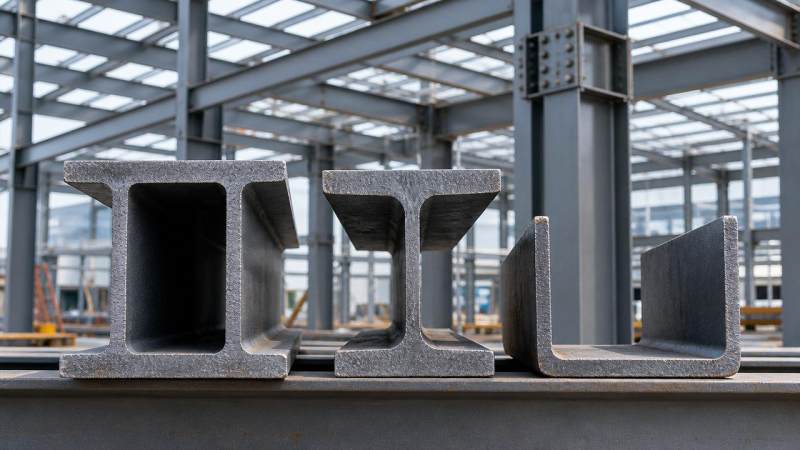
Steel Beam for construction decisions influence more than structural strength. They also affect welding volume, transport weight, connection design, erection speed, and long-term maintenance in aggressive environments.
In current steel projects, material efficiency is under closer review. Buyers and contractors increasingly compare section performance against fabrication complexity rather than selecting the heaviest section by default.
This is especially relevant for global supply chains. When profiles must meet ASTM, EN, JIS, or GB requirements, dimensional consistency and stable lead time become part of the technical decision.
For exporters such as Hongteng Fengda, which supplies channel steel, steel beams, angle steel, and custom structural components, the practical question is not only what a section is, but where it fits best.
The basic difference between H-beam, I-beam, and channel
The easiest way to separate these profiles is by geometry.
H-beam
An H-beam has wide flanges and a relatively thick web. Its cross-section looks balanced, which helps it resist bending and carry heavy loads across longer spans.
It is commonly used in columns, transfer beams, bridge members, industrial frames, and heavy building skeletons.
I-beam
An I-beam usually has narrower flanges than an H-beam. It remains efficient in bending, but its flange shape makes it more application-specific depending on load direction and connection details.
It is often selected for floor systems, platform supports, mezzanines, and moderate-span structures where weight control matters.
Channel steel
A channel has a C-shaped section. It is not symmetrical like H-beams or I-beams, so it behaves differently under torsion and eccentric loading.
Channels are widely used in purlins, bracing systems, trailer frames, equipment bases, edge members, and secondary structural supports.
How their performance differs under load
Shape determines structural behavior. That is the core issue behind Steel Beam for construction selection.
H-beams usually provide the best overall section stability for heavy structural work. Wider flanges improve moment resistance and make them suitable for columns as well as beams.
I-beams remain highly useful where the main demand is vertical bending. They can offer an efficient balance between section weight and load capacity in repetitive building layouts.
Channels are valuable when the structure needs lighter framing, edge support, or easier integration with panels, brackets, and fabricated assemblies.
Where each profile fits best
In practical use, the right Steel Beam for construction depends on whether the member is primary, secondary, exposed, fabricated, or part of a modular system.
- H-beams suit steel buildings, heavy workshops, bridge frames, machine foundations, and large-span load paths.
- I-beams suit floors, roof support members, equipment platforms, and regular structural grids.
- Channels suit wall girts, purlins, stair stringers, solar supports, trailers, racks, and reinforcement details.
In fabrication shops, channels are often chosen because they are easier to combine into built-up frames. In contrast, H-beams are favored when fewer members must carry more force.
Beam choice is often linked to envelope materials
Structural sections rarely work alone. Beam selection is closely tied to roof, wall, insulation, and cladding systems, especially in industrial buildings, agricultural facilities, and prefabricated structures.
For example, a light steel frame using channels or I-beams may be paired with coated sheet systems to reduce dead load and improve weather resistance.
A useful option in those projects is Color Coated Galvanized Steel Sheet PPGI, made from aluminum-zinc steel for applications such as warehouses, factories, houses, schools, hospitals, greenhouses, and storage buildings.
With thickness from 0.2mm to 1.2mm and widths from 600mm to 1250mm, it supports lightweight enclosure design. Coating systems such as PE, SMP, HDP, and PVDF help adapt performance to different climates.
That matters because Steel Beam for construction is not only about load-bearing members. It is also about how the whole building system manages corrosion, heat, appearance, and installation efficiency.
What the market is paying attention to now
Several trends are shaping section selection.
- Higher demand for material traceability and standard compliance.
- More emphasis on weight optimization rather than overspecification.
- Preference for suppliers that can provide both standard sections and OEM fabrication support.
- Closer review of corrosion exposure, especially in coastal, chemical, and humid environments.
- Faster project schedules, making consistent lead time a technical issue, not only a commercial one.
This is where established structural steel exporters can add value. Reliable production, controlled tolerances, and familiarity with international standards reduce uncertainty before installation begins.
How to evaluate the right Steel Beam for construction
A sound decision usually starts with the load path, but it should not stop there.
Check the role of the member
Primary beams and columns often justify H-beams. Secondary framing may be better served by channels or lighter beam profiles.
Review connection details early
A profile that looks economical on paper may require more complex end plates, stiffeners, or welding. Fabrication cost can erase material savings.
Consider lateral stability
Channels are useful, but they need careful evaluation when torsion or eccentric loading appears. Unsupported length also changes beam behavior significantly.
Match the environment
In humid, coastal, or industrial atmospheres, beam protection, cladding compatibility, and coating strategy deserve as much attention as section size.
Look at supply practicality
Availability, dimensional range, certification, and shipping efficiency should be reviewed together. An ideal profile that cannot arrive on time is rarely the best choice.
A practical way to move from comparison to decision
If the project involves heavy loads, long spans, or combined beam-column duty, H-beams often lead the shortlist.
If the project needs efficient vertical support in a regular layout, I-beams may provide a cleaner balance of strength and section weight.
If the structure relies on secondary framing, edge support, or fabricated assemblies, channels may be the smarter solution.
The most useful next step is to compare section type, load case, connection method, exposure condition, and delivery requirement in one review sheet. That approach turns a basic Steel Beam for construction inquiry into a more reliable project decision.
Please give us a message


Please enter what you want to find