When tight clearances, uneven load paths, or connection offsets complicate maintenance work, steel angle unequal profiles provide a practical structural option.
Their asymmetric legs help crews fit reinforcement into restricted spaces without major redesign or excessive cutting on site.
In steel structures, retrofit details often fail because standard equal-leg angles cannot align with real offsets or support eccentric loads efficiently.
This article explains where steel angle unequal works best, why it matters in maintenance, and how reliable supply supports compliant project execution.
Basic overview of steel angle unequal
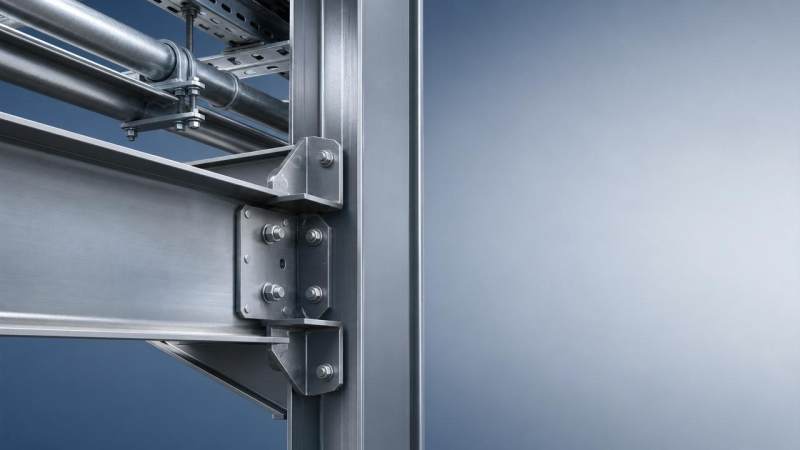
Steel angle unequal is an L-shaped structural section with two legs of different widths.
That simple dimensional difference creates more flexibility than a standard equal angle in retrofit and adjustment work.
One leg can provide wider bearing or attachment area.
The shorter leg can reduce interference with nearby equipment, cladding, pipe runs, cable trays, or existing brackets.
Because of this geometry, steel angle unequal is commonly selected for secondary framing, connection support, bracing details, and repair plates.
It is especially useful where available installation space is different in vertical and horizontal directions.
Manufacturers typically supply these sections in carbon steel grades meeting ASTM, EN, JIS, or GB requirements.
Surface protection may include black finish, primer, painting, or galvanizing depending on the service environment.
For maintenance work, the value of steel angle unequal is not just shape.
It is the ability to reduce field modification while keeping structural intent and connection integrity.
Why offset and clearance issues are common in steel structures
In real projects, existing steel rarely matches ideal drawings perfectly.
Aging structures, thermal movement, prior repairs, and multi-trade interference often create difficult geometry.
Several conditions increase the need for steel angle unequal:
- Misaligned bolt lines between old and new members
- Insufficient edge distance for equal-leg connections
- Restricted access beside walls, ducts, or machinery
- Need to shift load paths around damaged material
- Different bearing width requirements on connected parts
These conditions are common in plant maintenance, mezzanine reinforcement, equipment platform upgrades, and warehouse alteration projects.
When standard sections force too much cutting or packing, installation time increases and quality becomes less consistent.
Using steel angle unequal early in the design review can reduce this risk.
How steel angle unequal improves structural fit and reinforcement efficiency
The practical advantage of steel angle unequal is better geometric matching.
That leads directly to faster installation and more predictable performance.
Better fit in constrained zones
A shorter leg can clear nearby obstacles while the longer leg still provides fastening area.
This helps avoid unnecessary trimming, which can affect coating and dimensional accuracy.
More effective handling of eccentric connections
When a load cannot act through the ideal centerline, asymmetric geometry can support practical connection detailing.
This is useful in repair brackets, seat angles, and offset framing transitions.
Reduced site labor
Less grinding, shimming, and drilling adjustment means shorter shutdown periods and cleaner field work.
That matters in facilities where access windows are limited.
Easier coordination with protective materials
In some envelope or support details, galvanized sheet products complement angle-based reinforcement.
For covers, guards, or secondary closures, Galv Sheeting can be matched with steel framing.
Available in galvanized steel and carbon steel, it supports thicknesses from 0.12mm to 6.00mm and widths from 600mm to 1500mm.
Grades such as DX51D+Z, SGCC, and S350GD+Z align with multiple international standards, including ASTM, JIS, EN, and GB.
Industry signals shaping section selection
Maintenance and retrofit projects now face tighter cost, safety, and compliance targets.
That changes how structural sections are selected for small but critical upgrades.
These signals explain why steel angle unequal remains relevant across industrial buildings, logistics facilities, and infrastructure support structures.
Typical scenarios where steel angle unequal performs best
Not every connection needs an unequal angle.
But several recurring situations show clear advantages.
In these examples, steel angle unequal solves physical fit problems while still supporting sound structural detailing.
Practical selection and specification considerations
Choosing steel angle unequal should start with load, geometry, and environment, not only stock availability.
- Confirm leg dimensions against clearance envelopes
- Check thickness and section properties for actual forces
- Review bolt spacing, weld access, and edge distances
- Match grade and coating to service conditions
- Require mill documentation and standard compliance
Where corrosion protection is critical, surrounding sheet components may also need coordinated zinc coating performance.
For example, secondary closures using galvanized sheet can support weathering resistance in construction and industrial applications.
Products such as Z275 or DX52D+Z options within Galv Sheeting are often used where durable protective layers are required.
Reliable manufacturers with modern production and strict quality control help ensure consistent tolerances and dependable lead times.
Implementation notes for maintenance and retrofit work
Before fabrication, verify existing dimensions on site.
Small measurement errors can remove the clearance advantage that steel angle unequal provides.
It is also important to review how the section will be oriented.
Rotating the longer leg can change bearing behavior, fastener access, and interference with adjacent parts.
For welded installations, heat effects on coating repair should be planned in advance.
For bolted repairs, hole tolerances and slip requirements must align with the governing design standard.
If the connection supports dynamic equipment or vibration, stiffness and fatigue considerations should be checked carefully.
These steps turn steel angle unequal from a convenient shape into a controlled structural solution.
Next-step guidance for reliable project execution
Steel angle unequal is most valuable when retrofit conditions are irregular and installation time is limited.
Its asymmetric geometry helps solve clearance limits, offset connections, and uneven support demands with fewer field compromises.
For better results, prepare a section schedule, confirm standards, and review coating needs before ordering.
Working with an experienced structural steel manufacturer from China can improve material consistency, customization options, and delivery reliability.
When the goal is efficient maintenance with standards-compliant steel products, careful specification of steel angle unequal can reduce sourcing risk and support smoother project completion.
Please give us a message


Please enter what you want to find