Why steel angle bar size matters in fabrication
Choosing the right steel angle bar size affects strength, weldability, weight, and total project cost.
In fabrication, a small size change can alter load paths, connection details, and even transport efficiency.
That is why steel angle bar selection is not only about fitting a drawing.
It is also about matching a section to real service conditions, code requirements, and shop capabilities.
For construction frames, machinery supports, racks, and bracing assemblies, the right dimensions help avoid overdesign and weak detailing.
Suppliers with broad structural steel experience, such as Hongteng Fengda in China, usually support this process by aligning angle steel supply with ASTM, EN, JIS, and GB requirements.
This becomes more important when projects source globally and need stable quality, consistent lead times, and dependable dimensional tolerance.
Understanding common steel angle bar dimensions
A steel angle bar is an L-shaped section formed by two legs joined at ninety degrees.
The basic size is usually described by leg length and thickness.
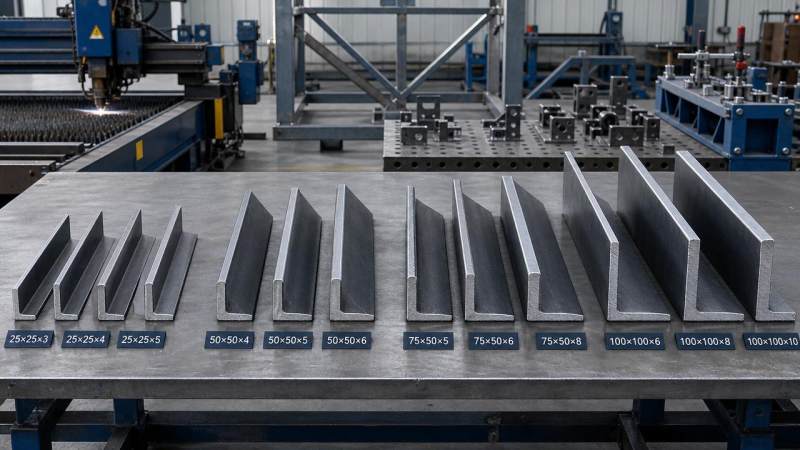
For example, 50 x 50 x 5 mm means equal legs of 50 mm with 5 mm thickness.
Unequal angles, such as 75 x 50 x 6 mm, are also widely used.
They help when one leg must carry bolts, while the other fits a narrow support face.
Typical size ranges
Common light-duty sections start around 25 x 25 mm and are often used for frames, guards, and small brackets.
Medium sections from 40 x 40 mm to 75 x 75 mm appear in shelves, equipment bases, trailers, and general support structures.
Heavier steel angle bar sizes, such as 90 x 90 mm or 100 x 100 mm and above, are more common in structural bracing and industrial assemblies.
In practice, section weight per meter often matters as much as the nominal size.
It influences freight cost, handling, and installation speed.
Equal and unequal angles in real jobs
Equal angles are popular because they are simple to specify and easy to stock.
They work well for symmetric bracing, corner reinforcement, and straightforward welded frames.
Unequal angles solve different layout problems.
They are useful where one leg needs more bolt edge distance or where clearance is limited.
- Equal angle steel angle bar suits simple supports and repeated fabrication.
- Unequal angle sections suit offset loads and tighter connection geometry.
- Both choices depend on the connection method, not only the load value.
This is one reason drawings should be reviewed together with workshop details before ordering material.
What the industry pays attention to now
Current demand is not centered only on price per ton.
Buyers increasingly compare tolerance control, standard compliance, traceability, and processing consistency.
For a steel angle bar, dimensional accuracy affects fit-up during welding and bolting.
Straightness matters in long members.
Surface condition matters when galvanizing, painting, or further machining is required.
Standards and source reliability
Projects serving North America, Europe, the Middle East, and Southeast Asia often need consistent material documentation across regions.
That is where an experienced exporter becomes useful.
Hongteng Fengda supplies angle steel and related structural sections with controlled production and quality checks aligned with major international standards.
This helps reduce sourcing uncertainty when fabrication schedules are tight.
How size selection changes by application
The best steel angle bar size depends on how the section behaves inside an assembly.
A bracket carrying static weight is different from a support exposed to vibration, wind, or impact.
In mixed assemblies, angle sections are often paired with plates, channels, or beams.
For example, base stiffeners or mounting interfaces may use plate material rather than larger angle legs.
In those cases, Mild Steel Plate Supplier options in A572 or S355JR can complement angle members in construction, bridges, racks, and mechanical mounting plates.
That combination often improves fabrication flexibility without forcing one steel angle bar section to do every job.
Thickness, strength, and fabrication trade-offs
Thickness is not a minor detail.
It influences local buckling resistance, weld heat input, drilling time, and finished weight.
A thicker steel angle bar may improve durability in rough service, but it can also increase cost and slow fabrication.
Usually, the best choice balances structural need with shop efficiency.
Material grade also matters
When sections connect to plate assemblies, matching grade performance is important.
Low-carbon and low-alloy high-strength materials are often selected for their weldability and forming performance.
For plate-based support details, grades with yield strength from 42 to 65 Ksi are common depending on the duty level.
This is relevant when an angle section transfers load into bridge panels, heavy machinery bases, or support plates.
Practical checks before ordering
A steel angle bar should be reviewed beyond nominal dimensions.
Several checkpoints can prevent costly mismatch later.
- Confirm whether equal or unequal legs better suit the connection layout.
- Check thickness against weld size, bolt hole distance, and corrosion allowance.
- Verify the required standard, grade, and test documentation.
- Review straightness and tolerance if long members must align precisely.
- Consider coating or galvanizing before finalizing hole details and edge preparation.
- Compare stock availability with custom rolling or cutting lead time.
These checks are especially useful when sourcing from overseas and combining several structural products in one shipment.
A capable supplier can coordinate angle steel, beams, channels, cold formed profiles, and plate materials under one specification path.
A better way to compare options
Comparing steel angle bar options works best when the decision is tied to use, not just catalog numbers.
Start with the load case, connection style, exposure condition, and fabrication method.
Then compare leg size, thickness, weight, grade, and standard compliance as one package.
If the assembly includes plates, support interfaces, or mounting details, it also helps to review compatible materials such as flat or rectangular plate in custom sizes.
That makes specification work clearer and reduces the chance of redesign after procurement begins.
A well-matched steel angle bar is not simply the strongest available section.
It is the section that fits the job, the process, and the project timeline with the fewest compromises.
The next useful step is to map required sizes against actual fabrication details, then compare supplier capability, standards coverage, and delivery reliability before final selection.
Please give us a message


Please enter what you want to find