When sourcing stainless wire rod for high-stress applications—whether as stainless steel coil wire, cold drawn steel wire, or 304 stainless steel wire—many buyers overlook a critical quality indicator: decarburization depth. Though rarely listed on mill test reports or certs, this surface carbon loss directly compromises fatigue life and mechanical integrity. As a trusted ss wire manufacturer and stainless steel wire manufacturer based in China, Hongteng Fengda ensures rigorous decarburization control across all stainless wire rod, coated stainless steel wire, and galvanized stainless steel wire products—helping engineers, procurement teams, and project managers mitigate failure risk before it reaches the job site.
Why decarburization depth matters—even when it’s missing from your certificate
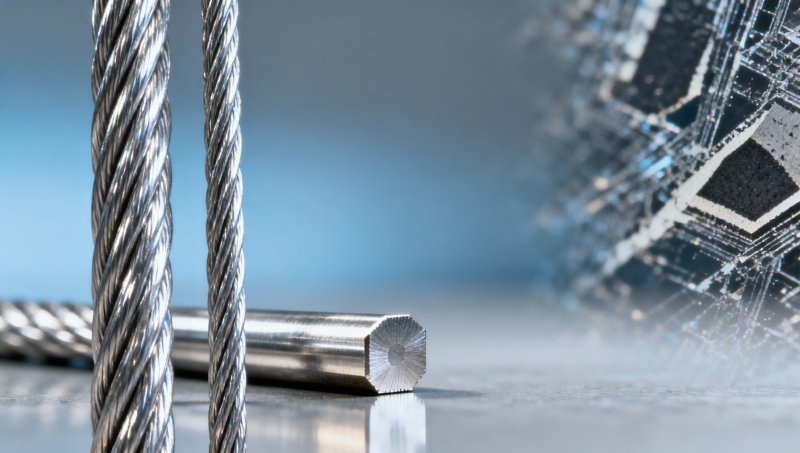
Decarburization is the loss of carbon from the surface layer of steel during hot rolling or heat treatment. In stainless wire rod—especially grades like 304, 316, or 430—the depth of this carbon-depleted zone can range from 0.02 mm to over 0.15 mm depending on furnace atmosphere, cooling rate, and soak time. While most mill test reports (MTRs) list tensile strength, yield point, and chemical composition, decarburization depth is almost never included—despite its direct correlation with fatigue crack initiation.
Fatigue life in cyclic-loading applications—such as suspension components, spring wires, or fasteners in infrastructure projects—can drop by 30–50% when decarburization exceeds 0.08 mm. This isn’t theoretical: ASTM A1018/A1018M Annex A1 provides standardized microhardness-based measurement methods, and EN 10263-4 explicitly defines maximum allowable decarb depth for cold heading wire (≤0.10 mm for Ø ≤ 16 mm). Yet many global buyers accept certificates without verifying this parameter—until field failures occur.
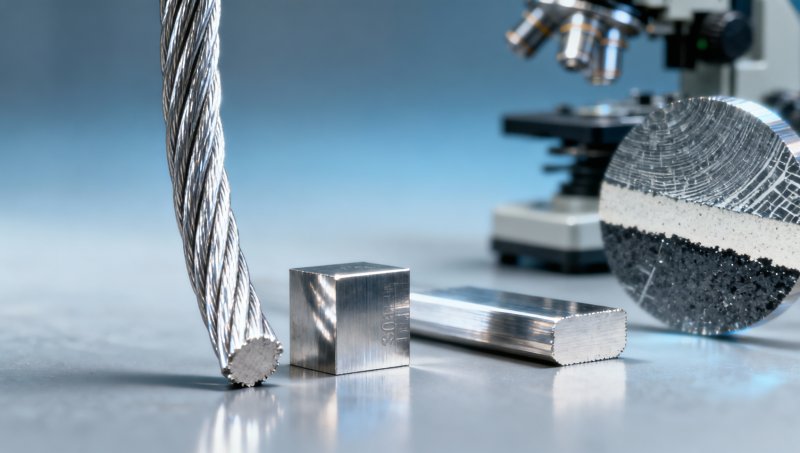
Hongteng Fengda applies in-line optical emission spectroscopy (OES) and post-rolling controlled-atmosphere cooling to limit decarburization to ≤0.05 mm across all stainless wire rod batches—verified via quarterly third-party metallographic audits per ISO/IEC 17025. This discipline supports structural integrity in demanding civil engineering construction, including bridges, tunnels, and high-rise foundations where long-term reliability is non-negotiable.
How decarburization affects real-world performance—and which applications are most vulnerable
Not all stainless wire rod applications face equal risk from decarburization. High-cycle, low-amplitude loading—like vibration-dampening rebars in seismic zones or coiled springs in rail signaling systems—shows accelerated crack propagation when the hardened subsurface layer is compromised. In contrast, static-load uses (e.g., anchor rods or formwork ties) tolerate deeper decarb—but only up to ASTM A955 limits (0.12 mm max for Grade 60).
The following table compares fatigue sensitivity across common usage scenarios:
This data-driven differentiation explains why generic “cert-compliant” wire rod often fails under project-specific stress profiles. For example, a 304 stainless steel wire used in flood control gate actuators requires stricter decarb control than the same grade used in decorative railing—yet both may share identical MTRs. That’s why Hongteng Fengda offers application-specific decarb verification reports upon request—not just standard certs.
What to check beyond the certificate: 5 procurement checkpoints
Since decarburization depth isn’t certified by default, procurement teams must embed verification into sourcing workflows. Here are five actionable checkpoints:
- Request metallographic cross-section reports for at least one batch per order—specify ASTM E384 microhardness testing at 0.1 mm intervals from surface to core.
- Verify furnace atmosphere logs: Nitrogen/hydrogen mix ratios below 3% H₂ reduce decarb risk by ~65% vs. air-cooled lines.
- Confirm final draw pass temperature: Cold drawing after annealing >900°C increases decarb susceptibility—opt for sub-critical anneals (750–850°C).
- Require traceability to heat number, not just lot number—enables root-cause analysis if fatigue issues emerge onsite.
- Validate surface finish consistency: Matte or dull surfaces often indicate excessive oxidation—and correlate with deeper decarb layers.
These checks add no more than 2–3 business days to lead time but prevent multi-million-dollar rework in infrastructure projects. Hongteng Fengda integrates all five into standard OEM workflows—for Wire rod orders exceeding 50 MT, we provide complimentary decarb validation reports aligned with EN 10263-4 and ASTM A1018.
Why partner with a China-based structural steel manufacturer that controls decarb at source
Many global buyers assume decarburization control is solely a metallurgical challenge—requiring expensive post-production grinding or coating. But Hongteng Fengda addresses it upstream: our 120,000-ton/year hot-rolling line features dual-zone controlled cooling, inline OES monitoring every 90 seconds, and AI-driven thermal profile adjustment to maintain ±5°C furnace uniformity. The result? Consistent decarb depth ≤0.05 mm across all diameters—from 6mm to 50mm—and full compliance with BS4449-2005, GB1449.2-2007, and ASTM A615.
Beyond technical control, our value lies in operational alignment with your decision cycle:
- Procurement & finance teams: Fixed 30% TT advance + 70% balance terms, with LC-at-sight accepted—no hidden financing costs.
- Project managers: Guaranteed 25-day production-to-shipment window for standard Wire rod specs (HRB400, Q235, ASTM A53 GrB), extendable to 35 days for custom coatings.
- Quality & safety officers: Full SGS/BV CE-certified documentation, plus optional witnessed third-party fatigue testing per ISO 10273.
Whether you’re specifying for a dam in Southeast Asia, a metro system in the Middle East, or modular housing in North America—we align decarb control, delivery precision, and compliance transparency to your project’s risk profile. Contact us today to request a decarb verification sample report, discuss OEM tolerances for your next order, or schedule a virtual audit of our heat-treatment process.
Please give us a message


Please enter what you want to find