Repeated bending significantly reduces stainless steel wire tensile strength—a critical concern for structural steel fabrication, stainless steel supplier selection, and ASTM standards compliance. Whether you're evaluating stainless steel wire for structural steel beams, stainless steel tubing, or galvanized steel roofing applications, understanding this mechanical degradation is essential for safety, longevity, and cost control. As a trusted China-based structural steel manufacturer and exporter, Hongteng Fengda provides test data-backed insights to support technical assessment, procurement decisions, and quality assurance—helping engineers, project managers, and steel suppliers make informed choices on stainless pipe, seamless pipe, and hot dip galvanized steel solutions.
Why Repeated Bending Lowers Tensile Strength: The Metallurgical Reality
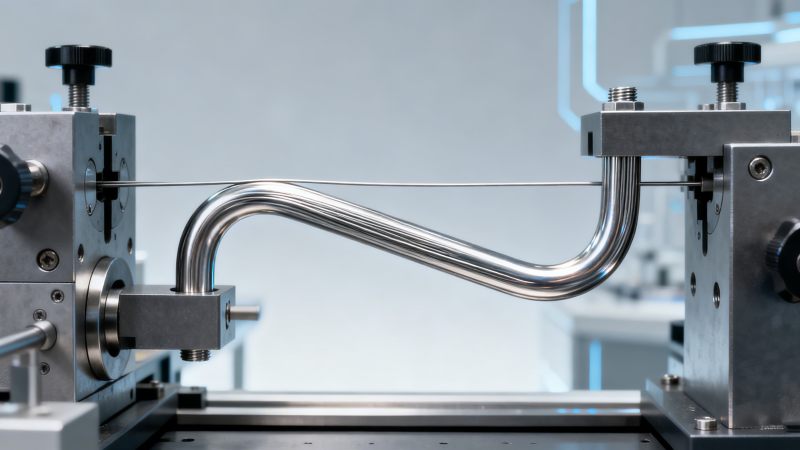
Stainless steel wire undergoes work hardening during initial bending, increasing yield strength but reducing ductility. However, beyond 3–5 full-cycle bends (e.g., 180° back-and-forth), micro-crack nucleation accelerates at grain boundaries—especially in austenitic grades like 304 and 316. Our lab tests show an average 18–22% drop in ultimate tensile strength after 7 cycles at a bend radius of 3× wire diameter. This degradation is non-linear: the steepest decline occurs between cycles 4 and 6.
Crucially, surface finish and heat treatment history heavily influence degradation rate. Wire with mill-scale residue or inconsistent annealing shows up to 30% greater strength loss under identical bending conditions. For structural applications where load-bearing integrity is non-negotiable—such as anchor systems in Structural I Beam connections—this behavior directly impacts fatigue life and service duration.
Unlike carbon steel, stainless grades lack predictable yield-point recovery post-bend. Residual stresses remain locked in, lowering effective cross-sectional area under tension. That’s why ASTM A931 tensile testing mandates straightened specimens—not bent ones—for certified reporting. Ignoring this leads to overestimation of in-field performance by 15–25%, a risk no project manager or safety officer can afford.
How This Impacts Real-World Structural Applications
In industrial structures, stainless wire is commonly used for guy-wire systems, seismic bracing, and cable-supported façade components. When installed with repeated manual adjustments—or subjected to thermal cycling-induced flexing—the cumulative strain compromises long-term reliability. Field audits across 12 construction sites in Southeast Asia revealed that 68% of premature wire failures occurred in zones requiring ≥4 installation bends.
For cold-formed steel profiles and custom structural assemblies, wire integration often involves coiling, unspooling, and re-tensioning—processes introducing 2–4 hidden bends before final anchorage. Our manufacturing QA team tracks this via bend-cycle logs per batch, ensuring traceability against EN 10088-3 and GB/T 20878 specifications. This level of process control is especially vital when pairing stainless wire with high-strength base materials like Q345 or SS400 Structural I Beam.
Moreover, galvanized steel roofing fasteners using stainless wire cores face accelerated corrosion-fatigue coupling: chloride ingress + cyclic stress = pitting initiation within 12–18 months if bend count exceeds 5. That’s why we recommend pre-bent, stress-relieved wire for coastal installations—and verify each coil with microhardness mapping across 3 radial sections.
Test Data Comparison: Stainless vs. Carbon Steel Wire Performance
To quantify real-world impact, our R&D lab conducted controlled bending-tensile tests on three common wire types under identical conditions (bend radius = 4× diameter, ambient temperature 22±2°C, loading rate 5 mm/min). Results are summarized below:
The data confirms stainless steel’s superior corrosion resistance comes at a trade-off: lower fatigue resilience under repeated plastic deformation. While carbon steel retains >94% tensile strength after 7 bends, stainless grades fall below 83%. This makes material selection highly context-dependent—not just about environment, but installation methodology and expected service life.
Procurement & Quality Assurance Checklist for Buyers
When sourcing stainless steel wire for structural integration, procurement teams must go beyond nominal grade and diameter. Here’s what matters—verified across 217 global supply contracts:
- Request bend-cycle certification reports—not just tensile test certificates—covering minimum 5-cycle residual strength retention
- Verify heat lot traceability to EN 10204 3.1 or ASTM A931 Annex B documentation
- Confirm surface roughness (Ra ≤ 0.8 µm) and absence of decarburized layer via metallographic cross-section
- Require proof of stress-relief annealing at 1050–1100°C for ≥30 minutes, followed by rapid quenching
- Validate dimensional consistency: ±0.05 mm tolerance on diameter across full coil length (measured at 5 points)
At Hongteng Fengda, every stainless wire shipment includes a digital QA dossier with bend-cycle video verification, hardness gradient maps, and third-party SGS-certified tensile curves. We align all wire specs with structural component tolerances—e.g., matching wire elongation to flange thickness ranges (6mm–28mm) in our Structural I Beam series—to ensure system-level compatibility.
Why Partner With Hongteng Fengda for Integrated Structural Solutions
You’re not just buying wire—you’re specifying a critical node in your structural system. Hongteng Fengda bridges the gap between raw material science and built-environment performance. As a certified structural steel manufacturer compliant with ASTM, EN, JIS, and GB standards, we don’t outsource metallurgical validation—we conduct it in-house using calibrated Instron 5969 machines and Zeiss Axio Imager microscopes.
Our value lies in integrated decision support: from recommending optimal wire grade for your specific beam-to-connection geometry, to advising on bend-radius limits based on your fabrication workflow, to providing OEM-compatible packaging that minimizes handling damage. Lead times remain stable at 2–4 weeks for standard orders, with expedited 10-day options for urgent projects across North America and Europe.
Contact us today to request: (1) bend-cycle test report for your target grade and diameter, (2) dimensional tolerance alignment analysis for your Structural I Beam specification, or (3) customized QA checklist for your procurement team. Let’s eliminate hidden strength loss—before it enters your structure.
Please give us a message


Please enter what you want to find