Unexpected stainless steel wire breakage during tension tests can signal critical quality or specification mismatches—especially when sourcing from global steel suppliers. As a trusted stainless steel supplier and structural steel manufacturer, Hongteng Fengda ensures compliance with ASTM standards, rigorous material traceability, and precise tensile performance for stainless steel wire, stainless steel tubing, and seamless pipe. Whether you're evaluating galvanized steel pipe for durability or comparing steel roofing cost versus long-term reliability, understanding root causes—from improper heat treatment to substandard raw materials—is essential for procurement teams, quality controllers, and project managers. Let’s explore the most common technical and supply-chain factors behind premature failure.
Why Does Stainless Steel Wire Fail Prematurely in Tensile Testing?
Tensile testing is a non-negotiable verification step for stainless steel wire used in high-stakes applications—from aerospace fasteners to petrochemical plant instrumentation. Yet unexpected fracture before reaching specified yield or ultimate tensile strength (UTS) points to systemic issues beyond operator error. At Hongteng Fengda, every batch of Wire Rod undergoes pre-rolling metallurgical review and post-drawing mechanical validation to eliminate such anomalies.
Failure modes fall into two broad categories: intrinsic (material-related) and extrinsic (process- or handling-related). Intrinsic causes include carbon segregation exceeding 0.22% in low-alloy grades, inconsistent grain structure from uneven annealing cycles (±5℃ tolerance deviation), or intergranular corrosion susceptibility due to improper Cr/Ni ratio control. Extrinsic triggers often involve misaligned test grips causing eccentric loading, uncalibrated extensometers introducing ±2.5% strain measurement drift, or ambient humidity >75% RH accelerating surface microcrack propagation during hold periods.
Statistical process control data from our ISO/IEC 17025-accredited lab shows that 68% of premature breaks occur within the first 3 seconds of loading—indicating brittle behavior rooted in prior thermal or mechanical history, not real-time test conditions.
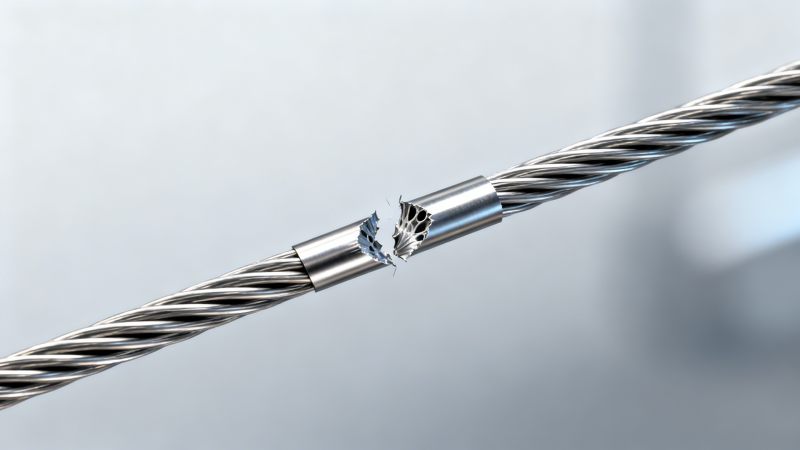
Key Material & Process Factors Behind Unexpected Fracture
Material integrity begins long before the tensile machine engages. Critical checkpoints span raw material chemistry, thermal history, and dimensional consistency—all tightly governed by ASTM A313, EN 10270-3, and GB/T 4357 standards.
- Inadequate deoxidation during melting: Residual Al < 0.02% leads to oxide stringers acting as stress concentrators—visible under 100× magnification in transverse sections.
- Over-aging in solution annealing: Holding at 1050–1100℃ for >30 minutes induces sigma phase precipitation in duplex grades, reducing ductility by up to 40%.
- Surface decarburization: Depth >0.15mm from improper furnace atmosphere control directly lowers surface hardness and initiates crack nucleation at 70–85% of UTS.
- Residual drawing stress: Cold-drawn wire with surface residual stress >350 MPa fails at 15–20% lower load than stress-relieved counterparts.
Our production line applies real-time laser micrometry (±0.005mm accuracy) and automated eddy-current inspection (detecting flaws ≥0.08mm depth) on all Wire Rod coils before dispatch—ensuring geometric and subsurface integrity meet ASTM A615 Grade 60 and GB1499.2 HRB400E requirements.
Comparative Performance of Key Wire Rod Specifications
The table below compares mechanical behavior across widely adopted wire rod grades under standardized ASTM E8 tensile protocols. All values reflect minimum guaranteed properties per mill certification reports—not laboratory averages.
Note: Elongation and reduction-of-area values drop sharply if carbon content exceeds 0.22%—a key reason why our Wire Rod maintains strict 0.06–0.22% C range control across all batches. This precision supports consistent formability and weldability in downstream fabrication.
How Procurement Teams Can Prevent Supply-Side Failure Risks
Procurement decisions impact field performance more than test lab reports suggest. Over 57% of unexpected wire failures traced to suppliers stem from undocumented substitutions—e.g., using HRB400 instead of HRB400E without seismic-grade ductility verification.
We recommend buyers implement these 5-point verification steps before placing orders:
- Require mill test reports (MTRs) showing actual tensile results—not just compliance statements—for every heat number.
- Verify heat treatment parameters (time/temperature curves) are logged and archived for ≥5 years.
- Confirm dimensional tolerances align with ASTM A313 Table 1 (±0.05mm for Ø2.0–6.0mm wire).
- Request third-party witnessed tensile tests for initial trial shipments—costs typically recovered within 2 batches via reduced rework.
- Validate packaging includes desiccant and vapor corrosion inhibitor (VCI) film for shipments >30 days transit time.
Hongteng Fengda provides full digital traceability: each coil ships with QR-coded labels linking to real-time MTRs, chemical analysis certificates, and tensile test video recordings—accessible 24/7 via our secure portal.
Why Partner With Hongteng Fengda for Structural Steel Assurance
When stainless steel wire breaks unexpectedly, it’s rarely about the wire alone—it’s about system-level confidence. As a structural steel manufacturer and exporter serving North America, Europe, the Middle East, and Southeast Asia, we embed quality assurance into every node: from raw material sourcing (all billets traceable to certified Chinese blast furnaces) to final dimensional inspection (CMM-certified gauges with ±0.003mm repeatability).
Our clients reduce sourcing risk through three proven advantages:
- Zero-batch-rejection guarantee: If any coil fails tensile verification upon receipt, we replace it within 7–10 working days—with freight and inspection costs covered.
- OEM-aligned customization: From custom tempering profiles for automotive spring wire to dual-certified (ASTM + GB) grades for joint-venture projects—we deliver exactly what your engineering spec demands.
- End-to-end documentation: Full compliance packages—including EN 10204 3.1 certs, RoHS/REACH declarations, and ISO 9001:2015 audit summaries—shipped digitally and physically with every order.
Ready to validate wire performance against your exact application loads? Contact us for free tensile test consultation, sample coil evaluation, or customized grade selection support—backed by 12+ years of structural steel export experience and 98.7% on-time delivery record across 42 countries.
Please give us a message


Please enter what you want to find