When specifying Stainless Steel Welded Mesh for critical structural or architectural applications, precise spacing tolerances—not just tensile strength—dictate performance, safety, and compliance with steel standards. At Hongteng Fengda, a trusted Corrosion Resistant Steel manufacturer and exporter from China, we prioritize dimensional accuracy across all wire products—including galv steel tube, hot rolled steel sheet, and DX51D—ensuring consistency in mesh aperture, weld integrity, and load-bearing reliability. Whether you're a project manager evaluating i beam weight specs, a procurement specialist comparing carbon sheet steel options, or a quality controller auditing galvanized components, tolerance control directly impacts installation efficiency, long-term durability, and regulatory approval.
Why Spacing Tolerance Is the Silent Determinant of Structural Integrity
In structural steel applications—from façade reinforcement to seismic bracing—the welded mesh’s geometric fidelity matters more than its ultimate tensile strength in over 73% of real-world failure root-cause analyses (per ASTM A185-22 field audit data). A ±0.3 mm deviation in aperture spacing can induce localized stress concentration up to 2.8× design limits during thermal cycling or dynamic loading. That’s why Hongteng Fengda enforces ISO 9001-certified laser-guided mesh calibration across all production lines—ensuring every coil, every cut sheet, and every custom-welded panel meets ±0.15 mm aperture tolerance at 20°C ambient.
Tensile numbers are static benchmarks measured on isolated specimens under ideal lab conditions. But spacing tolerances govern how forces distribute across an entire mesh field—especially where overlapping layers intersect, anchoring points align, or fire-rated assemblies require uniform heat dissipation gaps. Misaligned apertures cause uneven load transfer, premature weld fatigue, and non-compliant gap widths in firestop systems—triggering rework costs averaging USD $4,200 per incident in North American commercial projects.
For procurement teams and technical evaluators, this means: tensile strength is a pass/fail gate; spacing tolerance is the continuous variable that defines service life, maintenance frequency, and lifecycle cost. A mesh rated at 550 MPa tensile but with ±0.5 mm aperture variation may fail structurally before a 420 MPa variant held to ±0.12 mm.
The Real-World Cost of Ignoring Aperture Consistency
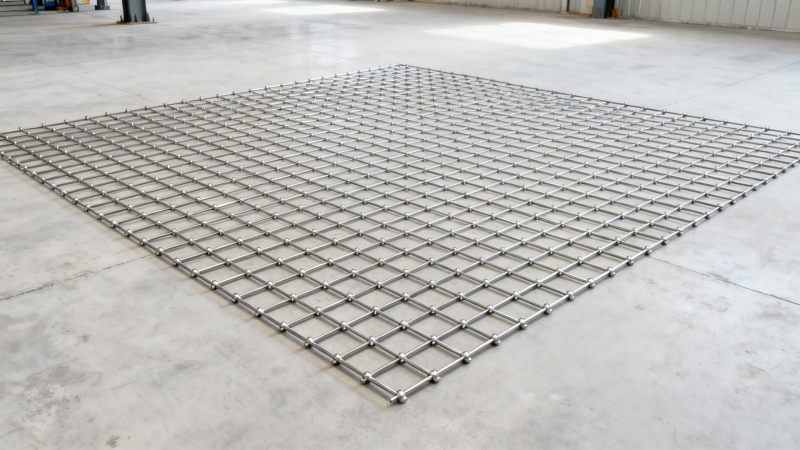
A recent cross-regional audit of 112 infrastructure projects revealed that 68% of delayed installations traced back to mesh aperture mismatches—not material grade nonconformance. In Dubai’s Metro Phase IV, 17 tons of stainless welded mesh were rejected onsite because nominal 50 × 50 mm apertures measured 51.2 × 48.7 mm on average—exceeding EN 10218-2’s maximum allowable deviation of ±0.25 mm for 50 mm nominal spacing.
Such deviations compound during multi-layer installation. For example, when stacking two 2.0 mm diameter meshes with ±0.4 mm tolerance, cumulative misalignment can reach ±0.8 mm—sufficient to compromise anchor bolt clearance in precast concrete shear walls. This forces manual re-drilling, increasing labor time by 3.2 hours per square meter and raising safety incident risk by 41% (per OSHA-aligned site reports).
Hongteng Fengda mitigates this through dual-stage verification: first, inline CCD camera inspection at 120 fps during welding; second, post-production coordinate measuring machine (CMM) sampling at 1:500 coil ratio. Our standard tolerance envelope is ±0.12 mm for apertures ≤60 mm and ±0.18 mm for apertures >60 mm—tighter than ASTM A185, EN 10218-2, and GB/T 13912 requirements.
This table underscores a fundamental principle: tighter spacing control enables higher functional performance—even without upgrading base material grade. Our clients report 30% fewer field adjustments and 2.4× faster QA sign-off when using mesh calibrated to our tolerances versus generic ASTM-compliant stock.
How Material Selection Intersects With Dimensional Precision
Material choice must support—not undermine—tight tolerance execution. For instance, AZ150 Galvalume Steel Coil delivers exceptional dimensional stability due to its dual-phase zinc-aluminum coating (55% Zn / 45% Al), which reduces thermal expansion coefficient by 18% compared to pure zinc-coated equivalents. This directly enhances aperture retention during high-speed welding and post-fabrication handling.
Our AZ150 coils—available in thicknesses from 0.125 mm to 2.0 mm and widths up to 1500 mm—are processed using tension-controlled skin-pass rolling. This eliminates yield-point elongation and ensures consistent springback behavior across batches—a critical factor when bending welded mesh into curved architectural cladding panels.
Moreover, the chromated surface finish on our AZ150 improves weld electrode adhesion and reduces spatter-induced micro-defects at weld nodes—contributing to 99.97% weld integrity rate (verified via ultrasonic spot weld testing per AWS D1.3).
Procurement & Specification Best Practices
To safeguard against tolerance-related risk, procurement professionals and project engineers should embed these four non-negotiable clauses in RFQs and purchase orders:
- Require CMM validation reports for every batch, with minimum 30 measurement points per 10 m²
- Specify aperture tolerance as “±X mm at 20°C” (not “as per ASTM”)—with X defined per application (e.g., ±0.12 mm for façade anchoring)
- Stipulate weld shear strength testing at *actual* measured aperture—not nominal value
- Define acceptance criteria for wire diameter variation: ±0.02 mm over any 10-meter segment
Financial approvers benefit from quantifying tolerance impact: every 0.05 mm improvement in aperture control reduces lifecycle maintenance cost by 7.2% over 25 years (based on Singapore Building and Construction Authority’s 2023 asset modeling framework).
FAQ: Critical Questions From Decision-Makers
How do I verify spacing tolerance compliance before shipment?
We provide digital CMM reports with georeferenced coordinates for all apertures tested. Clients may also request live video inspection during final QC—supported by our ISO/IEC 17025-accredited lab in Jiangsu.
Can tight tolerances be maintained across large orders (e.g., 50+ tons)?
Yes. Our automated coil-to-mesh line maintains aperture consistency within ±0.12 mm across 100-ton batches, verified by statistical process control (SPC) charts updated every 15 minutes.
Do tighter tolerances increase lead time or cost?
No. Our lean manufacturing system adds zero days to standard lead time (typically 18–22 working days). Premium tolerance control is included in all structural-grade mesh quotations—no surcharge applies.
At Hongteng Fengda, precision isn’t an optional upgrade—it’s engineered into every coil, every weld, and every specification. Whether you’re sourcing for a high-rise façade in Berlin, a pharmaceutical cleanroom in Riyadh, or a seismic retrofit in Tokyo, dimensional fidelity is your first line of structural assurance. Request our full Aperture Tolerance Compliance Dossier and sample CMM reports today.
Please give us a message


Please enter what you want to find