Ovality in stainless steel tubing after cold drawing is a critical quality parameter—especially for structural steel fabrication, stainless steel supplier compliance, and ASTM standards adherence. As a leading structural steel manufacturer & exporter from China, Hongteng Fengda routinely addresses this issue for global buyers of stainless steel pipe, seamless pipe, and carbon steel pipe. How much ovality is acceptable? The answer depends on application, tolerance class, and end-use requirements—from precision instrumentation to structural steel beams and galvanized steel pipe systems. In this article, we break down industry-accepted limits, measurement methods, and how top-tier steel suppliers like us ensure consistency—helping procurement teams, technical evaluators, and project managers make confident, standards-compliant decisions.
What Is Ovality—and Why Does Cold Drawing Affect It?
Ovality quantifies the deviation of a tube’s cross-section from a perfect circle. It’s calculated as: (Maximum Outside Diameter − Minimum Outside Diameter) ÷ Specified Outside Diameter × 100%. During cold drawing—a process that enhances tensile strength and surface finish by pulling tubing through a die—the metal undergoes non-uniform plastic deformation. Residual stresses, die wear, lubrication inconsistencies, and mandrel alignment all contribute to measurable ovality increases—typically ranging from ±0.3% to ±1.2% depending on wall thickness, material grade, and processing parameters.
For structural applications—such as load-bearing frameworks or modular steel assemblies—even minor ovality can impact fit-up accuracy, weld penetration consistency, and bolted joint integrity. That’s why ASTM A269, EN 10216-5, and GB/T 12771 all define strict ovality tolerances tied directly to nominal diameter and wall thickness. Ignoring these thresholds risks field rework, certification rejection, or long-term fatigue performance loss.
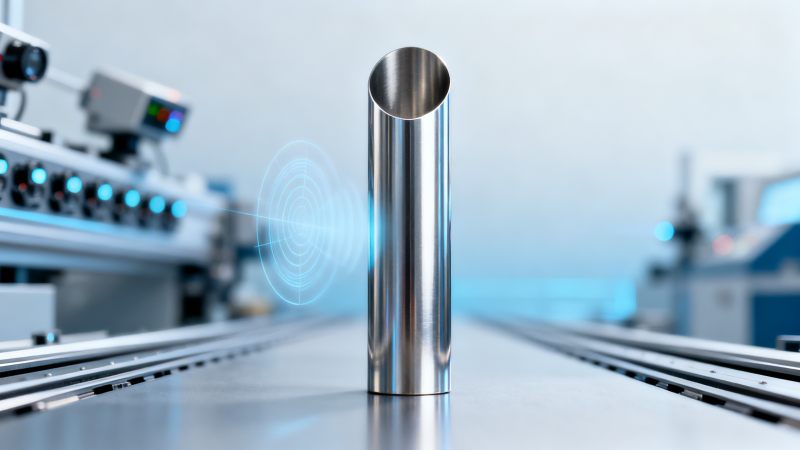
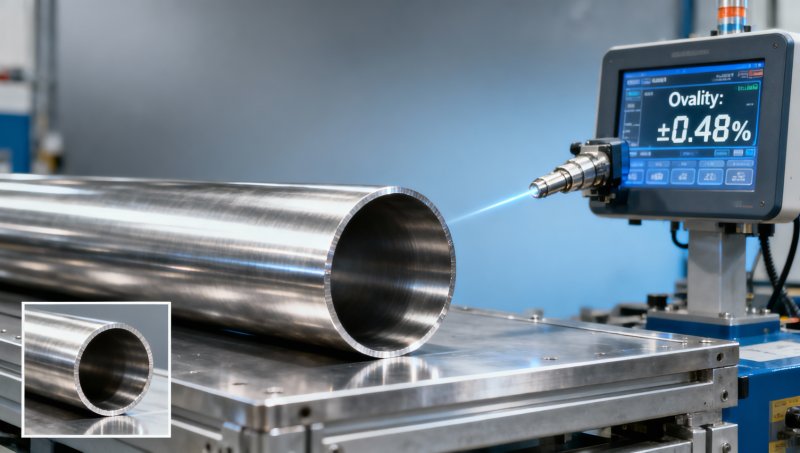
At Hongteng Fengda, our cold-drawing lines integrate real-time laser micrometry and closed-loop tension control. This allows us to maintain ovality within ±0.5% for tubes up to Ø219 mm—well below ASTM A269’s typical ±1.0% allowance for standard grades. Precision isn’t incidental; it’s engineered into every production phase.
Acceptable Ovality Limits by Application & Standard
Tolerance acceptance isn’t universal—it’s application-driven. Structural steel fabricators installing stainless tubing into seismic bracing systems require tighter control than those using it for decorative railings. Below are common thresholds aligned with international specifications:
Note: These values assume standard wall thickness (e.g., SCH10–SCH40). For ultra-thin-walled (<2.0 mm) or heavy-wall (>12.7 mm) tubing, ovality may increase by up to 0.3 percentage points unless compensated via post-draw straightening or multi-pass drawing. Our engineering team provides free tolerance validation reports upon request—covering dimensional repeatability across 3 production batches.
How We Control Ovality—From Mill to Delivery
Cold-drawn stainless tubing ovality isn’t managed solely at the drawing stage—it’s controlled across six interdependent phases:
- Raw material screening: Incoming coil undergoes ultrasonic testing to eliminate micro-voids or banding that cause asymmetric flow during drawing.
- Die-mandrel calibration: Tooling is verified daily against traceable master gauges; wear beyond 0.015 mm triggers replacement—not adjustment.
- Tension profiling: We use 4-zone variable-frequency drives to match draw force to yield point—reducing longitudinal strain variation to <±2.5%.
- Post-draw straightening: All structural-grade tubing passes through 12-roll straighteners set to ±0.15 mm runout tolerance.
- Statistical process control (SPC): Cpk ≥ 1.33 maintained across 3 shifts using automated vision inspection at 120 fps.
- Final verification: Every shipment includes a Certificate of Conformance listing actual ovality (measured at 4 axial positions per meter).
This integrated approach ensures consistency even for custom orders—like I Shaped Beams used in hybrid stainless-carbon frameworks where tube-to-flange alignment must hold within ±0.8 mm over 12-meter spans.
Procurement Checklist: 5 Critical Questions Before Ordering
When sourcing cold-drawn stainless tubing internationally, procurement and technical teams should jointly verify the following before finalizing PO terms:
- Does the supplier provide third-party ovality test reports per ASTM E29 or ISO 2768-2—not just “complies with spec” statements?
- Is post-draw straightening included in the base quote—or billed separately? (Unstraightened tubing adds 3–5 days lead time and 8–12% rework risk.)
- What is the maximum lot size covered under one C of C? (Hongteng Fengda caps it at 15 metric tons to guarantee batch homogeneity.)
- Can they supply sample cuttings for your QA lab’s independent verification—within 5 working days of inquiry?
- Do they offer tolerance waivers for non-critical zones (e.g., ±1.5% for non-welded end sections), reducing cost without compromising safety?
These checks reduce qualification delays by up to 40% and prevent costly field rejects—especially important when coordinating deliveries with I Shaped Beams and other structural components.
Why Global Buyers Choose Hongteng Fengda for Precision Tubing & Structural Steel
We don’t treat ovality as a pass/fail checkbox—we treat it as a controllable engineering variable. With ISO 9001-certified cold-drawing lines, in-house metallurgical labs, and 12+ years serving North American infrastructure projects and EU industrial OEMs, we deliver what generic mills cannot:
- Pre-shipment dimensional audits: Free CMM scanning on 10% of order volume (min. 3 pieces) for orders >5 MT.
- Lead time certainty: 21–28 days FOB Shanghai for standard grades—guaranteed in contract, not estimated.
- Multi-standard compliance: Single-lot documentation covering ASTM, EN, JIS, and GB simultaneously—no re-testing required.
- Technical co-engineering: Our engineers collaborate remotely to validate drawings, suggest tolerance relaxations, and simulate fit-up behavior—before tooling begins.
Whether you’re specifying tubing for a high-rise façade system or integrating stainless elements with I Shaped Beams in a chemical plant expansion, contact us today for a no-cost tolerance review, sample support, or customized packaging solutions—including protective film, bundle strapping, and mill-test report formatting per your QA system.
Please give us a message


Please enter what you want to find