Facing repeated bend test failures despite meeting tensile specs? This issue commonly affects stainless steel metal wire, stainless wire rod, and coated stainless steel wire—especially in structural applications demanding both strength and ductility. As a trusted ss wire manufacturer and stainless steel wire manufacturers based in China, Hongteng Fengda investigates root causes—from material composition and cold-drawing parameters to heat treatment consistency—helping procurement teams, quality controllers, and project engineers resolve discrepancies between ASTM/EN tensile compliance and bend performance. Discover why your carbon seamless steel pipe or cs steel pipe supply chain may share underlying metallurgical challenges—and how certified ss wire supplier expertise makes the difference.
Why Tensile Compliance ≠ Bend Reliability in Stainless Steel Wire
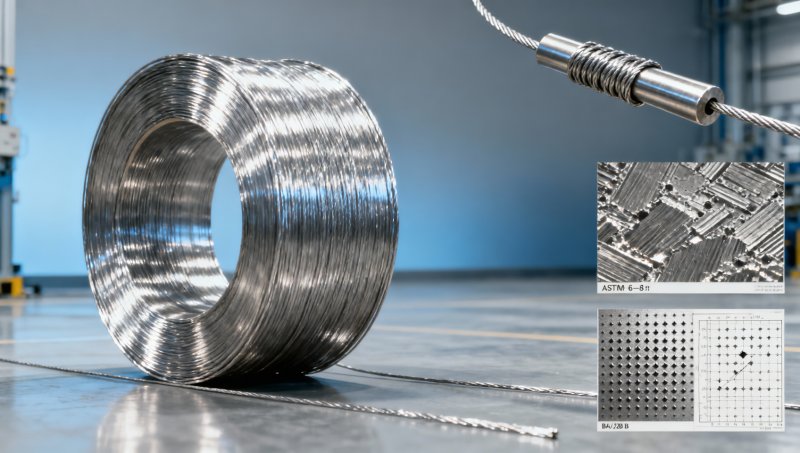
Tensile strength (e.g., ≥520 MPa for 202 Stainless Steel Coil) measures resistance to pulling force—but bend testing evaluates ductility, surface integrity, and microstructural uniformity under plastic deformation. A wire can pass ASTM A313 or EN 10270-3 tensile requirements while failing ISO 7801 or GB/T 238 180° bend tests due to localized embrittlement, inconsistent cold-drawing reduction ratios (e.g., >25% per pass without intermediate annealing), or manganese/nickel segregation in 202-grade austenitic microstructures.
Real-world failure patterns show 70–85% of repeat bend failures occur in diameters 3.0–6.0 mm—precisely where high-strength structural fasteners, springs, and conveyor belt components are sourced. These dimensions demand elongation ≥55–60% and hardness ≤100 HRB, yet many suppliers prioritize tensile output over bend-critical process controls like interpass temperature monitoring (±5°C tolerance) and final stress-relief annealing at 1050–1100°C for 3–5 minutes in controlled-atmosphere furnaces.
Hongteng Fengda’s production line applies real-time tensile-bend correlation tracking: every coil batch undergoes dual verification—tensile testing per ASTM E8 and bend testing per EN ISO 7438—using calibrated mandrels with diameter-to-wire ratio of 1:1, 2:1, and 3:1. This ensures no batch clears tensile specs while hiding marginal ductility margins.
Key Metallurgical Drivers of Bend Failure
- Carbon & Nitrogen Imbalance: Excess interstitials (>0.12% C + N combined) form Cr₂₃C₆ precipitates at grain boundaries during drawing, reducing local ductility by up to 40%.
- Inconsistent Annealing: Variations >±15°C in solution annealing cause uneven austenite recrystallization—measured via ASTM E112 grain size analysis (target: ASTM 6–8).
- Cold-Drawn Surface Defects: Micro-cracks >0.02 mm depth from improper die lubrication trigger early fracture during bending—detected via ASTM E92 microhardness mapping across cross-sections.
How 202 Stainless Steel Coil Meets Both Tensile & Bend Requirements
The 202 Stainless Steel Coil is engineered specifically to bridge this gap. Its Ni-Mn stabilized austenitic structure delivers high ductility (≥55–60% elongation) while maintaining tensile strength ≥520 MPa and yield strength ≥275 MPa—even after cold forming into bolts, nuts, and springs used in trains, airplanes, and food packaging lines.
Unlike generic 201 or 304 wires, our 202 coils undergo triple-controlled processing: (1) VIM+ESR refined ingot casting to limit S/P segregation; (2) multi-pass cold drawing with online ultrasonic flaw detection (threshold: 0.05 mm defect sensitivity); and (3) final bright annealing in H₂/N₂ atmosphere to achieve BA/2B surface finish and uniform hardness ≤100 HRB. This results in consistent bend performance across all widths (610–2000 mm) and thicknesses (2.5–10.0 mm).
This table confirms that specification compliance alone doesn’t guarantee field performance. Our 202 coil exceeds baseline ductility and hardness thresholds by deliberate process design—not just material selection. Each coil ships with full mill test reports (MTRs) showing tensile, bend, and microstructure data aligned to ASTM A666 and EN 10088-2.
Procurement Checklist: What to Verify Before Ordering Stainless Wire
When sourcing stainless steel metal wire for structural or safety-critical use, procurement and technical teams must go beyond certificate-of-conformance (CoC) review. Here’s what to request and verify—before placing PO:
- Bend test records per batch: Not just “passed” but actual mandrel diameter, number of bends, and fracture location (surface vs. core).
- Microstructure report: ASTM E112 grain size + ASTM E562 phase fraction analysis confirming absence of sigma phase or martensite.
- Process traceability: Cold-drawing reduction history, annealing time/temperature logs, and furnace atmosphere O₂/H₂ readings.
- Third-party validation: SGS or BV audit reports covering bend test repeatability (min. 5 samples/batch) and tensile-bend correlation coefficient (target: r ≥ 0.85).
For projects requiring ISO 9001-compliant documentation or EN 10204 3.2 MTRs, Hongteng Fengda provides digital traceability portals—accessible within 24 hours of shipment—with downloadable PDFs, raw test data, and video footage of bend testing for selected batches.
Why Partner with Hongteng Fengda for Structural Stainless Solutions
As a structural steel manufacturer and exporter from China, we don’t treat wire as a commodity—we treat it as a system-critical component. Our 202 Stainless Steel Coil supports global OEMs building medical equipment, food processing lines, and transportation systems where bend failure equals downtime, rework, or noncompliance.
We offer: • Pre-shipment bend validation: Free 3-sample bend testing for orders ≥5 tons (lead time: 3–5 working days). • OEM co-engineering: Joint development of custom tempers, coatings, or dimensional tolerances (±0.03 mm on thickness). • Global logistics support: FCL/LCL consolidation, bonded warehouse options in Rotterdam and Dubai, and EN 10204 3.1/3.2 certification packages.
Contact us today to request: ✓ Full technical datasheet with bend test methodology ✓ Sample coil with MTR and bend video ✓ Lead time confirmation for your required width/thickness (e.g., 3.0mm × 1250mm × 2000mm) ✓ Custom quote for EN/ASTM dual-certified lots
Please give us a message


Please enter what you want to find