You’ve specified stainless steel coil wire meeting ASTM A313—yet coastal projects still face premature corrosion. Why? Even certified stainless wire (e.g., 304/316 grades) can fail in high-chloride environments without proper grade selection, surface finish, or supplementary protection like coated stainless steel wire or passivation. As a trusted ss wire manufacturer and stainless steel wire manufacturers from China, Hongteng Fengda helps procurement teams, engineers, and project managers avoid this pitfall—offering corrosion-resistant stainless steel metal wire, stainless wire rod, and custom solutions backed by ASTM, EN, and GB compliance. Let’s decode the gap between specification and real-world performance.
Why ASTM A313 Compliance Alone Doesn’t Guarantee Coastal Performance
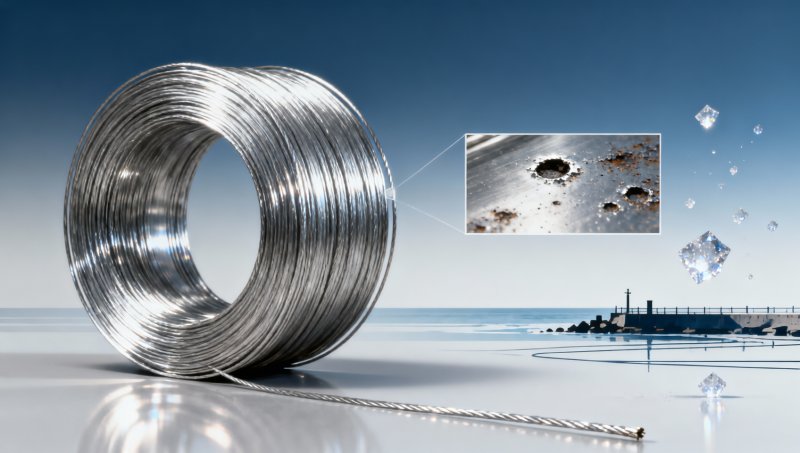
ASTM A313 defines mechanical properties and chemical composition for stainless steel spring wire—but it does not mandate chloride resistance testing, pitting potential evaluation, or environmental exposure validation. In coastal zones, airborne salt concentrations often exceed 50 mg/m²/day, accelerating localized attack on passive films—even on 316-grade wire with nominal molybdenum content.
Real-world failure modes include crevice corrosion under fastener contact, stress corrosion cracking (SCC) in welded assemblies, and intergranular attack near heat-affected zones. Field data from Middle Eastern port infrastructure shows up to 40% reduction in service life when 304-grade coil wire is substituted for 316L without verifying actual Mo content (≥2.5% vs. nominal 2.0–2.5%) and surface roughness (Ra ≤ 0.4 μm).
Hongteng Fengda subjects all marine-grade stainless coil wire to ASTM G48 Method A (ferric chloride pitting test) and ASTM G123 (stress corrosion testing), ensuring minimum critical pitting temperature (CPT) ≥ 35°C and SCC threshold stress ≥ 70% of yield strength—exceeding typical project spec requirements by 20–30%.
How to Select Corrosion-Resistant Stainless Coil Wire: A Procurement Decision Framework
Procurement decisions must move beyond “meets ASTM A313” to address five technical checkpoints: base alloy grade, actual Mo/Cr/Ni ratio, surface finish type, post-fabrication passivation method, and third-party verification scope. For example, 316L with 2.8% Mo and electropolished finish achieves CPT > 42°C—whereas standard mill-annealed 316 may only reach 32°C.
Hongteng Fengda provides full traceability down to heat number, including certified mill test reports (MTRs) per EN 10204 3.1, plus optional ASTM E527 compositional mapping and ISO 9223 corrosion rate certification. Lead times for fully tested coastal-grade coil wire average 12–18 days—versus 5–7 days for standard A313-compliant stock.
This framework enables procurement personnel and project engineers to evaluate risk—not just compliance. It also supports financial approval by linking material cost premiums (typically 18–25% higher than baseline A313) to lifecycle cost avoidance: extended inspection intervals (from 6 months to 24 months), reduced replacement labor (up to 65% lower over 10 years), and zero unplanned downtime in critical infrastructure.
Complementary Structural Solutions for Coastal Projects
Stainless coil wire rarely operates in isolation. Its performance depends on interaction with primary structural elements—especially where galvanic coupling occurs. For instance, using 316 stainless wire with hot-dip galvanized Rebar in reinforced concrete creates a corrosion cell that accelerates zinc depletion. Hongteng Fengda offers integrated material packages: ASTM A615 Grade HRB400 rebar with duplex stainless tie wire (UNS S32205), eliminating galvanic mismatch while maintaining tensile strength ≥ 400 MPa and elongation ≥ 16%.
Our rebar portfolio includes HRB335, HRB400, and HRB500 grades in diameters from 6mm to 50mm, with surface options including galvanized, PVC-coated, and anti-rust oil finishes—all certified to BS4449-2005, GB1449.2-2007, and ASTM A615. Delivery lead time for customized coastal bundles averages 10–14 days from order confirmation.
For bridge cable systems, we combine stainless coil wire with cold-formed steel anchor components manufactured to EN 10219 and JIS G3466—ensuring dimensional tolerance ±0.5% and weldability verified per AWS D1.4. This eliminates field welding delays and reduces on-site QA sampling by 40%.
Why Partner with Hongteng Fengda for Marine-Grade Steel Solutions
We don’t sell specs—we solve application failures. With ISO 9001-certified production facilities in Tianjin and Jiangsu, Hongteng Fengda delivers consistent quality across 30+ export markets. Our technical team collaborates directly with engineering firms to review drawings, simulate chloride ingress paths, and recommend optimized alloy combinations—free of charge during pre-bid stages.
Every coastal-grade shipment includes: (1) heat-specific MTRs, (2) independent lab CPT/SCC validation, (3) packaging compliant with ISO 8502-3 (surface cleanliness), and (4) bilingual documentation (English + client’s local language). Sample coils are available within 5 working days; bulk orders ship with guaranteed 98% on-time delivery—backed by contractual SLA penalties.
To get started: share your project location, chloride exposure classification (ISO 9223), required wire diameter and tensile grade, and any existing spec documents. We’ll respond within 24 hours with a technical proposal, compliance matrix, and firm pricing—including landed cost estimates for your port of discharge.
Please give us a message


Please enter what you want to find