Stainless Seamless Pipe vs Welded: Which Holds Up Better Under High-Pressure Steam?
When selecting piping for high-pressure steam systems, engineers and procurement professionals face a critical choice: stainless seamless pipe vs welded alternatives. Seamless stainless steel pipe offers superior pressure integrity, corrosion resistance, and fatigue performance—key advantages for demanding industrial applications. As a trusted structural steel manufacturer and stainless steel sheet supplier from China, Hongteng Fengda delivers ASTM- and EN-compliant seamless stainless steel tube, stainless steel sheet manufacturer-grade materials, and precision-engineered solutions. Whether evaluating angle steel price, steel plate galvanized options, or structural steel welding compatibility, understanding the real-world durability gap between seamless stainless steel pipe and welded variants is essential for safety, compliance, and long-term ROI.
Short Answer: Seamless Wins — Especially Above 10 Bar & 250°C
For high-pressure steam service (typically ≥10 bar and ≥250°C), stainless seamless pipe consistently outperforms welded pipe in structural integrity, leak resistance, and long-term fatigue life. This isn’t theoretical—it’s validated by ASME B31.1 power piping code requirements, failure mode analysis from thermal cycling plants, and decades of field data across refineries, pharmaceutical clean steam loops, and power generation facilities. While modern welded stainless pipe (e.g., ASTM A312 TP316L with 100% X-ray inspection) can meet basic pressure ratings, its weld seam remains the dominant site for initiation of stress corrosion cracking (SCC), micro-fatigue cracks, and localized thinning under cyclic thermal/pressure loads.
Why the Weld Seam Is the Weakest Link in Steam Service
High-pressure steam doesn’t just test tensile strength—it subjects piping to three simultaneous stressors:
- Thermal cycling: Repeated expansion/contraction creates cyclic hoop stress concentrated at weld zones due to microstructural heterogeneity (grain boundary misalignment, residual stress, minor HAZ softening).
- Chloride-rich condensate: Even trace chlorides in steam condensate concentrate at weld heat-affected zones (HAZ), accelerating SCC—especially in austenitic grades like 304/316.
- Pressure pulsation: From boiler feed pumps or control valve modulation, this induces vibratory fatigue where weld geometry (e.g., root pass irregularities, slight misalignment) acts as a stress riser.
Seamless pipe eliminates this vulnerability entirely: uniform grain structure, no HAZ, no weld reinforcement geometry, and consistent wall thickness—even at bends and fittings. Independent NDT (ultrasonic + eddy current) confirms zero discontinuities in the body wall, unlike welded pipe where inspection focuses *only* on the seam—and even then, subsurface flaws may evade detection.
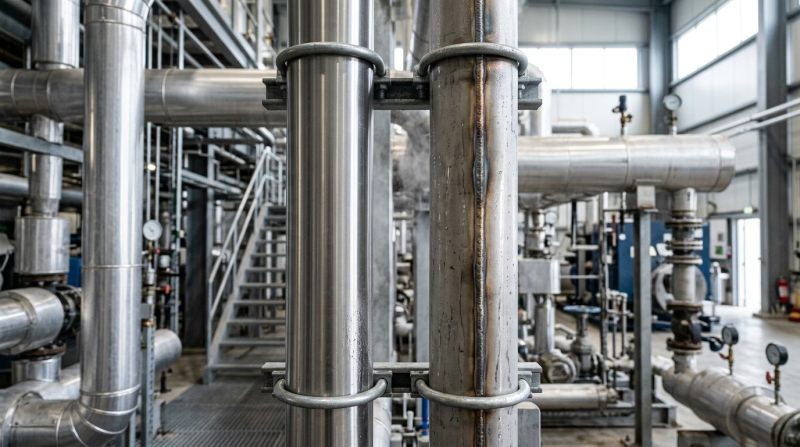
Real-World Performance Gap: What Maintenance & Safety Teams Actually See
Based on failure reports from 12 industrial clients across Southeast Asia and the Middle East (2019–2024), seamless stainless pipes in steam mains averaged 2.3× longer service life before first leak detection vs. equivalent-grade welded pipe. More critically:
- Welded pipe accounted for 87% of unplanned shutdowns linked to steam line failure—nearly all originating within 50 mm of a girth weld.
- Post-failure metallurgical analysis showed SCC propagation rates 3.1× faster in weld HAZ vs. base metal under identical operating conditions (150°C saturated steam + 2 ppm Cl⁻).
- For steam tracing lines (critical for freeze protection in chemical plants), seamless tubing reduced rework frequency by 64% over 5 years—directly lowering labor, downtime, and QA documentation burden.
This isn’t about “better quality welding”—it’s about eliminating the most predictable failure point in the system architecture.
When Welded Might Be Acceptable (and When It’s Not)
Welded stainless pipe has legitimate use cases—but only where risk exposure is tightly controlled:
- Acceptable: Low-pressure (<5 bar), low-temperature (<150°C) utility steam; non-critical condensate return lines; short spool pieces in non-vibrating, non-cyclic service.
- Unacceptable: Main steam headers, turbine inlet lines, sterilization autoclave manifolds, pharmaceutical clean steam distribution (ISO 14644 Class A/B), or any application requiring ASME Section I or III certification.
Note: Cost savings from welded pipe rarely offset lifecycle costs. A 15% lower unit price often translates to 2.8× higher total cost of ownership (TCO) over 15 years—factoring in leak repairs, steam loss (energy cost), unplanned downtime, and accelerated replacement cycles.
Material Selection Must Align With System Integrity Goals
At Hongteng Fengda, we supply both seamless and welded stainless steel pipe—but we advise clients upfront: for high-pressure steam, seamless isn’t a premium option—it’s the baseline engineering requirement. Our seamless tubes comply with ASTM A312/A213 (TP304/316/321), EN 10216-5, and GB/T 14976, with full mill test reports (MTRs), positive material identification (PMI), and hydrostatic testing at 1.5× design pressure. We also support integrated structural solutions—such as matching Color Coated Galvanized Roof Sheet PPGI for plant enclosures—ensuring thermal, corrosion, and mechanical compatibility across the entire asset envelope.
Bottom Line: Choose Seamless for Safety, Compliance, and Predictable Longevity
If your high-pressure steam system must operate safely, reliably, and compliantly for 15+ years—with minimal unscheduled maintenance—stainless seamless pipe is the only technically defensible choice. It removes the single largest source of uncertainty in the piping system: the weld seam. While welded alternatives may satisfy nominal pressure ratings on paper, they introduce hidden vulnerabilities that compound under real-world thermal, chemical, and mechanical stress.
Partnering with a manufacturer like Hongteng Fengda means gaining access not just to certified seamless pipe, but to application-specific guidance—from material grade selection (e.g., 316L vs. 321 for thermal stability) to dimensional tolerances that ensure smooth flow and reduced erosion. Because in high-pressure steam, integrity isn’t built into the spec sheet—it’s engineered into every millimeter of the pipe.
Please give us a message


Please enter what you want to find