Choosing the right stainless coil tubing sizes can significantly reduce bending errors, welding waste, and material loss in daily operations.
For industrial and structural steel projects, size selection directly affects fit-up accuracy, routing efficiency, and installation speed.
When stainless coil tubing matches the required bend radius, wall thickness, and connection layout, rework becomes easier to control.
This matters in fabrication lines, equipment piping, support assemblies, and compact structural systems where every cut and weld adds cost.
A practical understanding of stainless coil tubing sizes helps improve workflow consistency and supports more reliable project outcomes.
Understanding stainless coil tubing sizes in steel-related fabrication
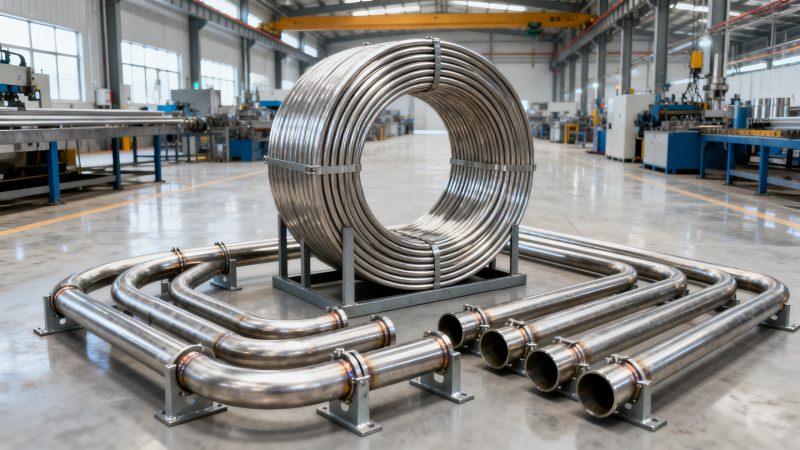
Stainless coil tubing is supplied in continuous lengths, then bent, routed, and connected for fluid, instrumentation, or compact structural applications.
The most important dimensions are outer diameter, wall thickness, coil length, and the minimum bend radius.
These factors influence pressure performance, springback behavior, welding frequency, and the number of fittings required on site.
In steel processing environments, the wrong size often creates avoidable scrap during cutting, trial bending, and alignment correction.
Smaller diameters may simplify routing in narrow spaces, but they can also increase pressure drop and handling sensitivity.
Larger diameters may improve flow, yet they need more space and larger bend radii, which can complicate installation.
Wall thickness is equally important because it affects strength, weld preparation, bending stability, and resistance to flattening.
For steel-related projects, dimensions should be reviewed together with support spacing, vibration exposure, and assembly tolerances.
Current industry focus on waste reduction and dimensional control
Material efficiency is now a core concern across steel fabrication, industrial piping, and modular construction supply chains.
Stainless coil tubing receives attention because improper sizing quickly turns into welding waste, fitting waste, and downtime.
Several practical signals explain this trend:
- Tighter project schedules leave less room for bending trials and layout correction.
- Higher alloy and energy costs make scrap reduction more valuable.
- Modular fabrication demands better dimensional repeatability across batches.
- International quality standards require more stable tolerance control.
The table below shows how common sizing issues create waste during steel project execution.
How proper stainless coil tubing selection improves project value
Well-matched stainless coil tubing sizes improve more than material yield. They also support stable labor efficiency and clearer cost forecasting.
Fewer welds mean fewer inspection points, less heat input, and reduced distortion around connected steel assemblies.
Long continuous tubing runs also reduce the risk of leakage at joints, especially in vibration-prone installations.
In mixed-material projects, stainless coil tubing often works beside structural steel supports, channels, and fabricated mounting components.
That makes coordination with other steel products important during design and procurement planning.
For example, support frames, curtain wall supports, and equipment bases may use sheet or coil-based steel products for stable fabrication.
In those cases, dimensional consistency across materials helps reduce cumulative assembly deviation.
A related option in broader steel supply planning is Cold Rolled Steel Coil.
This product is used in construction and steel structures, with thickness from 0.1mm to 300mm and width from 0.6m to 3m.
Available grades include Q355, Q345B, Q420, Q460, Q690, 16Mo3, 16MnR, and other standard materials.
Its balanced mechanical properties and cost-effectiveness make it useful for factory steel frameworks and support components.
When stainless coil tubing is integrated with precision-formed steel parts, consistent sourcing can simplify manufacturing coordination.
Typical application scenarios and size considerations
Different operating environments require different stainless coil tubing priorities. Size selection should match both performance and installation conditions.
For long routing paths, continuous stainless coil tubing often reduces the total number of field welds.
For dense machinery areas, the bend radius should be checked before finalizing support locations and clamp spacing.
Where tubing crosses steel frames or enclosed channels, installation allowances should be included early to avoid late modifications.
Practical recommendations for reducing bending and welding waste
A waste-reduction strategy starts before ordering. It depends on dimensional planning, realistic tolerances, and production coordination.
- Confirm the required outer diameter based on flow, space limits, and fitting compatibility.
- Match wall thickness to pressure, bend severity, and expected vibration conditions.
- Review minimum bend radius against actual tooling capacity, not only theoretical values.
- Use layout drawings that include clamps, brackets, and steel support interference zones.
- Request stable dimensional tolerances to improve repeatability in batch fabrication.
- Plan coil lengths that minimize intermediate joints while remaining practical for handling.
It is also useful to test one representative route before committing to full production quantities.
A trial section can reveal springback, clamp conflict, or weld access problems that drawings may not show clearly.
When working with structural steel assemblies, check coating conditions, edge exposure, and fixation points around tubing runs.
This helps prevent later rework caused by bracket relocation or thermal distortion near welded sections.
Next-step planning for more reliable stainless coil tubing use
Selecting stainless coil tubing sizes is not only a material choice. It is a process decision linked to bending quality and total installed cost.
The best results usually come from reviewing diameter, wall thickness, routing length, and support geometry together.
For steel-related projects, that review should also consider adjacent fabricated parts, structural members, and standard compliance requirements.
A clear specification sheet can reduce uncertainty before production starts and limit expensive field corrections later.
If a project includes both tubing systems and structural steel components, aligning dimensions early improves delivery and installation efficiency.
Hongteng Fengda supports global steel projects with reliable manufacturing, customized solutions, and international standard compliance.
A practical next step is to compare required tubing routes, bend conditions, and support structures before finalizing the order list.
That approach helps stainless coil tubing perform more consistently while reducing bending waste, welding waste, and unnecessary material loss.
Please give us a message


Please enter what you want to find