When evaluating piping for demanding industrial systems, stainless steel pipe specifications play a direct role in pressure rating, safety, and long-term performance. For technical assessors, understanding how dimensions, wall thickness, material grade, and manufacturing standards interact is essential for accurate selection and risk control. This article outlines the key specification factors that influence pressure capacity and project reliability.
In industrial procurement, pressure capability cannot be judged by outside appearance alone. Two pipes may look similar in diameter, yet their allowable working pressure can differ significantly because of schedule, corrosion allowance, production method, temperature limits, and code compliance. For technical review teams, these differences directly affect system uptime, inspection intervals, and project liability.
For global buyers sourcing from manufacturers in China and other major steel markets, a specification sheet should be treated as an engineering control document rather than a sales attachment. Clear interpretation of stainless steel pipe specifications helps reduce mismatch risk, align procurement with ASTM, EN, JIS, or GB requirements, and support more reliable decisions across construction, industrial processing, and manufacturing projects.
How Dimensions and Wall Thickness Define Pressure Capacity
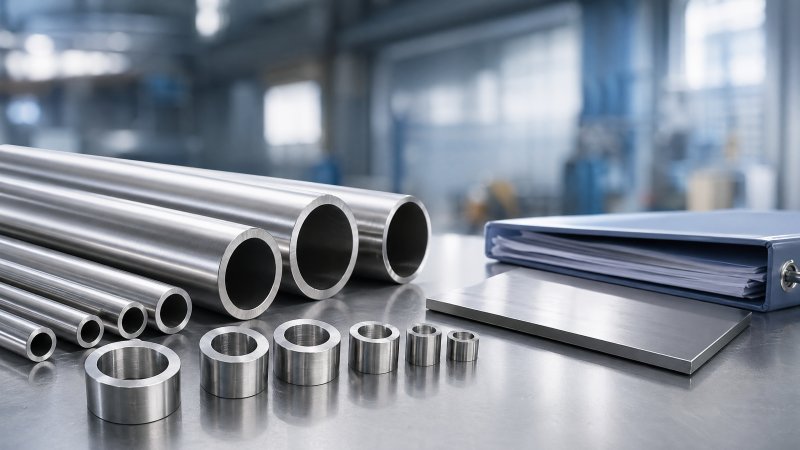
Among all stainless steel pipe specifications, outside diameter and wall thickness are usually the first parameters evaluated for pressure service. Pressure rating rises as wall thickness increases, but the relationship is not linear in every case because code formulas also consider allowable stress, manufacturing tolerance, and corrosion allowance. A 2-inch pipe in Schedule 80 can withstand much higher internal pressure than the same nominal size in Schedule 10.
Technical assessors should pay close attention to the distinction between nominal pipe size and actual wall section. In many projects, the mistake is not choosing the wrong diameter, but assuming a nominal size carries the same wall across all schedules. A wall difference of only 1.5 mm to 3 mm can materially change pressure performance, especially in systems above 10 bar, 25 bar, or 40 bar.
Another key point is mill tolerance. If a specification allows a negative wall tolerance, the minimum actual wall may be lower than the nominal value shown on the drawing. For pressure calculation, many engineering teams check minimum guaranteed wall rather than theoretical wall. This is particularly important in aggressive media, where future corrosion may consume 0.5 mm to 2.0 mm of thickness during service life.
Why schedule matters more than nominal size alone
Schedule designations such as Sch 10, Sch 40, and Sch 80 are shorthand for wall thickness ranges tied to diameter. They are practical selection tools, but they do not replace detailed verification against the design code. For instance, increasing from Sch 10 to Sch 40 can improve pressure capacity substantially, yet the final acceptable pressure still depends on grade, temperature, and weld efficiency assumptions.
The table below shows a simplified comparison framework that technical assessors can use during early-stage screening. Exact values should always be checked against the relevant standard and engineering calculation method.
The practical conclusion is simple: stainless steel pipe specifications should be reviewed using effective wall thickness, not catalog assumptions. This approach supports more conservative and more accurate pressure assessment, especially for lines subject to cyclic loads, corrosive media, or elevated temperatures.
In B2B sourcing, buyers should request dimensional tolerances, test reports, and applicable pipe schedule references before approving material for fabrication. This reduces the chance of redesign after receiving goods and improves alignment between procurement and engineering teams.
Material Grade, Temperature, and Corrosion Resistance
Dimensions alone do not determine pressure serviceability. Material grade is equally important because allowable stress changes with composition, temperature, and corrosion behavior. In stainless systems, 304 and 316 are among the most frequently evaluated grades, but their suitability varies depending on chloride exposure, acidic media, design temperature, and expected service life.
At elevated temperatures, pressure rating can decline because the material’s allowable stress falls as temperature rises. A pipe acceptable at ambient conditions may need derating at 200°C, 300°C, or higher, depending on code and grade. Technical assessors should always match the pressure calculation to actual operating temperature, not only to hydrotest or room-temperature values.
Corrosion behavior also affects long-term pressure integrity. In chloride-bearing environments, pitting or crevice corrosion can reduce wall locally, leading to pressure loss or leakage long before general corrosion becomes visible. This is why stainless steel pipe specifications should be linked to media analysis, cleaning method, maintenance interval, and expected years in service.
When 316-related material data becomes relevant
In projects involving aggressive process conditions, assessors often compare pipe material choices with adjacent plate, support, tank, or equipment components. For example, 316 Stainless Steel Plate is commonly selected where stronger resistance to pitting and acidic exposure is needed. Its 2%–3% molybdenum content improves corrosion resistance in challenging environments and helps maintain system consistency when pipework connects to 316-based fabricated assemblies.
For reference, 316 stainless steel material data often cited in component evaluation includes tensile strength of at least 520 MPa, yield strength of at least 275 MPa, elongation around 55%–60%, hardness not exceeding 183 HB, and density near 7.98 g/cm³. These values do not directly define pipe pressure rating by themselves, but they support broader material compatibility reviews in chemical processing, food handling, transport equipment, and high-temperature industrial applications.
If a project combines piping with plate-fabricated equipment, consistent corrosion performance can reduce inspection complexity. Assessors should compare not just grade names, but also finish, traceability, and certification such as ISO, SGS, or BV documentation where relevant to the purchase package.
Typical grade selection checkpoints
- Confirm whether the service medium contains chlorides, acids, or cleaning chemicals that can accelerate localized corrosion.
- Check the operating temperature range, such as ambient to 150°C, 150°C to 300°C, or intermittent high-temperature exposure.
- Review whether a corrosion allowance is expected over 5, 10, or 20 years of service life.
- Verify compatibility with connected fittings, flanges, vessels, and support structures to prevent mixed-material risk.
The key takeaway is that material grade should be selected as part of a full system review. Pressure rating is not only about initial strength; it is also about preserving wall integrity under actual media and temperature conditions throughout the asset lifecycle.
Manufacturing Method and Standards Compliance
Another major factor affecting pressure confidence is how the pipe is manufactured and which standards govern it. Seamless and welded stainless steel pipes can both serve pressure applications, but their inspection requirements, dimensional consistency, and code acceptance may differ by project. For technical assessors, this is where stainless steel pipe specifications move from general purchasing data into compliance-critical engineering information.
Seamless pipe is often preferred for high-pressure or highly critical service because it avoids a longitudinal weld seam. However, modern welded pipe produced under qualified procedures and tested to applicable standards can also be suitable for many process systems. The decision should be based on design pressure, test regime, code requirement, and fabrication route rather than assumption alone.
Standards such as ASTM, EN, JIS, and GB influence chemical limits, mechanical properties, hydrostatic testing, nondestructive examination, marking, and tolerances. A specification sheet that lists only size and grade, without the governing standard, is incomplete for pressure evaluation. In export projects, mismatch between requested standard and delivered standard is one of the most common avoidable risks.
What technical assessors should verify in mill documents
Before purchase approval, review teams should ask for mill test certificates, heat numbers, dimensional tolerances, and test scope. At minimum, documentation should confirm grade, size, wall thickness, standard, and inspection status. For more demanding systems, buyers may also request PMI, radiographic examination, ultrasonic testing, or hydrotest confirmation depending on the line class and project specification.
The table below highlights common verification points that support pressure-related decision-making during procurement and incoming inspection.
For international buyers, working with suppliers that understand multi-standard production and export documentation can shorten approval cycles by 1 to 2 weeks in many projects. It also helps reduce rework caused by incomplete traceability, mismatched marking, or inconsistent paperwork between engineering and purchasing teams.
Manufacturers serving global construction and industrial markets often support this process by supplying standard sections, OEM steel components, and coordinated documentation across different steel categories. That capability becomes valuable when a project includes both pressure-related stainless piping and structural steel interfaces requiring reliable lead times and quality control.
Pressure Rating Assessment in Real Project Scenarios
Technical assessors rarely evaluate pipes in isolation. The real question is whether the selected pipe will perform under combined conditions: internal pressure, design temperature, pressure fluctuation, support spacing, vibration, corrosion, and installation quality. Stainless steel pipe specifications should therefore be checked within the full piping class and service scenario, not only on a material takeoff sheet.
In process systems, the difference between design pressure and operating pressure must be clearly understood. If the operating pressure is 16 bar, the design pressure may be set higher to account for upset conditions, pump surge, or control valve events. A common assessment mistake is selecting pipe close to normal operating conditions without sufficient margin for transient peaks.
Service environment also matters. For example, a line in a clean indoor food system differs greatly from a coastal chemical facility exposed to chlorides and thermal cycling. The same nominal pipe may require different grade, wall thickness, or inspection criteria depending on whether the expected service life is 3 years, 10 years, or more than 20 years.
A practical 5-step review process
- Define design conditions, including pressure, temperature, medium, and corrosion assumptions.
- Check stainless steel pipe specifications against applicable code and project class requirements.
- Verify minimum wall after tolerance and corrosion allowance are considered.
- Review manufacturing standard, testing level, and traceability documents before order release.
- Confirm compatibility with fittings, flanges, supports, and fabrication procedures before installation.
This five-step method helps teams turn specification review into a repeatable control process. It is especially useful when coordinating among engineering, procurement, quality, and site teams across different countries or contractors.
Common misjudgments that increase risk
- Using nominal size as a proxy for pressure capability without checking schedule and minimum wall.
- Ignoring temperature derating and relying only on room-temperature mechanical values.
- Assuming all 304 or all 316 materials perform equally without checking standard and certificate details.
- Overlooking corrosion allowance in systems with acidic washdown, salt exposure, or cleaning chemicals.
In practice, better assessment early in the procurement cycle can prevent costly site changes later. Even a short technical review meeting before purchase order confirmation can save 2 to 4 weeks of schedule disruption caused by material substitution, failed inspection, or redesign of adjacent components.
Procurement Guidance for Global Buyers and Project Teams
For sourcing teams, the goal is not only to buy compliant pipe but to secure predictable project execution. That means balancing price, lead time, documentation quality, standard compliance, and supply continuity. Stainless steel pipe specifications should be embedded into RFQs, technical annexes, and inspection plans so that suppliers quote on the same basis and evaluation remains objective.
A complete inquiry package should usually include 6 core items: material grade, standard, size range, schedule or wall thickness, testing requirement, and application environment. Adding expected service temperature and medium description further improves quote accuracy. Without these details, apparent price savings may disappear once clarifications, retesting, or replacement become necessary.
For buyers working on mixed steel packages, it is often efficient to cooperate with manufacturers that can also support structural steel products, fabricated components, and OEM solutions under controlled production systems. Companies with modern manufacturing facilities and experience in ASTM, EN, JIS, and GB compliance can help reduce sourcing complexity, especially when project delivery spans North America, Europe, the Middle East, or Southeast Asia.
Suggested supplier evaluation matrix
The following matrix can be used by technical and procurement teams to compare offers beyond unit price alone. It is particularly helpful when shortlist decisions must be made within 3 to 7 business days.
This comparison method often reveals that the lowest quoted price is not the lowest-risk option. In pressure-related applications, the cost of one nonconforming delivery can exceed the savings from several percentage points of unit-price reduction.
For project teams seeking a long-term steel supply partner, reliability in documentation, consistent lead times, and the ability to support customized solutions are often as important as the base material itself. These factors contribute directly to smoother execution and lower sourcing uncertainty.
FAQ for Technical Assessors Reviewing Pipe Pressure Requirements
How should stainless steel pipe specifications be checked first?
Start with 4 items: outside diameter, wall thickness or schedule, material grade, and governing standard. Then verify design temperature and corrosion allowance. This sequence covers the main variables that most directly influence pressure rating and avoids early errors caused by relying only on nominal size or material name.
Is thicker wall always the best choice?
Not always. A thicker wall usually improves pressure capacity, but it may also increase weight, welding time, and material cost. In some systems, changing grade, improving corrosion resistance, or tightening quality control can be more effective than simply moving from one schedule to the next. Selection should match the full design basis.
What documents should be required from suppliers?
Most technical assessors request mill test certificates, dimensional inspection data, marking and traceability details, and confirmation of the production standard. For critical service, additional records such as NDT results, PMI, or hydrotest confirmation may be appropriate. The exact requirement depends on line class and project specification.
How can buyers reduce sourcing risk on international projects?
Use a clearly defined RFQ, standard-matched specifications, and a pre-shipment documentation review. Allowing 5 to 10 working days for technical clarification before final release can reduce the chance of receiving noncompliant material. It is also helpful to source from manufacturers experienced in export packaging, multi-standard production, and customized steel supply coordination.
Pressure performance is the result of multiple variables working together, not one isolated property. Accurate review of stainless steel pipe specifications requires attention to diameter, wall thickness, grade, temperature, manufacturing route, inspection level, and long-term corrosion conditions. For technical assessors, this structured approach supports safer designs, more reliable procurement, and fewer costly surprises during fabrication or operation.
Hongteng Fengda supports global industrial and construction buyers with dependable steel manufacturing, export coordination, and customized supply solutions across standard and OEM requirements. If you need support comparing specifications, aligning materials with international standards, or planning a broader steel sourcing package, contact us today to get a tailored solution and discuss your project in detail.
Please give us a message


Please enter what you want to find