When selecting stainless steel bar for marine applications, choosing between 304 and 316 isn’t just about cost—it’s about long-term structural integrity in aggressive saltwater environments. While 304 offers good corrosion resistance, 316’s molybdenum content delivers superior pitting and crevice resistance—critical for offshore platforms, shipbuilding, and coastal infrastructure. As a trusted structural steel manufacturer & exporter from China, Hongteng Fengda supplies ASTM/EN-compliant stainless steel square bar for architectural use and marine-grade bars with reliable lead times—addressing key concerns like standard vs custom steel lead time for industrial buyers and mill MOQ vs trader MOQ steel for industrial applications.
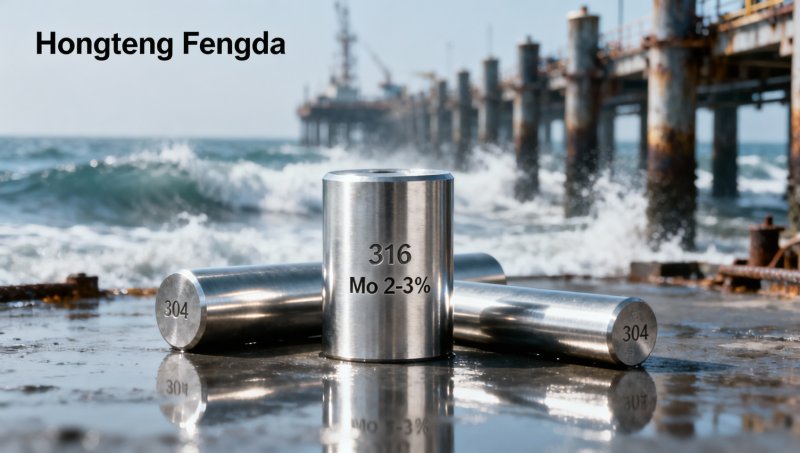
Why Corrosion Resistance Isn’t One-Size-Fits-All in Marine Environments
Saltwater exposure triggers electrochemical reactions that accelerate localized corrosion—especially pitting and crevice corrosion—where chlorides concentrate and oxygen diffusion is limited. Standard 304 stainless steel (18% Cr, 8% Ni) forms a passive chromium oxide layer, but lacks sufficient resistance when chloride ions penetrate micro-defects. In contrast, 316 stainless steel adds 2–3% molybdenum, which stabilizes the passive film and enhances repassivation kinetics. This difference becomes decisive in submerged or splash-zone applications where intermittent wet-dry cycles intensify chloride accumulation.
For project managers overseeing port expansions or offshore wind turbine foundations, material failure isn’t merely a repair cost—it’s a schedule delay, safety hazard, and reputational risk. That’s why leading marine engineering firms specify ASTM A276/A479 316 round, hexagonal, and Hot Rolled Steel Sheet Pile systems compliant with EN 10088-3 for critical load-bearing components. Hongteng Fengda’s mill-controlled hot-forging process ensures uniform grain structure and optimal carbide distribution—minimizing sensitization risks during welding on-site.
Technical Performance: Quantifying the Difference
Corrosion resistance isn’t theoretical—it’s measurable. The Pitting Resistance Equivalent Number (PREN) provides a standardized metric: PREN = %Cr + 3.3 × %Mo + 16 × %N. For common grades:
Note: PREN > 40 indicates super-austenitic performance—often over-engineered for standard marine use. For most coastal infrastructure, 316 strikes the optimal balance of performance, weldability, and cost-efficiency.
Procurement Guide: Navigating Lead Times, MOQs, and Certification
Industrial buyers face real-world trade-offs: Traders may offer lower MOQs but lack mill traceability; mills ensure compliance yet impose rigid minimum order quantities. At Hongteng Fengda, we bridge this gap. Our dual-track model supports both mill MOQ vs trader MOQ steel for industrial applications: standard 316 stainless steel bar (e.g., 20–100 mm Ø, lengths up to 6m) ships from stock with 4–6 week standard vs custom steel lead time for industrial buyers. For OEM projects requiring non-standard dimensions or surface finishes (e.g., pickled, bright-annealed), our custom lead time remains competitive at 8–12 weeks—backed by ISO 9001-certified production planning.
Certification matters beyond paperwork. Every heat lot includes MTRs (Mill Test Reports) per EN 10204 3.1, verifying chemical composition, mechanical properties (Rp0.2 ≥ 205 MPa, Rm ≥ 520 MPa), and intergranular corrosion testing per ASTM A262 Practice E. This transparency directly supports project managers / engineering project leads in audit-ready documentation and quality control personnel in incoming inspection workflows.
Real-World Validation: From Design to Deployment
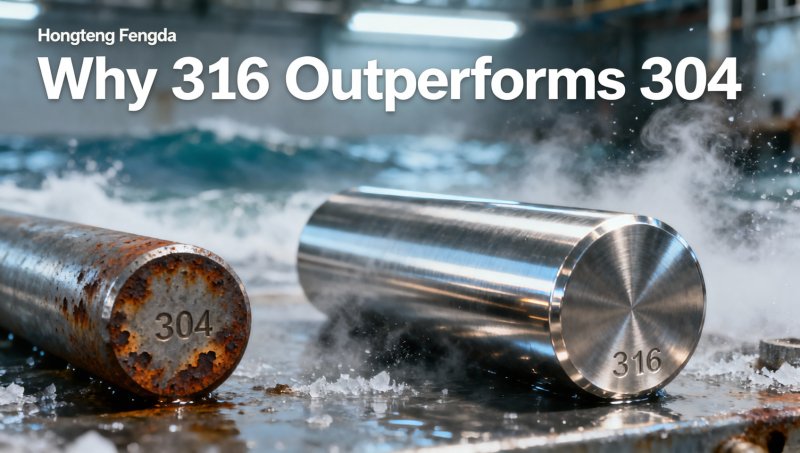
A recent case involved supplying 316 stainless steel square bar for architectural use and marine-grade anchor bolts to a desalination plant in Dubai. With ambient temperatures exceeding 45°C and airborne sea-salt concentrations >1.5 mg/m³, 304 would have required costly protective coatings and frequent replacement. Hongteng Fengda delivered EN 10088-3-compliant 316 bars—cut to precise lengths, pre-threaded, and certified for ASME B16.5 Class 150 service. Result: zero corrosion-related maintenance in 36 months of operation.
Similarly, for a Steel I Beam supplier in Malaysia for infrastructure projects, our team collaborated on hybrid solutions—pairing 316 marine-grade fasteners with S355 structural beams—ensuring galvanic compatibility while optimizing total installed cost. This cross-material expertise reflects our role as a strategic partner—not just a vendor.
Why Choose Hongteng Fengda for Your Marine-Grade Steel Needs?
As a professional structural steel manufacturer & exporter from China, Hongteng Fengda combines deep metallurgical understanding with global supply chain agility. We serve procurement professionals who need predictable steel beam factory price in Middle East markets, dealers/distributors seeking consistent Angle Steel price per ton Philippines for industrial use, and engineering decision-makers requiring full traceability from melt shop to delivery.
Our advantages are operational—not just promotional: • Stable production capacity: Dual-shift rolling lines dedicated to stainless and carbon grades • Consistent quality: In-house spectroscopy, tensile testing, and salt-spray chambers (ASTM B117) • Dependable lead times: Real-time ERP integration with logistics partners across ASEAN, GCC, and EU • Custom flexibility: From how to calculate i beam weight for industrial projects support to bespoke packaging for tropical shipping
Whether you’re evaluating 201 vs 304 stainless steel cost for food industry applications—or specifying stainless steel bar for marine applications—contact Hongteng Fengda today. Let’s engineer reliability, together.
Please give us a message


Please enter what you want to find