If you are comparing stainless steel angle for a coastal plant, a port structure, or a chemical processing site, the real question is not just “Which size fits?” It is “Which material choice will still perform after years of salt, moisture, fumes, washdowns, and fabrication stress?” In these environments, the wrong grade or finish can turn a reasonable purchase into a maintenance problem. The right choice usually comes from balancing corrosion resistance, structural demand, weldability, standard compliance, and supply consistency rather than chasing the lowest initial price.
That is why stainless steel angle needs to be evaluated as a service-life component, not a catalog item. A section that looks acceptable on paper may still fail early if chloride exposure, crevice design, surface contamination, or poor fabrication control were underestimated.
Where stainless steel angle actually succeeds, and where it gets overspecified
In real projects, stainless steel angle is often selected for support frames, brackets, edge protection, equipment bases, walkways, cable support structures, and connection components exposed to aggressive environments. It is a practical choice when carbon steel would require frequent repainting, galvanizing alone would not last long enough, or contamination from rust is unacceptable.
But there is a common mistake here: some teams assume stainless steel is automatically the safest answer for any marine or chemical site. It is not. Stainless performs well only when the grade matches the exposure and the detailing avoids traps for moisture, chlorides, or chemicals. A poorly selected stainless angle can pit, tea-stain, or crack, even though the invoice says “stainless.”
A short answer, if you need one: for coastal and chemical duty, the best stainless steel angle is usually the one whose grade, finish, fabrication method, and design details match the exact corrosion mechanism on site, not simply the most expensive alloy available.
Grade selection matters more than many buyers expect
Most evaluation problems start here. People compare 304, 316, duplex, or other stainless options as if they were just pricing tiers. They are not. They respond differently to chlorides, acids, cleaning chemicals, temperature swings, and fabrication heat.
For mild atmospheric exposure, indoor industrial use, or locations with occasional moisture but limited chloride loading, 304 stainless steel angle may still be workable. For open coastal exposure, splash zones, or sites with regular salt deposition, 316 is often the safer baseline because of its better pitting resistance. In more severe chemical or high-chloride settings, even 316 may not be enough, and that is the point where duplex grades or more specialized alloys need to be reviewed against the actual service environment.
What causes trouble is assuming “coastal” always means one condition. A warehouse 10 km inland is not the same as a desalination plant with warm spray and washdown cycles. A fertilizer plant is not the same as a chlor-alkali facility. If the environment includes concentrated chlorides, acidic vapors, stagnant wet pockets, or frequent cleaning with aggressive agents, the grade decision should be confirmed against plant conditions rather than copied from a previous project.
Where exact chemical compatibility is critical, project teams should verify the final material choice using plant chemical data, exposure temperature, concentration, and maintenance practice. That part should be validated against supplier data sheets, engineering standards, or owner specifications.
Do not evaluate corrosion resistance by alloy name alone
On site, corrosion rarely appears because someone chose a “bad metal” in the abstract. It usually appears because several smaller decisions lined up badly: the wrong grade, rough surface finish, welded heat tint left untreated, contact with carbon steel tools, poor drainage, trapped deposits, or dissimilar metal contact.
For stainless steel angle, three details are often underestimated:
- Surface finish: smoother surfaces generally retain fewer contaminants and are easier to clean.
- Post-fabrication condition: weld discoloration and embedded iron can weaken corrosion performance if not properly treated.
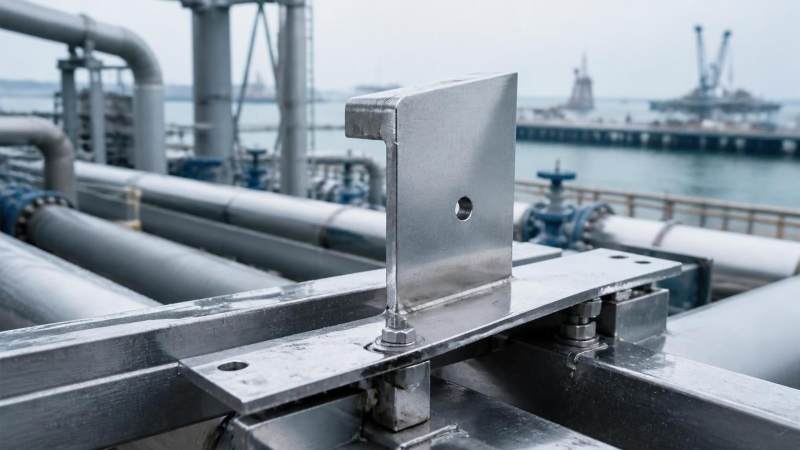
- Geometry: angle sections naturally create inside corners where salts, dirt, and liquid residue can accumulate.
That last point matters more than people think. An equal or unequal angle can become a corrosion pocket if it is installed with the wrong orientation or without drainage consideration. In marine and chemical service, simple design details such as avoiding stagnant traps, allowing rinse-off, and separating incompatible metals often have as much value as stepping up one alloy grade.
Load, thickness, and shape should be reviewed together
Some buyers focus heavily on corrosion grade and then treat the section size as routine. That creates a different kind of risk. Stainless steel angle still has to meet the structural function: supporting loads, resisting local buckling, handling impact or vibration, and fitting connection details without excessive distortion during fabrication.
Angle thickness matters for more than strength. Heavier sections may tolerate fabrication and site handling better, while thinner angles can become vulnerable to deformation, especially after welding or drilling. In corrosive service, section loss over time may also need to be considered depending on the design life and owner criteria.
It is also worth checking whether the angle is doing the right job geometrically. Sometimes a channel, flat bar assembly, or cold formed profile gives better stiffness, drainage, or fastening access than an angle. Good selection work includes asking whether stainless steel angle is the right section type in the first place.
Fabrication compatibility is one of the easiest places to lose performance
This is where many specifications look strong in theory and weak in execution. Stainless steel angle used in demanding environments should be reviewed not only as a mill product but as a fabricated part. Cutting method, weld process, filler compatibility, surface cleaning, passivation, and handling discipline all influence the final result.
If fabricators use tools contaminated by carbon steel, free iron can be transferred to the stainless surface. That may lead to rust staining that looks like stainless failure, even when the base material itself was acceptable. The same applies to weld zones that keep heavy heat tint without proper treatment in chloride-rich service.
For bolted assemblies, hole quality, burr removal, and washer or fastener material should also be checked. Dissimilar metal contact in wet or salty service can create avoidable galvanic issues, especially when stainless is connected to less noble metals without isolation.
In practice, when stainless angle is going into a difficult site, asking the supplier about fabrication controls is not a minor detail. It is part of material selection.
Standards and certification: what to verify before approval
Buyers often request compliance with ASTM, EN, JIS, or GB, but the meaningful question is which part of compliance matters for this order. At minimum, it is sensible to verify material grade, dimensional tolerance, mechanical properties where relevant, heat traceability if required by the project, and inspection documentation aligned with owner expectations.
For global projects, Hongteng Fengda supplies structural steel products including angle steel, channel steel, steel beams, cold formed profiles, and custom structural components with manufacturing aligned to major standards such as ASTM, EN, JIS, and GB. That matters less as a marketing line and more as a sourcing control point: technical evaluators need a supplier that can match the project standard set, maintain batch consistency, and support documentation without delays.
When reviewing quotations, it helps to confirm:
- exact stainless grade and standard designation
- section dimensions and tolerance basis
- surface condition and any finishing requirement
- whether fabrication, drilling, or cutting is included
- inspection documents and traceability level
- packaging and contamination control during shipment
These points prevent a common problem: receiving stainless steel angle that is technically close to the request but not fully aligned with the site requirement.
Coastal sites and chemical sites are not the same decision
It helps to separate the two.
For coastal projects, chloride deposition, humidity cycling, crevice exposure, and washdown frequency usually drive the decision. Here, grade selection, finish quality, and orientation of the angle section are often decisive.
For chemical sites, the first question is what the stainless angle will actually contact: airborne fumes, occasional splashes, concentrated liquid, high-temperature cleaning media, or only general industrial atmosphere. Stainless may be suitable for one zone of a plant and a poor choice for another. That is why experienced evaluators avoid blanket material rules across an entire facility.
Some project teams also use a mixed-material strategy. Structural supports may use stainless angle where corrosion risk is high, while other components use galvanized or coated systems where conditions are less severe and cost pressure is stronger. In broader corrosion-control packages, products such as Hot dipped Galvanized Steel Wire Rope may be considered for appropriate lifting, marine, or utility applications where zinc coating class can be matched to mild, medium, or severe corrosion exposure. That is a separate product family from angle steel, but it shows the right way to think about selection: match the protection system to the actual duty instead of applying one material logic everywhere.
Price is only useful when the service assumptions are clear
Comparing offers for stainless steel angle without aligning grade, finish, fabrication scope, and documentation usually leads to a false price comparison. One supplier may quote raw mill finish sections, another may include cut-to-length fabrication, and another may assume a different grade or tolerance route. The cheaper offer may still become the more expensive one after rework, delayed approvals, or premature corrosion.
For imported structural stainless products, consistency of supply matters as much as unit price. Projects with phased installation, repeat dimensions, or multiple destinations benefit from suppliers that can maintain stable production and specification control. That is especially relevant when angles are part of a larger structural package rather than a one-off local purchase.
Questions worth asking before you finalize stainless steel angle
Before sign-off, I would usually want clear answers to these points:
- What is the actual corrosive driver: salt, chemical splash, vapor, washdown, or contamination sensitivity?
- Is 304 truly sufficient, or is 316 the practical minimum?
- Will the angle geometry trap residue or stay wet for long periods?
- Does the fabrication scope include welding, and if yes, how will post-weld surface condition be controlled?
- Are fasteners, adjoining metals, and supports compatible with the stainless selection?
- What inspection and certification does the project really require?
If these answers are vague, the specification is not finished yet.
Final selection view
The best stainless steel angle for coastal and chemical sites is rarely chosen by dimension tables alone. Good decisions come from matching grade to corrosion mechanism, checking whether the angle section suits the load and drainage conditions, controlling fabrication quality, and sourcing from a supplier that can meet the required standards consistently.
If the project environment is modest, a simpler stainless solution may be enough. If chlorides, chemicals, or difficult maintenance conditions are part of the picture, be more conservative early. That usually costs less than correcting a bad stainless steel angle decision after installation.
FAQ
Is 304 stainless steel angle good enough for coastal use?
Sometimes, but not as a default. In light coastal exposure it may perform acceptably, but for open marine atmospheres, salt spray, or frequent chloride deposition, 316 is often the safer starting point.
Does stainless steel angle need surface treatment after welding?
In many aggressive environments, yes. Weld heat tint and contamination can reduce corrosion resistance, so post-weld cleaning or passivation may be needed depending on the service condition.
Should I always choose the highest stainless grade available?
No. Higher alloy content only makes sense when the site conditions justify it. Overspecifying can waste budget, while underspecifying raises long-term failure risk. The environment should decide.
Is galvanized steel a substitute for stainless steel angle in chemical or coastal projects?
Sometimes in less severe exposure, but not universally. Galvanized systems and stainless systems solve corrosion in different ways, and the right choice depends on the exact environment, design life, and maintenance plan.
Image Placeholder Notes
- : place near the section discussing corrosion traps and geometry; suggested image content: comparison of stainless angle installed with poor drainage versus good drainage in coastal service; alt text: “Stainless steel angle installation details showing drainage and crevice corrosion risk.”
Internal Link Anchor Text Suggestions
- stainless steel angle sizes and grades: product category or specification page
- 304 vs 316 stainless steel for structural use: comparison article
- custom structural steel fabrication: service page
- ASTM and EN structural steel standards: technical resource page
- corrosion-resistant steel solutions for marine projects: application page
External Source Directions
- stainless steel industry association technical guidance on corrosion and grade selection
- ASTM, EN, or JIS standards documentation relevant to stainless structural sections
- chemical compatibility and corrosion reference materials from established stainless producers or engineering institutes
Please give us a message


Please enter what you want to find