For technical evaluators, stainless steel 304 coil remains a widely specified material thanks to its balanced corrosion resistance, formability, and cost efficiency. Yet selecting it for demanding environments requires a clear view of both its practical applications and its performance limits. This article outlines where stainless steel 304 coil delivers reliable value, where caution is needed, and how buyers can assess suitability for industrial and structural use.
Where Does Stainless Steel 304 Coil Perform Best in Real Projects?
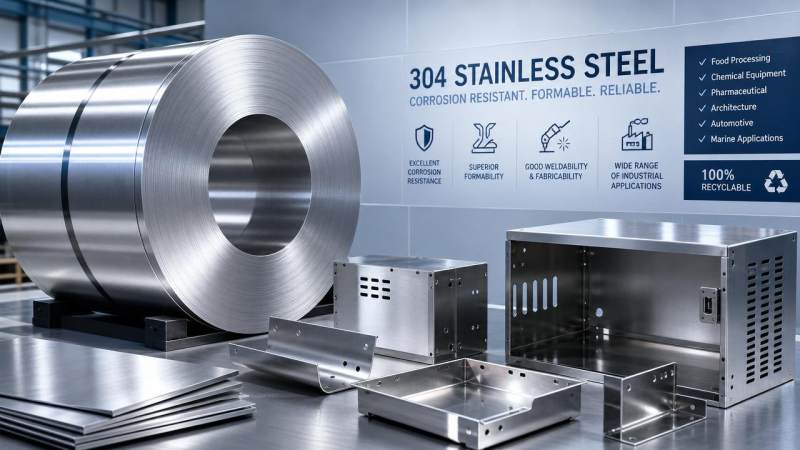
In the steel supply chain, stainless steel 304 coil is often selected when engineers need austenitic stainless material with dependable general corrosion resistance, good weldability, and stable forming behavior. It is commonly used in fabrication environments where performance must be predictable and procurement risk must stay controlled.
For technical evaluation teams, the main advantage is not that 304 solves every corrosion problem. Its value comes from balance. It can support a wide range of indoor, atmospheric, mildly wet, and process-related applications without the higher cost of molybdenum-bearing grades.
Typical application areas
- Food processing equipment, storage tanks, panels, and covers where hygiene, cleanability, and moderate corrosion resistance are needed.
- Architectural trim, cladding accessories, ceiling systems, and decorative industrial surfaces exposed to normal urban or indoor conditions.
- General fabrication for housings, machine covers, ductwork, and formed parts that require reliable bending and welding.
- Light chemical and water-contact applications where chloride concentration and temperature remain within manageable limits.
In export procurement, stainless steel 304 coil is also attractive because it is widely available under ASTM, EN, JIS, and GB systems. That makes cross-market specification alignment easier, especially for buyers comparing Chinese, European, and other international supply sources.
Key Technical Properties of Stainless Steel 304 Coil
Technical evaluators should look beyond the grade name. The performance of stainless steel 304 coil depends on chemical composition control, surface finish, thickness tolerance, coil flatness, and end-use fabrication method. A correct review should combine metallurgical basics with processing requirements.
The table below summarizes the most relevant property areas for procurement screening and design review of stainless steel 304 coil.
For many buyers, these factors matter more than nominal grade alone. A well-produced 304 coil with stable tolerances and good surface consistency often delivers better manufacturing results than a poorly controlled alternative with the same label.
Why fabrication quality matters
Coil users frequently process the material into panels, channels, covers, enclosures, and formed structural accessories. In those cases, edge condition, slit accuracy, and coil shape directly affect scrap rate, welding speed, and assembly fit-up. Technical evaluators should therefore ask for mill test data and practical processing information together.
What Are the Main Performance Limits of Stainless Steel 304 Coil?
The most common mistake in material selection is assuming stainless means universally corrosion-proof. Stainless steel 304 coil performs well in many service conditions, but it does have clear limits. These limits become important in coastal exposure, chloride-rich process areas, elevated temperatures, and highly aggressive cleaning regimes.
Situations that require caution
- Marine and coastal environments with salt deposition can trigger pitting or tea staining, especially on surfaces that are not regularly washed.
- Chloride-bearing water systems and cleaning chemicals can reduce long-term corrosion reliability.
- High-temperature service may affect scaling resistance and dimensional stability, depending on exposure duration and thermal cycling.
- Heavy structural load applications may require separate verification because 304 is usually selected for corrosion and fabrication advantages, not for replacing structural carbon steel sections in primary load-bearing systems.
This is why technical evaluation should be environment-based, not catalog-based. A buyer who understands media composition, temperature, cleaning routine, surface finish, and expected design life will make a better decision than one who compares grades only by price.
304 vs 316 vs Carbon Steel: How Should Evaluators Compare Options?
Many sourcing decisions do not involve stainless steel 304 coil in isolation. Evaluators often compare it with 316 stainless for tougher corrosion conditions or with carbon steel for budget-sensitive structural use. The correct choice depends on corrosion load, fabrication route, appearance expectations, and lifecycle cost.
The comparison table below helps technical teams review stainless steel 304 coil against common alternatives from a practical procurement perspective.
For projects where corrosion demand is moderate but not severe, stainless steel 304 coil often offers the most balanced total value. For primary structural sections or applications where paint systems are acceptable, carbon steel may remain more economical.
In mixed-material procurement, buyers may combine stainless coil for exposed fabricated parts with structural carbon steel products for the load-bearing frame. For example, some projects pair stainless panels or covers with items such as Q195 Carbon Steel Round Bar in non-exposed or budget-sensitive sections, especially where excellent strength, wear resistance, and diameter options from 5-2500mm support construction, railing, furniture, or water-supplying applications under ASTM, EN, JIS, or GB aligned sourcing plans.
How Should Technical Evaluators Screen Suppliers and Coil Specifications?
A reliable stainless steel 304 coil purchase depends on more than price. Technical teams should verify product traceability, specification clarity, and the supplier’s ability to maintain consistency across batches. This becomes even more important in export transactions where rework and delays are costly.
Practical screening checklist
- Confirm the applicable standard system, such as ASTM, EN, JIS, or GB, and make sure the order states thickness, width, finish, and tolerance clearly.
- Review mill test certificates and ask whether chemical composition ranges and mechanical properties are controlled consistently between lots.
- Check surface expectations in detail. A mismatch on finish can create downstream polishing costs, appearance claims, or fabrication issues.
- Ask about coil packaging, rust-prevention handling, edge protection, and shipping method, especially for long transit routes to North America, Europe, the Middle East, or Southeast Asia.
- Verify whether the supplier can support OEM dimensions, slitting, or custom structural integration when the project includes both stainless and structural steel components.
Hongteng Fengda supports this kind of evaluation by combining structural steel manufacturing experience with export-oriented documentation and quality control. For buyers managing multiple categories, that matters because the project rarely involves one product alone. It may include beams, channels, cold formed profiles, and selected stainless materials that must work together in one schedule.
Which Procurement Factors Most Affect Cost, Risk, and Delivery?
When sourcing stainless steel 304 coil, technical and purchasing teams usually face three competing pressures: budget, compliance, and lead time. Choosing the right supply plan means understanding where cost increases are justified and where they are simply avoidable.
The table below highlights key decision factors that influence commercial outcomes for stainless steel 304 coil procurement.
For international buyers, reliable lead times can be as important as unit price. A low-cost coil that arrives late or causes processing losses can quickly become the more expensive option in total project terms.
Common Misconceptions About Stainless Steel 304 Coil
Even experienced teams can make assumptions that weaken procurement results. Clarifying these points early helps avoid unsuitable specifications and later claims.
Misconception 1: 304 is suitable for every outdoor environment
Not always. In inland and moderate urban settings, stainless steel 304 coil may perform well. In coastal or chloride-laden air, a higher grade may be more appropriate depending on exposure, finish, and maintenance frequency.
Misconception 2: If the grade is correct, supplier differences do not matter
Supplier quality still matters a great deal. Surface consistency, tolerance control, packaging, and documentation directly affect fabrication and acceptance. Grade name alone does not guarantee usable material.
Misconception 3: Stainless always replaces carbon steel economically
That depends on function. Stainless steel 304 coil is excellent for corrosion-sensitive fabricated parts, but structural carbon steel often remains more practical for primary support members. Hybrid material planning is common and often cost-efficient.
FAQ: What Do Buyers Most Often Ask Before Ordering?
How do I know whether stainless steel 304 coil is enough for my environment?
Start with the exposure profile: chloride level, humidity, temperature, cleaning agents, and whether the surface will trap deposits. If the environment is mildly corrosive and regularly maintained, 304 is often suitable. If chlorides are persistent, compare 304 with 316 before final approval.
What should be included in a technical inquiry?
A useful inquiry should state grade, standard, thickness, width, finish, quantity, application, forming method, welding demand, certification expectation, destination market, and required lead time. This helps suppliers respond with a practical offer instead of a generic quotation.
Can stainless steel 304 coil be used together with carbon steel components?
Yes, many industrial and construction systems combine both. The key is to define which parts need corrosion resistance, appearance, or hygiene performance, and which parts mainly require structural capacity. Proper detailing is needed to manage joining methods and environmental exposure.
What delivery questions should technical teams ask early?
Ask about production schedule, available stock range, slit or cut-to-length support, export packing, inspection documents, and shipment arrangement. These points affect project sequencing just as much as the material specification itself.
Why Choose Us for Technical Support and Project Sourcing?
Hongteng Fengda serves global construction, industrial, and manufacturing projects as a structural steel manufacturer and exporter from China. Our strength is not limited to supplying standard items. We help buyers coordinate product specifications, structural compatibility, OEM requirements, and export delivery planning across multiple steel categories.
With modern manufacturing facilities and strict quality control, we support procurement teams that need practical answers on ASTM, EN, JIS, and GB aligned supply, stable production capacity, and dependable lead times. This is especially valuable when the project includes beams, channels, cold formed profiles, customized structural parts, and stainless components that must arrive in sync.
What you can discuss with us
- Parameter confirmation for stainless steel 304 coil, including finish, tolerance, and application fit.
- Product selection between stainless and carbon steel solutions for cost-controlled project design.
- Lead time review for mixed orders involving structural sections and fabricated steel components.
- Customized solutions, OEM support, and export documentation requirements.
- Certification expectations, sample support, and quotation planning for international procurement.
If you are evaluating stainless steel 304 coil for an industrial or structural application, contact us with your drawings, service conditions, target standards, and delivery schedule. We can help you narrow the right specification, reduce sourcing risk, and build a more workable steel procurement plan.
Please give us a message


Please enter what you want to find