In power plant engineering, where cyclic thermal loading drives material fatigue and long-term reliability is non-negotiable, selecting the right conduit is critical. A steam line cycling between 150°C and 420°C every eight hours isn’t just testing temperature tolerance—it’s probing microstructural resilience, weld integrity, and residual stress distribution. For technical evaluators responsible for specifying piping systems in fossil, nuclear, or combined-cycle facilities, the choice between stainless seamless pipe and welded alternatives isn’t about cost alone. It’s about predicting failure modes before commissioning, validating design margins against real-world transients, and ensuring compliance—not just on paper, but under decades of thermal hammering.
Let’s start with what’s often overlooked: fatigue in high-temperature stainless piping rarely initiates at the surface. It begins where geometry and metallurgy intersect—especially at welds. In welded stainless pipe, even with post-weld heat treatment (PWHT) and stringent radiographic inspection, the fusion zone introduces three persistent variables: grain coarsening across the heat-affected zone (HAZ), localized hardness gradients, and unavoidable tensile residual stresses. These don’t appear in mill certificates—but they show up clearly in strain-controlled thermal fatigue tests. ASTM E606-compliant experiments simulating 5,000–10,000 thermal cycles reveal that welded 304L and 316L pipes typically exhibit 30–55% lower fatigue life than their seamless counterparts under identical boundary conditions. The gap widens further when internal pressure is superimposed—common in boiler feedwater or reheater bypass lines.
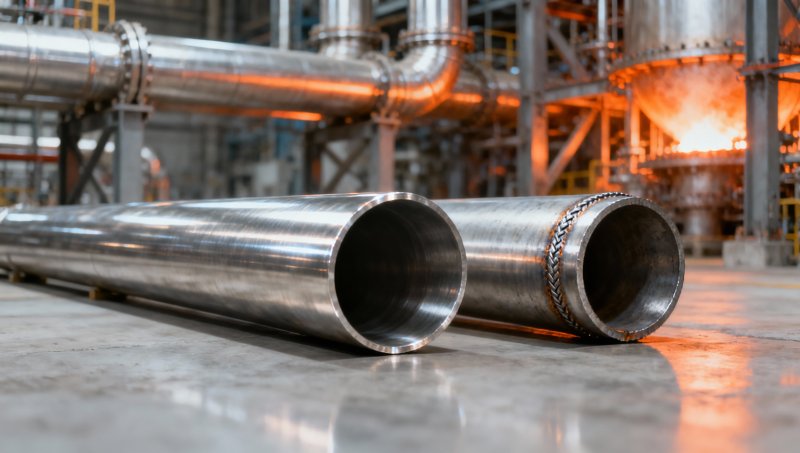
Why does seamless construction hold up better? Because it eliminates the weld seam entirely—not as a theoretical advantage, but as a physical one. Seamless pipe is formed through hot extrusion or cold drawing, preserving uniform grain flow along the longitudinal axis. No filler metal. No dilution zones. No micro-crack nucleation sites from arc instability or shielding gas turbulence. More importantly, seamless tubes undergo full-body solution annealing and pickling, delivering consistent corrosion resistance *and* homogenous ductility—even near fittings or bends where cold work would otherwise localize strain. This consistency matters when thermal expansion mismatches occur between pipe and support structures, or when transient condensation induces thermal shock.
Of course, “seamless” doesn’t automatically mean “fit for purpose.” Not all seamless stainless pipes are created equal. Material traceability, dimensional repeatability, and surface finish directly influence fatigue performance. A ±0.15 mm wall thickness variation may pass EN 10216-5 tolerances—but under cyclic bending, that inconsistency becomes a stress concentrator. Similarly, a poorly controlled draw pass can introduce subtle longitudinal seams or surface laps—defects invisible to the naked eye yet detectable via ultrasonic testing (UT) and quantifiable in fatigue life reduction. That’s why manufacturers like Hongteng Fengda integrate automated dimensional scanning and 100% eddy current inspection into final quality gates—not as a checkbox, but as a fatigue-risk mitigation step.
This attention to process control extends beyond piping. Consider auxiliary components exposed to similar thermal regimes—floor grating around turbine enclosures, walkway treads near exhaust ducts, or anti-skid platforms adjacent to high-temperature valves. Here, structural integrity and slip resistance must coexist without compromising service life. That’s where materials like the SM400A Patterned steel plate demonstrate cross-functional value. Though not a piping solution, its patterned surface—engineered to maintain ≥0.2× substrate thickness height—provides reliable traction even when wet or oily, while its SM400A grade ensures yield strength stability across temperature swings from –20°C to +250°C. Its tight dimensional tolerances (+/–0.02 mm thickness, +/–2 mm width) also reduce field welding complexity during installation—a subtle but meaningful contributor to overall system fatigue reliability.
But back to the core question: how do you translate lab data into field decisions? First, avoid conflating “pressure rating” with “fatigue capability.” ASME B31.1 permits welded stainless pipe for Category D fluid service—but doesn’t prescribe cycle limits for thermal transients exceeding 50°C amplitude. Second, scrutinize the test protocol behind any fatigue claim. Does it simulate actual thermal gradients (not just uniform heating)? Is strain measurement optical or extensometer-based? Are supports modeled realistically—or assumed rigid? Third, consider fabrication consequences. Welded pipe may allow longer shop-fabricated spools, reducing on-site welds—but each girth weld adds a fatigue-sensitive joint. Seamless pipe, by contrast, often requires more field joints—but each joint is a standardized, pre-qualified butt weld with predictable behavior.
There’s also a hidden lifecycle factor: inspection burden. Welded stainless piping demands more frequent non-destructive examination (NDE) over time—particularly phased array UT (PAUT) or time-of-flight diffraction (TOFD) to catch subsurface HAZ cracking. Seamless pipe shifts the focus toward general wall-thinning assessment and external pitting checks—lower frequency, higher confidence intervals. For asset owners managing aging fleets, this translates into fewer unplanned outages and more predictable maintenance windows.
None of this implies welded pipe has no place in power plants. For low-cycling, low-amplitude applications—like instrument air headers or chemical dosing lines—it remains a sound, economical option. But when duty cycles exceed 1,000/year, thermal amplitudes surpass 80°C, or safety-criticality rises (e.g., main steam, reheat, or reactor coolant loops), the fatigue life premium of stainless seamless pipe becomes measurable—not speculative. And that measurability is what enables rational risk allocation: between initial CAPEX, inspection costs, outage scheduling, and ultimate replacement timing.
Hongteng Fengda’s role here isn’t to sell pipe—it’s to supply predictability. As a structural steel manufacturer serving global EPC contractors and utility operators, we engineer stainless seamless pipe not just to meet ASTM A312 or EN 10216-5, but to perform within the scatter band of real fatigue data. Our production includes controlled cooling rates post-annealing, helium leak-tested packaging for moisture-sensitive grades, and batch-level mechanical property reporting traceable to heat number and rolling date. Because in thermal fatigue, the difference between 25,000 and 35,000 cycles isn’t abstract—it’s six months of uninterrupted generation, two avoided forced outages, and one less stress concentration your team won’t need to monitor next spring.
So when your next specification review asks, “Why seamless?”—don’t reach for marketing brochures. Reach for the thermal cycle log from Unit 3’s last startup sequence. Pull the NDE report from last year’s feedwater heater isolation valve. Compare the strain map from your FE analysis against published crack propagation rates for 316L HAZ versus base metal. Let the numbers speak—not the sales pitch. That’s how fatigue life stops being an estimate and starts becoming an engineered parameter.
And if you’re evaluating supporting infrastructure—grating, platforms, access covers—remember that fatigue doesn’t discriminate by component type. It follows stress, temperature, and time. Which is why choosing a partner who understands both piping metallurgy *and* structural integration—like Hongteng Fengda—means aligning material behavior with system behavior. Not just for today’s spec sheet, but for the 30th thermal cycle—and the 30,000th.
Please give us a message


Please enter what you want to find