Choosing the right stainless coil tubing size and bend radius is critical for performance, safety, and cost control in industrial and structural applications. For technical evaluation, dimensions and bending limits directly affect installation, pressure capacity, and long-term reliability. This guide explains how to assess stainless coil tubing with practical criteria, common mistakes, and project-focused recommendations.
What does stainless coil tubing size actually include?
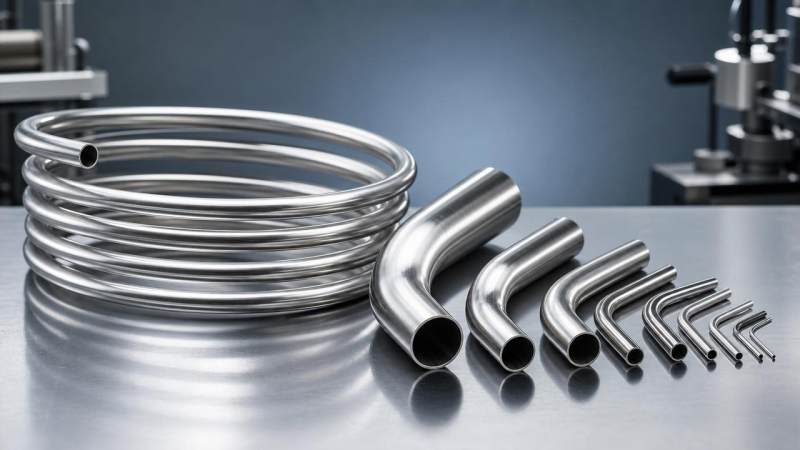
When engineers discuss stainless coil tubing, size means more than outside diameter. It usually includes outside diameter, wall thickness, coil length, and sometimes inside diameter.
Outside diameter affects flow rate, fitting compatibility, and routing space. Wall thickness influences burst strength, vacuum resistance, and bend behavior during installation.
A small change in wall thickness can significantly change the safe bend radius. Thicker walls resist collapse better, but they also increase weight and material cost.
Common stainless coil tubing sizes are often specified in inches or millimeters. Typical ranges include 1/8 inch to 1 inch outside diameter for industrial use.
For structural and process projects, buyers should also confirm tolerance. Dimensional consistency matters because fittings, supports, and automated bending tools depend on predictable geometry.
- Outside diameter: affects connection and flow
- Wall thickness: affects pressure and bendability
- Coil length: affects installation efficiency
- Tolerance: affects sealing and repeatability
If the application involves long continuous runs, stainless coil tubing can reduce joint count. Fewer joints often mean lower leakage risk and faster field installation.
How is bend radius defined for stainless coil tubing?
Bend radius is the minimum radius a tube can take without unacceptable flattening, wrinkling, cracking, or flow restriction. It is usually measured to the centerline of the tube.
For stainless coil tubing, bend radius depends on material grade, wall thickness, outside diameter, hardness, and bending method. Manual bending and machine bending do not always give the same result.
A tighter bend saves space, but it raises forming stress. If the bend is too aggressive, tube ovality increases and pressure performance may be reduced.
As a basic rule, larger outside diameters need larger bend radii. Thin-wall tubing also needs more careful control because it collapses more easily during forming.
Project documents should never rely on guesswork. Always request the recommended minimum bend radius from the supplier for the exact stainless coil tubing specification.
How do you choose the right stainless coil tubing for an application?
Start with service conditions. Pressure, temperature, fluid type, corrosion exposure, and routing complexity all influence the correct stainless coil tubing size.
For instrumentation lines, compact size and clean bends are often more important than very high flow capacity. For hydraulic or process lines, pressure resistance may become the first filter.
Installation environment also matters. Tight equipment layouts may require smaller stainless coil tubing or larger routing clearance to respect bend radius limitations.
If vibration is present, do not only look at dimensions. Support spacing, clamp design, and bend placement can strongly influence service life.
In steel-related fabrication, upstream material capability also supports downstream tubing performance. Midstream supply chains often combine tubing with coil-based raw materials and formed steel products.
For example, Rolled Coil can support broader manufacturing needs in boiler plate and formed steel processing.
This carbon steel solution covers grades such as Q235, Q235B, Q345, St37, and St52.4, with standards including ASTM, DIN, JIS, AiSi, and GB/T 700-2006.
Its good weldability and cold working properties make it useful where bending, stamping, forging, or hot rolling are required in connected steel systems.
- Check pressure and corrosion requirements first
- Match tube size to routing space and fittings
- Confirm the minimum bend radius before ordering
- Review tolerances for automated or repeat bending
- Consider total installed cost, not unit price only
What are the common mistakes when specifying stainless coil tubing?
One common mistake is selecting stainless coil tubing only by outside diameter. Without wall thickness, pressure rating and bend performance remain incomplete.
Another mistake is assuming all stainless grades bend the same way. Material condition and manufacturing quality can change the acceptable bend radius.
Some projects ignore springback. After bending, stainless tubing tends to recover slightly. That behavior can affect dimensional accuracy in compact layouts.
Poor handling during transport is another hidden risk. If coils are damaged before fabrication, local flattening can create stress points and reduce service life.
It is also risky to over-tighten bends to save space. A smaller envelope may look efficient, but flow restriction and fatigue risk can become expensive later.
Finally, many buyers forget to align tubing with end connections. Stainless coil tubing must match ferrules, compression fittings, and installation tooling exactly.
Quick warning signs
- No defined wall thickness in the drawing
- No supplier data for minimum bend radius
- No tolerance requirement for critical assemblies
- No review of vibration or pulsation conditions
- No inspection plan for incoming coils
How do size and bend radius affect cost and project timing?
The cheapest stainless coil tubing is not always the lowest-cost choice in service. Underspecified tubing can increase scrap, rework, downtime, and leakage risk.
Larger diameters and thicker walls usually cost more per meter. However, they may reduce failure risk and improve pressure margin in demanding systems.
Tighter bend requirements can increase fabrication cost. Special tools, slower bending speeds, and more inspection may be needed to keep geometry within limits.
Lead time can also change with specification complexity. Custom lengths, strict tolerances, and nonstandard coil dimensions often require extra production planning.
Good early specification reduces these delays. When stainless coil tubing details are clearly defined, approval, production, and installation all move more smoothly.
What is a practical checklist before ordering stainless coil tubing?
A simple checklist can prevent technical mismatch. It also improves communication between design, sourcing, and fabrication teams.
Pre-order checklist
- Confirm outside diameter and wall thickness
- State required material grade and standard
- Define pressure and temperature conditions
- Request minimum bend radius data
- Confirm coil length and dimensional tolerances
- Match tubing with fittings and installation tools
- Ask about inspection, packaging, and traceability
This checklist helps ensure the selected stainless coil tubing will fit the layout, survive service conditions, and avoid costly field corrections.
Stainless coil tubing performs best when size, wall thickness, and bend radius are evaluated together. A balanced decision supports safety, ease of installation, and total lifecycle value.
For steel supply projects that require dependable manufacturing support, clear standards, and customized solutions, early technical confirmation is the best next step.
Please give us a message


Please enter what you want to find