Spangle Sizes on Galvanised Sheet Steel: Aesthetic vs. Functional
The Metallurgical Reality Behind Surface Appearance
When specifying galvanised sheet steel for structural or architectural projects, technical evaluators often treat the spangle size as a purely visual choice. This assumption can lead to severe downstream issues in fabrication and finishing. The size of the spangle—ranging from large regular patterns to completely spangle-free surfaces—is not merely a cosmetic finish. It is a direct visual indicator of the cooling rate and the chemical composition of the zinc bath, which fundamentally dictates the microstructure, coating uniformity, and mechanical behavior of the zinc layer. The initial judgment for material selection is straightforward: if the component requires complex forming or subsequent painting, large regular spangles introduce functional liabilities that minimal or zero spangles do not. Conversely, if the steel will remain unpainted and exposed in an industrial or agricultural setting, regular spangle provides a specific aesthetic that is functionally acceptable. Understanding the metallurgical mechanics behind these finishes is essential for aligning material procurement with actual engineering requirements.Coating Uniformity and Grain Boundary Dynamics
Regular spangle is formed when the galvanised sheet cools relatively slowly, allowing zinc crystals to nucleate and grow into large, visible dendritic patterns. This slow cooling is often achieved by adding elements like lead, antimony, or bismuth to the zinc bath, which promote crystal growth. The functional consequence of this large crystal structure is macroscopic variation in coating thickness. The center of each spangle crystal is typically thicker, while the grain boundaries—the lines where the crystals meet—are significantly thinner. In corrosive environments, these thinner grain boundaries are the first points of failure. Once the zinc at the boundary is consumed, the underlying steel is exposed, leading to localized rust formation that can spread beneath the surrounding zinc layer. Minimal and zero spangle finishes are produced by accelerating the cooling rate immediately after the sheet exits the zinc bath, or by using specialized bath chemistries that suppress crystal growth. This rapid solidification prevents the formation of large dendrites, resulting in a uniform, matte, or smooth surface. The coating thickness remains highly consistent across the entire surface, eliminating the vulnerable thin grain boundaries and providing a more predictable, uniform barrier against corrosion.Formability and Fabrication Limitations
The physical topography of the zinc layer directly impacts how the steel behaves during fabrication. When galvanised sheet steel undergoes deep drawing, bending, or roll forming, the zinc coating is subjected to severe mechanical stress. On regular spangle products, the large, distinct crystals create a uneven surface topography. During forming, the friction between the die and the sheet is inconsistent. More critically, the brittle zinc-iron alloy layer beneath the pure zinc can fracture at the grain boundaries. As the steel deforms, these fractures propagate, causing the zinc to flake off or powder. This flaking not only ruins the surface finish but can also embed hard zinc particles into the forming dies, accelerating tool wear and causing surface defects on subsequent parts. Minimal and zero spangle coatings possess a much finer, more uniform microstructure. The absence of large grain boundaries means the coating deforms more plastically with the underlying steel substrate. This significantly reduces powdering and flaking during complex stamping or roll forming operations, ensuring better dimensional accuracy, preserving the integrity of the corrosion protection, and extending the life of fabrication tooling.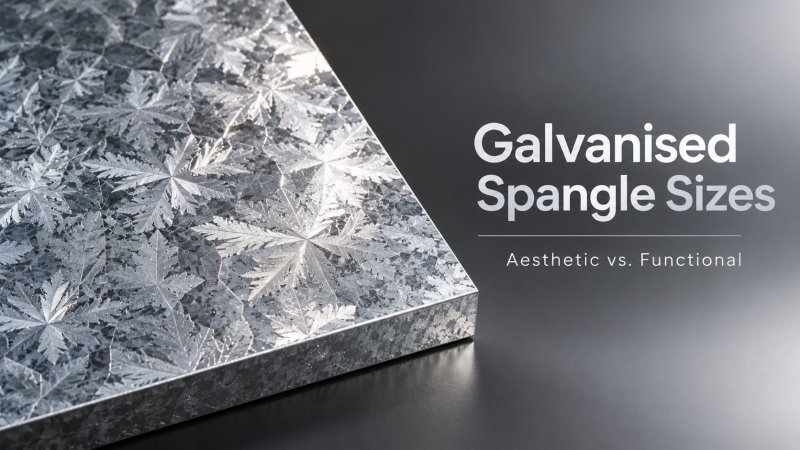
Paint Adhesion and Surface Preparation
For architectural applications where galvanised steel must be painted to match specific color schemes or provide additional chemical resistance, the spangle size becomes a critical factor in coating adhesion. Applying paint directly over regular spangle is highly problematic. The smooth, pure zinc surface of the large crystals offers poor mechanical keying for paint resins. Furthermore, the visible spangle pattern will often "telegraph" through the paint film, creating an uneven, wavy visual defect that is unacceptable in high-end architectural finishes. To achieve proper adhesion, regular spangle surfaces require aggressive surface preparation, such as sweep blasting or the application of specialized wash primers, to physically abrade the smooth zinc and create a profile for the paint to grip. This adds significant time and cost to the fabrication process. Zero spangle galvanised sheet steel is the industry standard for pre-painted or post-painted applications. The fine, uniform surface provides an ideal, consistent substrate for chemical pre-treatments (like phosphating or chromating) and subsequent paint adhesion. The absence of large crystal boundaries prevents the telegraphing effect, ensuring a perfectly smooth final painted surface.Evaluating Material Alternatives for Extreme Requirements
There are scenarios where the functional limits of galvanised coatings are reached, regardless of the spangle size. In highly corrosive environments, or in applications demanding pristine, uncoated aesthetics where painting is not an option, technical evaluators must look beyond zinc-coated carbon steel. For instance, in sectors such as food processing, medical facilities, or high-end residential decoration where surface finish, hygiene, and extreme corrosion resistance are paramount, the galvanising process itself may be incompatible with the design intent. In such cases, the material selection shifts to bare corrosion-resistant alloys. A common benchmark in these specific industrial piping systems or structural frameworks is the 304 Stainless steel pipe, which offers excellent mechanical properties and workability without relying on a secondary zinc coating. Recognizing when to pivot from optimised galvanised products to inherently corrosion-resistant materials is a key part of the technical evaluation process.Decision Framework for Technical Evaluators
Selecting the correct spangle size requires mapping the material properties against the specific lifecycle of the component. The following framework can guide the specification process:- Unpainted, Exposed Structural or Roofing Applications: Regular spangle is generally acceptable. The functional requirement is basic barrier protection, and the large crystalline pattern is often desired for its traditional industrial aesthetic. Ensure the specified coating mass (e.g., Z275) is sufficient for the local atmospheric corrosivity, keeping in mind the localized thinning at grain boundaries.
- Complex Formed or Deep Drawn Components: Specify minimal or zero spangle. The uniform coating thickness and fine microstructure are necessary to prevent flaking, powdering, and die wear during severe deformation. Regular spangle will likely result in high rejection rates during fabrication.
- Painted Architectural or Structural Elements: Zero spangle is mandatory for any application requiring a high-quality painted finish. It eliminates the need for aggressive mechanical surface preparation, prevents the telegraphing of the zinc pattern through the paint, and ensures maximum adhesion and long-term durability of the topcoat.
- Welded Assemblies: While spangle size has a secondary effect on welding compared to coating thickness, zero or minimal spangle products often provide a more consistent surface for automated welding processes, reducing the variability in burn-off and porosity caused by the uneven pure zinc layer of regular spangles.
Previous page: Already the first one
Next page: Already the last one
Please give us a message


Please enter what you want to find