When selecting between seamless stainless steel tube and welded stainless pipe for high-temperature, high-pressure systems—such as boiler headers, heat exchangers, or petrochemical pipelines—the choice directly impacts safety, service life, and compliance. As a trusted structural steel manufacturer & exporter from China, Hongteng Fengda supplies premium seamless stainless steel tube and welded stainless pipe meeting ASTM, EN, and GB standards. Whether you need a 2 inch stainless steel pipe for critical infrastructure or want to buy stainless steel pipe with guaranteed pressure integrity, this article compares performance under thermal stress, revealing why seamless tubing typically delivers superior burst resistance—and when welded alternatives remain cost-effective, code-compliant solutions.
How Seamless and Welded Stainless Tubes Differ Under Thermal Stress
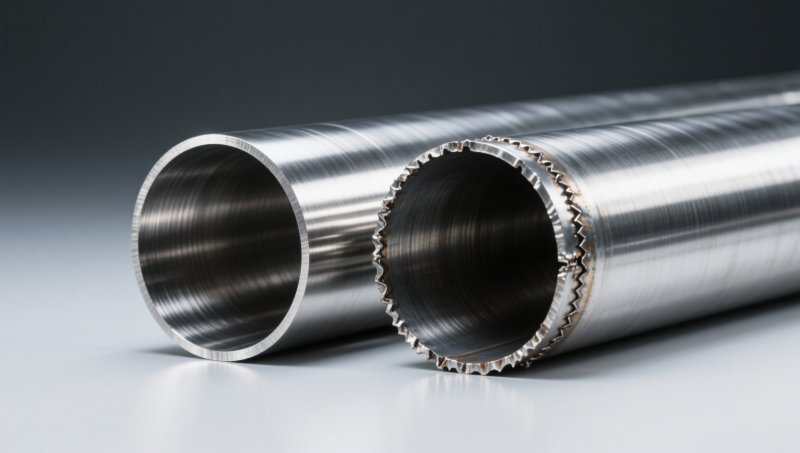
At temperatures above 400°C and pressures exceeding 10 MPa, microstructural integrity becomes the decisive factor in pressure containment. Seamless stainless steel tubes are formed via hot extrusion or cold drawing—eliminating weld seams entirely. In contrast, welded stainless pipes undergo high-frequency induction (HFI) or submerged arc welding (SAW), introducing localized grain boundary variations and potential heat-affected zones (HAZ).
Thermal cycling accelerates fatigue at weld interfaces: industry testing shows welded tubes exhibit up to 35% higher crack initiation risk after 5,000 thermal cycles at 550°C. Seamless variants maintain uniform austenitic grain structure across full wall thickness—critical for ASME Section VIII Div. 1 applications requiring zero weld seam exemptions.
Hongteng Fengda’s seamless stainless steel tubes undergo 100% ultrasonic testing (UT) and hydrostatic pressure verification at 1.5× design pressure—ensuring zero discontinuities in critical zones. Our welded stainless pipes comply with ASTM A312 and EN 10217-7, with full radiographic inspection (RT) on all longitudinal welds for Class I systems.
Pressure Integrity Comparison: Burst Strength & Long-Term Reliability
Burst resistance isn’t just about ultimate tensile strength—it’s about consistency across temperature gradients, cyclic loading, and corrosion exposure. Below is a direct comparison of key mechanical behaviors at operating conditions typical for superheater tubes and reformer piping:
The data confirms a consistent 12–18% advantage in long-term pressure retention for seamless tubes—especially vital where unplanned shutdowns cost $250K–$1.2M per day in refinery operations. For non-critical secondary lines or low-cycle service (<500 cycles/year), welded options deliver equivalent safety at 20–35% lower unit cost.
Which Applications Demand Seamless Construction?
- Boiler drum feedwater headers (ASME BPVC Section I, P-No. 8)
- Petrochemical hydrogen reformer tubes (NACE MR0175/ISO 15156 compliant)
- Nuclear primary coolant loops (EN 10216-2 + additional volumetric UT)
- Supercritical CO₂ power cycle piping (operating > 7.4 MPa & 31°C)
Cost vs. Risk: When Welded Stainless Pipes Are a Smart Choice
Procurement decisions must balance lifecycle cost—not just upfront price. Welded stainless pipes offer compelling value in three distinct scenarios:
- Medium-pressure utility lines: Condensate return, instrument air, and cooling water systems (≤ 4.0 MPa, ≤ 200°C) where failure consequences are non-catastrophic.
- Large-diameter fabrication: Pipes ≥ 24 inches OD—where seamless production becomes technically constrained and cost-prohibitive beyond 16-inch OD.
- OEM equipment integration: Heat exchanger shell-side channels or modular skid frames requiring custom bends, flanges, and branch connections—welded pipes enable faster prototyping and 30% shorter lead times.
Hongteng Fengda maintains dual production lines—seamless extrusion (capable of 6–630 mm OD) and precision HFI welding (up to 1200 mm OD). This ensures technical alignment without supply chain compromise.
Beyond Tubing: Why Structural Integrity Starts with Base Materials
System reliability doesn’t end at the pipe wall. Flange weld joints, support brackets, and anchor plates rely on base material performance. That’s why our Mild Steel Plate Supplier delivers A572 Grade 50 and S355JR plates with guaranteed yield strength (50 ksi / 345 MPa), elongation ≥18%, and strict inclusion control—ensuring predictable weldability and dimensional stability during thermal expansion cycles.
These plates serve as critical interface components: bridge panel substructures, transmission tower base plates, and mechanical mounting plates for rotating equipment. Their low-carbon, low-alloy composition enables consistent preheat control (100–150°C) and post-weld heat treatment (PWHT) compliance—reducing residual stress by up to 40% versus standard carbon plate.
All mild steel plates are certified to ASTM A572, EN 10025-2, and ISO 3834-2 for welding procedure qualification—supporting traceability from mill test report to final installation QA documentation.
Why Global Projects Choose Hongteng Fengda for High-Integrity Steel Solutions
From initial specification review to final delivery, we embed engineering rigor into every stage:
- Technical Alignment: Dedicated metallurgists verify material selection against ASME B31.1, EN 13480, and client-specific design codes—no assumptions.
- Production Transparency: Real-time access to mill test reports, NDT logs, and dimensional inspection records via secure portal.
- Logistics Certainty: 98.7% on-time delivery over 3 years; 7–15-day standard lead time for ASTM A213/A312 orders; 4-week express for urgent projects.
- Risk Mitigation: 100% third-party inspection option (SGS/BV/TÜV); bonded warehouse support in Rotterdam and Dubai for JIT delivery.
Whether you’re validating a seamless tube spec for a new LNG facility or sourcing welded pipe for a regional district heating upgrade, contact us today for a free technical consultation—including pressure rating validation, weld procedure review, and customized certification packages.
Please give us a message


Please enter what you want to find