Seamless CS pipe tolerances aren’t universal—they vary significantly by mill, standard (ASTM A106, EN 10216), and production process. Whether you’re sourcing industrial galvanized pipe, electrical galvanized pipe, or carbon steel pipe A106 for critical infrastructure, mismatched tolerances can derail project timelines, compromise weld integrity, or trigger costly rejections. As a trusted carbon steel pipe manufacturer and galvanised steel pipe supplier, Hongteng Fengda helps procurement teams, engineers, and project managers align specs with actual mill capabilities—ensuring seamless CS pipe, coated steel pipe, and galvanized steel conduit meet both design intent and international compliance (ASTM/EN/GB). Let’s clarify why ‘as-specified’ isn’t always ‘as-delivered’.
Why Seamless CS Pipe Tolerances Differ Across Mills
Tolerance variation in seamless carbon steel (CS) pipe is not an anomaly—it’s an engineered reality. Each mill applies distinct rolling, heat treatment, and finishing protocols governed by equipment age, calibration frequency, and operator expertise. For instance, mills operating under ASTM A106 Grade B typically hold OD tolerance within ±0.75% for pipes ≥168.3 mm, while EN 10216-2 compliant producers may specify ±1.0% for identical dimensions. That seemingly small 0.25% delta translates to ±1.7 mm on a 680 mm OD pipe—enough to prevent flange alignment or exceed groove fit-up allowances in ASME B31.4 pipeline welding.
Moreover, wall thickness tolerance bands diverge sharply: ASTM A106 permits –12.5% minimum wall (i.e., a 10 mm nominal wall may measure as low as 8.75 mm), whereas EN 10216-2 restricts it to –10.0% under certain heat treatment conditions. These differences are not arbitrary—they reflect regional safety philosophies, historical failure data, and infrastructure load expectations.
Hongteng Fengda maintains dual-certified production lines calibrated against both ASTM and EN reference standards. Our QA team performs 100% ultrasonic testing (UT) and hydrostatic pressure verification per batch, with traceable mill test reports (MTRs) issued for every shipment. This ensures that when your specification calls for “ASTM A106 Gr. B, OD 219.1 mm ±0.75%, WT 8.2 mm –12.5%”, what arrives matches the intended engineering envelope—not just the nominal label.
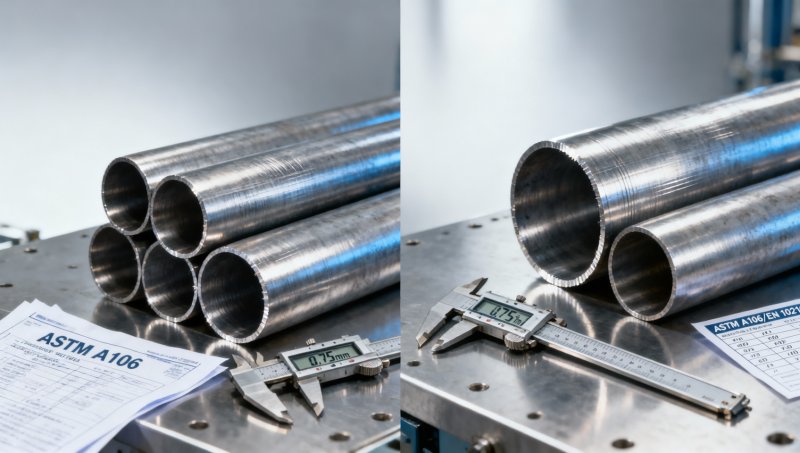
How Standards Shape Real-World Tolerance Acceptance
Standards define *permissible* tolerance ranges—but acceptance depends on application context. A 200 mm OD seamless pipe used in non-pressure structural bracing (e.g., crane jib supports or mining truck frames) may tolerate ±1.2% OD variance without functional impact. In contrast, same-dimension pipe routed through a high-pressure steam manifold in a power plant must conform to tighter, certified bands—often requiring third-party inspection per ISO 17020 before installation.
Below is a comparative summary of key tolerance parameters across three widely adopted standards:
This table reveals a critical insight: no single “tightest” standard universally applies. Selection hinges on end-use requirements—not just certification checkboxes. For example, EN 10216-2’s looser OD band may be acceptable for buried district heating conduits where thermal expansion compensates minor misalignment, but its stricter wall allowance makes it preferable for cyclic-load applications like hydraulic support columns in coal mines.
Procurement Best Practices to Avoid Tolerance Mismatches
Procurement professionals often treat tolerance clauses as boilerplate—until dimensional non-conformance triggers rejection. To prevent this, adopt these five evidence-based practices:
- Specify *functional* tolerances—not just standard references. Example: “OD tolerance shall not exceed ±1.0 mm at any point along length, verified via laser micrometer per ISO 1101.”
- Require pre-shipment dimensional reports with at least 3 measurement points per 3-meter pipe length.
- Define acceptance criteria for straightness and ovality separately—especially for large-diameter (>406 mm) pipe used in field welding.
- Align mill certifications with project jurisdiction: North American projects demand ASTM-compliant MTRs; EU tenders require EN 10204 3.2 declarations.
- Engage your supplier early in design review—Hongteng Fengda offers free technical consultation to validate spec feasibility before PO issuance.
For structural applications demanding high-strength flat stock, our Carbon Steel Sheet Plate meets GB/T1591 Q345A (16Mn) with guaranteed tensile strength ≥470 MPa and elongation ≥21%. Its composition—C: 0.15–0.19%, Mn: 1.20–1.50%, V: 0.015–0.030%—ensures optimal weldability and fatigue resistance in excavators, bulldozers, and hydraulic roof supports.
When to Choose Mill-Specific Tolerance Validation
Not all projects require custom tolerance validation—but certain scenarios make it non-negotiable. Consider mandating mill-specific verification if:
- Your piping system operates above 350°C or below –29°C (requiring notch toughness validation per ASTM A370).
- Welding will occur in-field using automated orbital GTAW, where root gap consistency depends on precise ID/OD concentricity.
- The pipe integrates into seismic-rated structures (e.g., ASCE 7-22 Category IV), where cumulative dimensional variances affect load path modeling.
- You’re consolidating multiple pipe sizes under one contract—mill capability varies more across diameters than grades.
At Hongteng Fengda, we offer optional third-party witnessed dimensional audits (SGS/BV) for orders exceeding 50 metric tons. Lead time impact is minimal—just 3–5 working days—and eliminates post-delivery disputes. Our typical delivery window for seamless CS pipe remains stable at 25–35 days after confirmed L/C or TT, regardless of order size.
FAQ: Tolerance Alignment in Global Sourcing
How do I verify if my supplier’s tolerance claims are mill-validated?
Request their latest mill certificate showing actual measured values—not just “conforms to ASTM A106”. Cross-check reported OD/WT against your purchase order’s acceptance criteria. At Hongteng Fengda, all MTRs include raw UT scan logs and hydrotest records traceable to furnace lot numbers.
Can I request tighter tolerances than standard allows?
Yes—within mechanical feasibility limits. For example, we routinely supply ASTM A106 pipe with ±0.5% OD tolerance (vs. standard ±0.75%) for premium OEM clients. Additional cost is typically 8–12%, offset by reduced field rework.
What’s the most common cause of tolerance-related rejection?
Misaligned specification language. Example: writing “ASTM A106 Gr. B, OD 273.1 mm ±0.75%” without clarifying whether tolerance applies to hot-finished or cold-drawn condition—resulting in a 2.0 mm vs. 1.2 mm allowable variance difference.
Conclusion: Precision Starts Before the First Mill Roll
“As-specified” only equals “as-delivered” when specifications reflect real-world mill capability—not theoretical ideals. Seamless CS pipe tolerance variance is neither a quality flaw nor a compliance loophole—it’s a design parameter requiring proactive alignment between engineering intent, standard frameworks, and manufacturing reality. Hongteng Fengda bridges that gap through dual-standard production lines, full-traceable documentation, and collaborative engineering support tailored for global infrastructure, mining, and heavy machinery sectors.
Whether you’re specifying pipe for offshore platforms or sourcing Carbon Steel Sheet Plate for mining truck chassis, our team helps translate complex tolerance requirements into executable, auditable deliverables—without compromising lead time, cost control, or regulatory confidence.
Contact Hongteng Fengda today to request a free tolerance alignment review for your next structural steel or seamless pipe order.
Please give us a message


Please enter what you want to find