When evaluating ss304 pipe price, buyers compare more than a unit rate. They assess chemistry, tolerance, finish, certification, and service life. In steel projects, a lower quote can hide higher downstream risk.
For construction, industrial fabrication, and export supply, understanding grade specs explains what you are really paying for. It also helps control total cost, reduce replacement risk, and improve fit-for-purpose sourcing decisions.
Why ss304 pipe price changes across real project scenarios
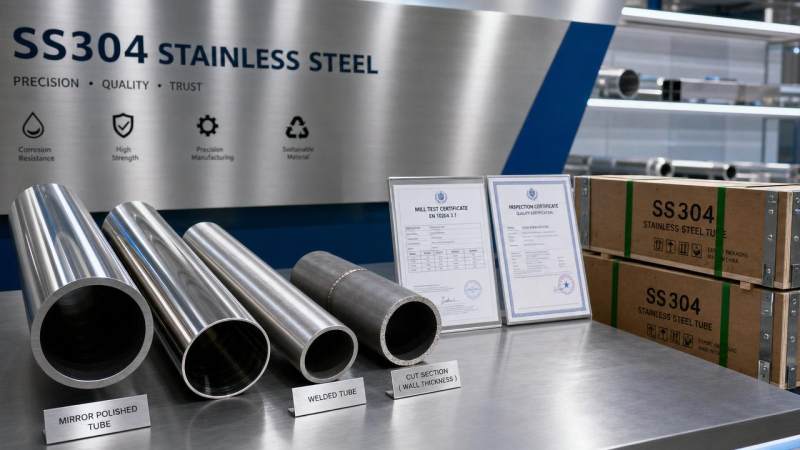
The same nominal SS304 pipe may carry very different costs. The reason is simple: application conditions are not the same, and neither are quality expectations.
A decorative tube for visible architecture needs a different finish from a process line. A structural support tube may need dimensional consistency more than mirror polish.
Because of this, ss304 pipe price should be judged by use case. Grade compliance alone does not define value. Processing stability, welding behavior, and inspection scope also affect cost.
Scenario one: structural and support applications
In structural frames, brackets, or support assemblies, buyers focus on wall thickness accuracy, straightness, and reliable mechanical performance. These factors influence fabrication efficiency and assembly quality.
Here, a very low ss304 pipe price can create hidden waste. Inconsistent thickness may increase cutting loss, welding correction time, and fit-up errors on site.
Scenario two: industrial fluid or process systems
For industrial lines, chemical composition, internal cleanliness, and pressure-related tolerance become more important. A pipe that meets basic appearance needs may still fail process expectations.
In this setting, ss304 pipe price often rises with tighter inspection, traceability, and documentation. Material test reports and standard compliance add real value, not just paperwork.
Scenario three: export orders with standard matching
Export projects usually require ASTM, EN, JIS, or GB alignment. Cost differences often come from certification readiness, packaging standards, marking rules, and batch consistency.
A competitive ss304 pipe price for export must include compliance confidence. If documents, labeling, or dimensions fail destination requirements, logistics savings disappear quickly.
What grade specs are you actually paying for
The market often discusses SS304 as if it were one simple item. In reality, price moves with a package of technical variables that affect performance and production cost.
Chemical composition stability
Nickel and chromium balance matters. Stable composition improves corrosion resistance and weld behavior. Better raw material control usually supports a firmer ss304 pipe price.
Dimensional tolerance and wall consistency
Outer diameter accuracy and wall thickness consistency directly affect installation and forming. Tight tolerance production needs better equipment and more inspection, which increases cost.
Surface finish level
Pickled, polished, brushed, or mirror finishes do not carry the same processing burden. When appearance matters, finish quality becomes a visible part of ss304 pipe price.
Manufacturing route and testing scope
Welded and seamless pipes differ in production cost. Added tests such as PMI, hydrostatic testing, or third-party inspection also change the final offer.
In many mixed-material projects, stainless tubes are only one part of the steel package. Structural systems may also require reinforcing materials such as HRB500 Rebar for high-load zones.
That product range covers models including HPB300, HRB400, HRB500, and seismic grades. It is used in super high-rise buildings, bridges, and heavy-duty industrial plants.
With sizes from φ6 to φ50 and standards such as ASTM, DIN, GB, and JIS, it supports broader steel package coordination when stainless pipe supply links with structural work.
How application needs create different ss304 pipe price expectations
A useful quote is not the cheapest one. It is the one aligned with service conditions, fabrication method, and compliance level. The table below shows how requirements shift by scenario.
This is why comparing ss304 pipe price without application context often leads to the wrong conclusion. A lower base price may mean reduced inspection, looser tolerance, or lower finish control.
How to judge whether a quoted ss304 pipe price is reasonable
The best way to evaluate price is to break the offer into measurable checkpoints. This makes supplier comparison more technical and less subjective.
- Confirm exact standard, size range, thickness, and length tolerance.
- Check whether the quote is for welded or seamless pipe.
- Ask about finish type, protective packing, and marking method.
- Verify test certificates, heat number traceability, and inspection scope.
- Review mill capability for stable repeat orders and export packing.
If these points are unclear, the quoted ss304 pipe price is incomplete. Incomplete quotes usually create change orders, delays, or quality disputes later.
A practical price evaluation formula
Think in terms of total delivered value. Include purchase price, fabrication loss, rework probability, compliance risk, and expected service life. This gives a better sourcing benchmark.
Common mistakes when comparing SS304 pipe offers
The most common mistake is treating all SS304 material as identical. Similar labels can still hide major differences in production quality and inspection depth.
- Comparing polished tube with unpolished industrial tube.
- Ignoring wall tolerance while focusing only on outer diameter.
- Overlooking export documentation and destination compliance rules.
- Accepting unclear certification language in the quotation.
- Choosing the lowest ss304 pipe price without checking batch stability.
Another frequent issue is underestimating logistics and packaging. Thin-wall stainless pipes can be damaged during transport, and poor packing can erase any initial savings.
Scenario-based sourcing advice for better value
For visible architectural work, prioritize finish samples and protective packaging. For fabrication projects, request dimensional reports. For export orders, validate standard documents before production.
For industrial use, ask for chemistry control, testing records, and welding suitability. In each case, the right ss304 pipe price is the one matched to actual performance needs.
A reliable structural steel supplier can support this process by combining stable production, international standard familiarity, and custom supply coordination across steel categories.
That matters when projects involve stainless pipe, structural sections, and reinforcing products in one schedule. Consistent quality control reduces sourcing complexity and helps keep timelines predictable.
Final takeaway: what are you paying for
In the end, ss304 pipe price reflects technical certainty. You are paying for grade stability, dimensional accuracy, finish quality, inspection confidence, and lower execution risk.
A meaningful comparison starts with the application scenario, then moves to specs, testing, and delivery details. That approach turns price review into a smarter steel sourcing decision.
If a project requires SS304 pipe with clear standard matching, export-ready documentation, and coordinated structural steel support, the next step is to confirm drawings, service conditions, and required certifications before quotation.
Please give us a message


Please enter what you want to find