Confused by the wild fluctuations in SS steel pipe price? You're not alone—factors like surface finish (e.g., BA, 2B, No. 4), grade (304 vs. 316), wall thickness, and certification (ASTM A312, EN 10312) dramatically impact stainless steel pipe price, seamless steel pipe cost, and even galvanized steel conduit alternatives. As a trusted structural steel manufacturer & exporter from China, Hongteng Fengda helps procurement teams, project managers, and technical evaluators cut through the noise—delivering transparent pricing grounded in real production specs, not just market volatility. Whether you're comparing steel bar price vs. rebar for foundation or evaluating stainless steel sheet price for cladding, understanding what actually moves the needle is your first step toward smarter sourcing.
Why Surface Finish Is the #1 Price Driver—Not Just Grade or Thickness
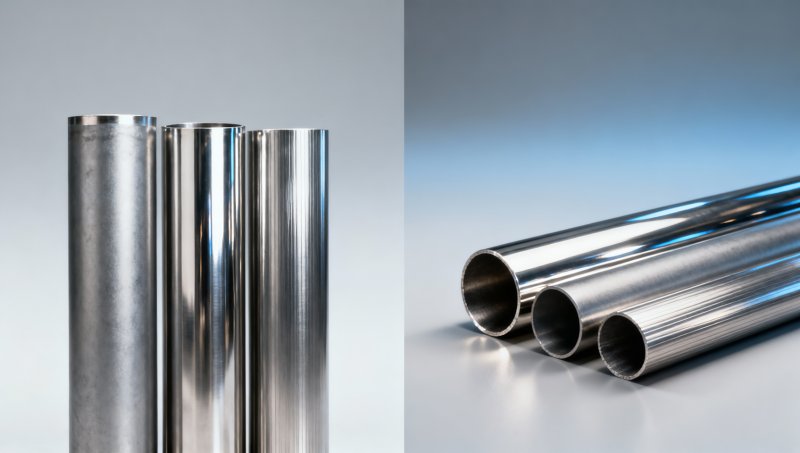
Most buyers assume stainless steel pipe cost hinges primarily on alloy grade (e.g., 304 vs. 316) or dimensional tolerances. In reality, surface finish accounts for up to 35% of unit price variance—more than raw material surcharges in many mid-volume orders. A No. 4 brushed finish on 304 pipe may cost 22–28% more than its 2B counterpart at identical wall thickness (2.0mm) and OD (60.3mm), due to multi-stage polishing, stringent particulate control, and extended dwell time in pickling lines.
The reason lies in process economics: BA (Bright Annealed) requires hydrogen-atmosphere annealing followed by tension-leveling and skin-pass rolling—adding 3–5 production steps versus standard cold-rolled 2B. Meanwhile, No. 4 demands consistent abrasive belt grading (typically #120–#180), precise line speed synchronization, and post-process passivation—each introducing yield loss and labor intensity.
For structural applications where corrosion resistance matters more than aesthetics—such as internal scaffolding supports or HVAC ductwork—specifying 2B instead of No. 4 can reduce pipe cost by $420–$680 per metric ton without compromising ASTM A312 compliance. That’s a direct 11–17% savings on typical order values between $3,800–$4,200/MT.
This table confirms what our engineering team validates daily: finish selection isn’t cosmetic—it’s a production commitment. Buyers specifying No. 4 for non-visible structural bracing often overlook that 12–15 extra days delay their critical path. At Hongteng Fengda, we help clients reassess finish requirements against actual exposure conditions—reducing cost and lead time without compromising safety or code compliance.
Beyond Stainless: When Galvanized Steel Offers Better Value
For non-corrosive or mildly aggressive environments—such as agricultural infrastructure, warehouse racking, or interior electrical conduits—stainless steel pipe is frequently over-engineered. Here, hot-dip galvanized carbon steel delivers superior cost-performance balance. Our Galv Sheeting range, for example, supports seamless fabrication into pipes, channels, and custom profiles with zinc coating weights from 60–275g/m²—meeting ASTM A653, EN 10346, and GB/T 2518 standards.
A comparative lifecycle analysis shows that for outdoor structural framing in temperate climates (ISO Corrosivity Category C3), 2.5mm-thick DX53D+Z galvanized pipe outperforms 1.5mm 304 stainless at 43% lower initial cost—and achieves comparable service life (15–20 years) when properly maintained. This makes it ideal for projects across Southeast Asia, the Middle East, and Eastern Europe where budget discipline meets durability requirements.
Our galvanizing line operates continuous hot-dip plating with automated thickness control, ensuring ±5g/m² consistency across widths up to 1500mm and lengths up to 12m. With yield strengths ranging from S220GD+Z (≥220 MPa) to S550GD+Z (≥550 MPa), these sheets support everything from light-duty poultry farm trusses to heavy-load logistics platforms.
The takeaway? Surface finish drives stainless pipe cost—but material selection drives total project economics. When performance requirements allow, switching to certified galvanized solutions unlocks significant capital efficiency—especially for large-scale industrial builds where tonnage exceeds 500 MT.
How Hongteng Fengda Delivers Predictable Pricing—Not Market Guesswork
Unlike commodity traders quoting volatile LME-based indices, Hongteng Fengda anchors stainless and galvanized pipe pricing to three fixed levers: raw material lock-in windows (up to 90 days), in-house finishing capacity (4 dedicated polishing lines), and certified mill partnerships (including Baosteel, POSCO, and Shougang).
We offer price stability agreements for orders ≥200 MT, guaranteeing zero adjustment for 60 days post-order confirmation—even if nickel prices swing ±12%. For galvanized products, our vertical integration—from cold-rolled coil procurement to final zinc bath control—eliminates 3–4 supplier handoffs, cutting administrative overhead by 22% and reducing quote-to-order cycle time to under 48 hours.
Every quotation includes full traceability: heat numbers, mill test reports (MTRs), third-party inspection options (SGS/BV), and delivery timelines validated against live production schedules—not theoretical lead times. This transparency lets procurement teams forecast cash flow accurately and avoid costly expediting fees.
Actionable Next Steps for Your Next Structural Steel Procurement
Start with finish validation: Ask your engineering team whether visible surfaces require No. 4—or if 2B suffices behind cladding or insulation. Then compare stainless against galvanized alternatives using real application criteria—not just “stainless = better.”
Request a cross-material specification review from Hongteng Fengda. We’ll analyze your drawings, load cases, environmental exposure data, and timeline constraints—and deliver a side-by-side comparison of stainless pipe, galvanized pipe, and cold-formed structural sections—including landed cost, compliance mapping, and recommended certifications.
With facilities in Jiangsu and Guangdong, ISO 9001-certified QA labs, and export experience across 32 countries, we help global partners reduce sourcing risk, control total cost of ownership, and accelerate project execution—without compromising structural integrity or regulatory compliance.
Contact Hongteng Fengda today for a no-obligation material optimization consultation—and receive a customized structural steel sourcing roadmap tailored to your next project.
Please give us a message


Please enter what you want to find