When selecting SS pipe specifications for critical structural or industrial applications, understanding the real-world impact of wall thickness tolerance—especially between seamless and welded stainless steel pipes—is essential. This distinction directly influences pressure integrity, corrosion resistance, and long-term performance—factors that procurement teams, engineers, and project managers weigh alongside carbon steel price, galvanized steel price, and steel rebar cost. As a trusted H beam manufacturer and steel rebar supplier from China, Hongteng Fengda ensures compliance with ASTM, EN, and GB standards—helping buyers balance technical requirements like l angle steel dimensions or steel plate for construction with cost efficiency and supply chain reliability.
Why Wall Thickness Tolerance Isn’t Just a Number
Wall thickness tolerance defines the permissible deviation from nominal pipe wall thickness—typically expressed as ±X% or ±Y mm per standard (e.g., ASTM A312: ±12.5% for seamless, ±10% for welded). In high-pressure systems (≥10 MPa), even a 0.3 mm under-tolerance in a 6 mm wall can reduce burst pressure by up to 18%. For corrosive environments like offshore platforms or chemical processing plants, reduced wall thickness accelerates localized thinning—shortening service life by 2–4 years versus spec-compliant material.
Unlike dimensional tolerances on flanges or bolt holes, wall thickness variation affects load-bearing capacity *throughout the entire pipe length*. That’s why structural engineers conducting fatigue analysis or seismic design require certified mill test reports (MTRs) verifying actual wall measurements—not just compliance statements. At Hongteng Fengda, every stainless steel pipe batch undergoes ultrasonic thickness scanning at 300 mm intervals, with full traceability to heat number and rolling pass.
Misinterpreting tolerance bands also triggers downstream risk: a welded pipe with +10% over-thickness may fail threading or welding fit-up; a seamless pipe at –12.5% may breach minimum wall requirements in ASME B31.4 or EN 13480-3. These aren’t theoretical margins—they’re audit checkpoints during third-party inspections for oil & gas or nuclear projects.
Seamless vs. Welded: Where Tolerance Impacts Your Project Timeline
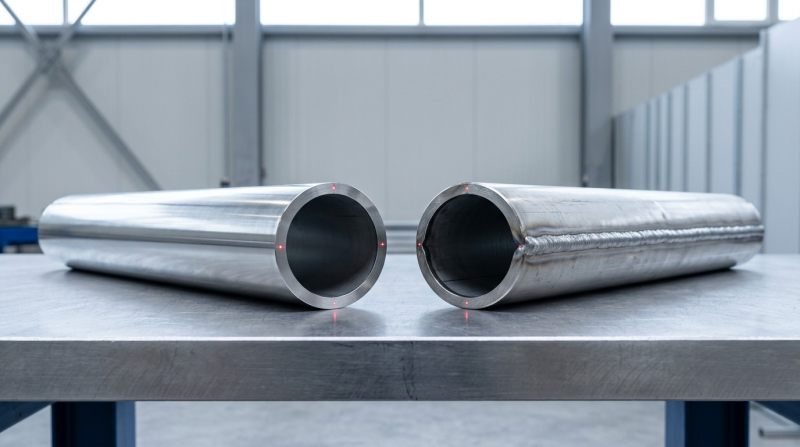
The manufacturing process fundamentally shapes tolerance behavior. Seamless pipes are hot-forged and cold-drawn, resulting in tighter radial consistency but higher variability along length due to die wear and temperature gradients. Welded pipes use precision strip feeding and automated seam fusion, delivering superior longitudinal uniformity—but introducing potential weld zone thinning (±0.15 mm typical) and heat-affected zone (HAZ) softening.
This table reveals a key decision driver: welded pipes offer broader size flexibility and longer single lengths—critical for marine risers or district heating networks where field welds increase inspection costs by 3×. But for ASME Section VIII pressure vessels requiring zero longitudinal welds, seamless remains mandatory—even with its wider tolerance band. Hongteng Fengda maintains dual-certified production lines, enabling clients to switch between seamless and welded grades (e.g., 304L, 316L, 2205) without changing procurement workflows.
Where Steel Sheet Piles Leverage Similar Precision Principles
Precision in wall thickness control extends beyond piping into structural elements like Steel Sheet Piles. Their interlock geometry—whether Larssen, cold-rolled, or hot-rolled—relies on consistent web thickness (±0.5 mm tolerance per EN 10248) to ensure watertightness in cofferdams or deep-water foundations. Under-driving resistance in hard soil layers depends directly on flange-to-web thickness ratios: S355 piles with 14 mm web deliver 22% higher penetration force than equivalent S275 piles at same width.
Hongteng Fengda’s sheet pile production uses laser-guided thickness monitoring during hot rolling, achieving ≤±0.3 mm deviation across 80+ meter lengths. This enables reusable pile systems—where dimensional repeatability prevents interlock galling after 5+ extraction cycles. For projects requiring custom profiles (e.g., Z-type with tapered flanges), our OEM capability integrates thickness mapping into CNC roll tooling design—ensuring tolerance compliance before first ton is rolled.
Procurement Checklist: 5 Non-Negotiables for Wall Thickness Compliance
- Require MTRs showing *actual measured wall* at ≥3 points per pipe (not just “within tolerance”)
- Verify test method: Ultrasonic (ASTM E797) preferred over mechanical calipers for curved surfaces
- Confirm standard alignment—e.g., ASTM A312 Class I (seamless) vs. Class II (welded) have different acceptance criteria
- Check for hydrostatic test pressure calculation: Must be based on *minimum wall*, not nominal
- For welded pipes: Demand radiographic testing (RT) reports covering 100% of seam length, not spot checks
These steps prevent costly field rejections—particularly for projects under API Q1 or ISO 9001:2015 audit. Hongteng Fengda embeds all five into standard documentation packages, with digital MTR access via client portal within 24 hours of shipment.
Why Partner with Hongteng Fengda for Precision-Critical Steel Procurement
We combine ISO 9001-certified quality systems with structural steel expertise spanning 15+ years—delivering verified wall thickness consistency across stainless pipe, Steel Sheet Piles, angle steel, channel steel, and custom beams. Our facility in Jiangsu operates 4 dedicated NDT labs, performing 100% ultrasonic thickness verification on all export-grade stainless products.
Global buyers rely on us for: stable lead times (12–18 days for standard SS pipe, 25–35 days for custom sheet piles), multi-standard compliance (ASTM/EN/GB/JIS), and technical support—from initial specification review to on-site installation guidance. Whether you need help selecting between seamless and welded grades for a desalination plant, or optimizing sheet pile interlock tolerances for a Singapore marine terminal, our engineering team provides actionable, standards-aligned recommendations—not generic datasheets.
Ready to validate your next SS pipe or sheet pile specification? Contact us for free technical consultation, sample MTR review, or a customized delivery timeline based on your project schedule and compliance requirements.
Please give us a message


Please enter what you want to find