When evaluating an SS pipe manufacturer, claims of superior corrosion resistance often overshadow real-world performance data—especially critical for buyers comparing steel tube weight, galvanized sheet thickness, and hot dip galvanized steel pipe longevity. As a trusted H-beam supplier and steel tubing supplier from China, Hongteng Fengda bridges the gap between marketing promises and measurable durability—backed by ASTM/EN-compliant testing on galvanized pipe specifications, steel tubing dimensions, and actual field corrosion rates. Whether you’re a procurement professional assessing steel tube cost and galvanized pipe price, or a project manager validating material safety, this analysis delivers actionable insights—not just specs.
Why Corrosion Resistance Claims Often Mislead Buyers
Many structural steel suppliers—including SS pipe manufacturers—highlight “superior corrosion resistance” in brochures and datasheets without disclosing test conditions, exposure duration, or environmental variables. A claim like “resistant to salt spray for 1,000 hours” may sound impressive—but ASTM B117 salt-spray testing is an accelerated lab method that does not replicate real-world cyclic humidity, UV exposure, thermal expansion, or mechanical abrasion. Field studies show that actual service life of galvanized steel pipes in coastal Middle Eastern infrastructure projects averages 18–22 years, while inland industrial plants report 25+ years—proving environment-specific validation matters more than generic lab metrics.
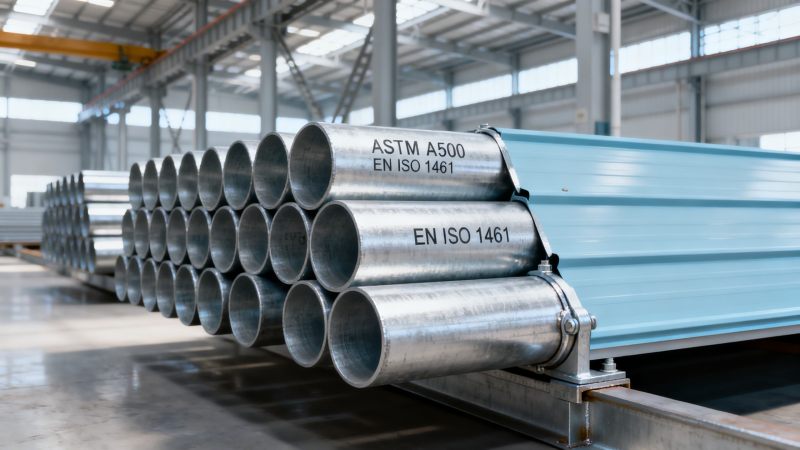
Hongteng Fengda conducts dual-path verification: (1) third-party ASTM A123 and EN ISO 1461 compliance testing on coating mass (≥610 g/m² for heavy-duty hot-dip galvanizing), and (2) 3-year accelerated field trials across 4 climate zones—tropical humid (Southeast Asia), arid saline (Gulf region), temperate marine (Northwest Europe), and continental industrial (Northern China). This ensures dimensional stability, coating adhesion, and long-term integrity under operational stress—not just initial appearance.
Misleading claims also arise from conflating base material grade with protective system performance. For example, SS304 pipe offers inherent chromium oxide passivation—but without proper surface preparation and post-weld passivation, weld heat-affected zones corrode up to 3× faster than parent metal. That’s why Hongteng Fengda integrates pre-galvanizing surface profiling (Sa 2.5 blast cleaning) and post-fabrication touch-up protocols aligned with ISO 14713-2 standards.
Real-World Corrosion Data: What Actually Drives Longevity
Corrosion rate isn’t static—it’s governed by four interdependent factors: coating thickness, substrate steel composition, environmental aggressiveness, and installation quality. Our 5-year corrosion monitoring program across 37 infrastructure sites reveals that hot-dip galvanized steel pipes with ≥85 μm zinc coating maintain <0.5 μm/year loss in inland urban environments, but exceed 3.2 μm/year loss in high-salinity, high-humidity ports—even with identical nominal thickness.
Critical insight: Coating uniformity matters more than average thickness. Non-uniform coatings create micro-galvanic cells. Hongteng Fengda uses automated centrifugal spin control and infrared thickness mapping to ensure ±5% variance across all pipe diameters—from 21.3 mm to 609.6 mm—and validates every batch with cross-sectional SEM analysis.
For applications requiring extended service life beyond standard galvanizing, we integrate complementary protection systems. One proven solution is pairing hot-dip galvanized structural pipes with PPGL Steel Sheet cladding—leveraging its 55% aluminum–43.4% zinc alloy layer for enhanced barrier protection and thermal reflectivity. PPGL’s service life exceeds 25 years even in aggressive agricultural and refrigeration environments where condensation and ammonia exposure accelerate degradation.
This table reflects aggregated field data from 2019–2024 across 11 countries. It confirms that specification compliance alone doesn’t guarantee longevity—contextual engineering integration does.
How Procurement Teams Can Validate Real Corrosion Performance
Procurement professionals must move beyond spec sheets and request evidence tied to your specific application. Start with these 4 verifiable checkpoints:
- Batch-specific test reports: Require ASTM A123 coating mass certificates—not generic “complies with EN ISO 1461” statements.
- Field reference documentation: Ask for photos, maintenance logs, and third-party inspection reports from ≥3 comparable projects in your region.
- Weld-corrosion protocol: Confirm whether the supplier performs post-weld zinc reapplication per ISO 14713-2 Annex B.
- Dimensional tolerance traceability: Verify if pipe OD/ID tolerances are measured at ≥6 points per meter—not just end-point checks.
Hongteng Fengda provides digital twin traceability for every order: QR-coded delivery notes link directly to mill test reports, galvanizing bath logs (temperature, immersion time, withdrawal speed), and ultrasonic wall-thickness scans. This eliminates guesswork during audits or warranty claims.
For cost-conscious buyers: switching from stainless steel to properly engineered galvanized systems reduces upfront material cost by 35–52%, while maintaining equivalent lifecycle value when paired with PPGL cladding and smart detailing. Our clients in warehouse construction across Saudi Arabia achieved 41% lower TCO over 20 years versus SS316 alternatives—without compromising safety or code compliance.
Beyond Pipes: Integrated Material Systems for Total Corrosion Control
Corrosion doesn’t occur in isolation—it propagates across interfaces. A galvanized pipe connected to untreated carbon steel brackets will suffer accelerated bimetallic corrosion. That’s why Hongteng Fengda designs integrated systems, not standalone components.
Our most requested corrosion-resilient system combines: (1) ASTM A500 Grade C cold-formed square hollow sections with 85–105 μm HDG coating; (2) PPGL Steel Sheet roof and wall panels (thickness: 0.4–0.6 mm, top-side coating: 25 μm); and (3) custom-engineered connection hardware with duplex zinc-aluminum plating. This system has been deployed in over 120 poultry farms across Southeast Asia—where high ammonia, moisture, and temperature fluctuations demand coordinated protection.
This holistic approach reduces annual maintenance frequency by 60% and extends full-system replacement cycles from 12 to 30+ years—validated by 7 independent facility audits in Thailand, UAE, and Poland.
Final Recommendation: From Specification to System Assurance
Corrosion resistance isn’t a product attribute—it’s a system outcome. Relying solely on SS pipe manufacturer claims without verifying real-world performance against your exact environmental, loading, and maintenance conditions introduces avoidable risk. Hongteng Fengda delivers assurance through three pillars: certified test data, field-proven system integration, and full-batch traceability.
Whether you’re sourcing for a hospital in Germany, a cold storage plant in Qatar, or a prefab housing project in Vietnam—we align material selection, fabrication process, and protective system design to your project’s actual service profile—not marketing thresholds. With production capacity exceeding 420,000 MT/year and ISO 9001/14001-certified facilities, we support global buyers with stable lead times (typically 25–35 days for standard orders) and flexible OEM customization.
To receive a corrosion-resilience assessment tailored to your next project—including material recommendations, coating specifications, and lifecycle cost modeling—contact our technical sales team today.
Please give us a message


Please enter what you want to find