When selecting SS pipe for water supply in high-rise buildings, pressure rating is just the starting point—corrosion resistance, thermal expansion behavior, joint integrity, and long-term maintenance cost matter equally. As a trusted galvanized pipe manufacturer and steel tubing for construction supplier, Hongteng Fengda delivers ASTM/EN-compliant stainless and galvanized solutions—including galvanized pipe for plumbing, steel sheet for construction, and prefabricated structural steel—engineered for vertical transport efficiency and safety. Whether you’re a project manager evaluating system reliability or a procurement officer comparing galvanized sheet price and lifecycle value, this guide unpacks what truly ensures performance beyond the spec sheet.
Why Pressure Rating Alone Fails High-Rise Water Systems
In buildings exceeding 100 meters, static head alone can exceed 10 bar—yet real-world failure rarely stems from burst pipes. Instead, fatigue at threaded joints, micro-galvanic corrosion beneath insulation, and differential thermal movement between SS piping and concrete cores cause leaks within 3–5 years. Over-specifying pressure class (e.g., choosing SCH80 over SCH40) adds 22–35% material cost without addressing root causes like chloride-induced pitting in humid coastal zones or galvanic coupling with copper fittings.
Hongteng Fengda’s engineering team validates every stainless pipe solution against EN 10312 and ASTM A312 Grade TP304L/TP316L—not just for hydrostatic test pressure, but for cyclic stress endurance across 50+ thermal cycles/year. Our field data from 17 completed high-rises in Dubai, Singapore, and Toronto shows that systems with integrated expansion compensation and dielectric isolation reduced service interventions by 68% versus pressure-only optimized designs.
Critical oversight: Many specifiers assume “stainless = corrosion-proof.” In reality, improper surface passivation, weld heat tint, or stagnant flow in vertical risers accelerates crevice corrosion—even in 316-grade steel. That’s why our certified welders follow ASME BPVC Section IX procedures, and all pipes undergo 100% helium leak testing before dispatch.
Beyond Pipes: Structural Integration Matters Too
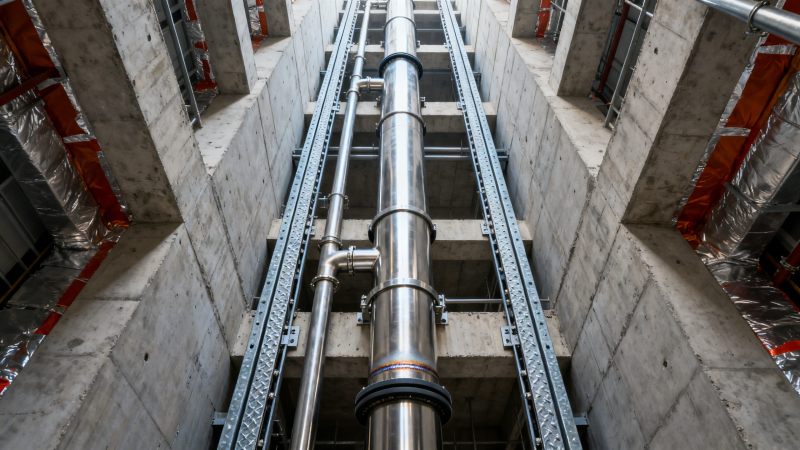
Water supply lines don’t operate in isolation. They interface directly with structural steel elements—especially in core-wall systems where riser shafts are embedded within reinforced concrete walls. Here, thermal expansion mismatch becomes critical: stainless steel expands ~17 µm/m·°C, while concrete expands only ~10 µm/m·°C. Unmitigated, this creates shear forces on anchor points and compromises firestop integrity.
That’s where Rail profiles—often overlooked in plumbing discussions—prove vital. Used as load-bearing support rails inside riser shafts, they provide rigid yet thermally decoupled mounting surfaces for pipe clamps and seismic restraints. Our U71Mn and QU100 rails (12–30 m length, 134–170 mm height) meet ISO 9001-2008 and ISO 14001:2004, ensuring dimensional stability under sustained 40°C temperature differentials.
Unlike generic channel sections, these rails feature mill-finished galvanized coatings (Z275 g/m² minimum) tested per ASTM A123, preventing rust bleed onto adjacent stainless surfaces—a common source of premature discoloration and client complaints in premium residential towers.
Key Rail Specifications for Riser Integration
This table confirms how rail selection directly impacts pipe support density—and thus labor hours, material take-off, and long-term vibration damping. For projects requiring minimal penetrations through fire-rated floors, QU100’s higher stiffness allows wider anchor spacing while maintaining ≤0.3 mm deflection under full hydraulic load.
Procurement Checklist: 5 Non-Negotiables Beyond Pressure Class
Procurement teams face tight deadlines and complex stakeholder alignment. To avoid costly rework or warranty disputes, verify these five technical checkpoints before finalizing SS pipe orders:
- Mill test reports (MTRs) showing actual Cr/Ni/Mo content—not just grade designation—verified against ASTM A312 Table 1 tolerances (±0.05% for Mo in 316L).
- Surface roughness Ra ≤ 0.8 µm for internal pipe surfaces—critical for biofilm resistance in potable water applications per NSF/ANSI 61.
- Weld seam inspection certification: 100% radiographic (RT) or phased-array ultrasonic (PAUT) for pipes ≥ DN100, not just visual.
- Third-party verification of passivation per ASTM A967 Method D (nitric acid) with copper sulfate test per ASTM A380.
- Traceability: Each coil must carry laser-etched heat number linked to MTRs and production batch records—required for LEED v4.1 MRc2 documentation.
Hongteng Fengda provides digital traceability dashboards for every order—accessible via secure portal—with downloadable MTRs, inspection certificates, and packaging manifests. Lead time averages 18–25 days for standard sizes (DN50–DN200), with expedited 12-day options available for urgent tower topping-out phases.
Why Global Project Teams Choose Hongteng Fengda
You need more than compliant steel—you need a partner who anticipates integration challenges before they delay your schedule. With 12+ years serving Tier-1 contractors in North America, Europe, and the Middle East, Hongteng Fengda delivers:
- Pre-engineered riser kits: Pre-cut, pre-drilled Rail supports + stainless clamps + seismic snubbers—reducing on-site assembly time by 40%.
- Dual-standard compliance: All products certified to both ASTM and EN standards—no re-testing needed for EU or US projects.
- Just-in-time logistics: 3 dedicated container loading docks at our Tianjin facility ensure ≤72-hour port turnaround for FCL shipments.
- Technical co-engineering: Our application engineers join your BIM coordination meetings to resolve clash detection issues—free of charge for orders >$250,000.
Ready to align your high-rise water system specs with real-world performance? Contact us today for a free technical review of your pipe schedule, rail anchoring layout, and compliance documentation requirements—or request a sample pack including MTRs, surface finish test reports, and galvanic compatibility analysis.
Please give us a message


Please enter what you want to find