For distributors and agents sourcing ss 304 coil, understanding weight tolerance is essential to protecting yield, pricing accuracy, and customer satisfaction.
Small deviations in coil weight can affect slitting, blanking, inventory, freight, and final project margins.
This article explains how ss 304 coil weight tolerance shapes downstream performance and how reliable Chinese steel supply improves consistency.
Why weight tolerance matters in real ss 304 coil supply scenarios
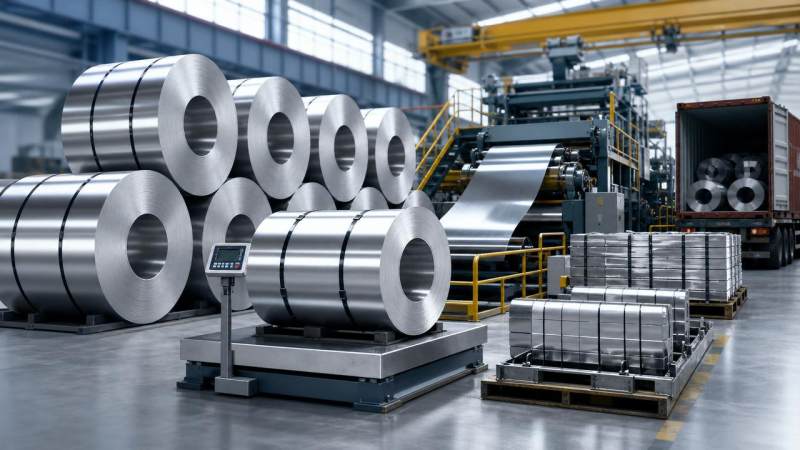
In stainless steel trading, quoted thickness and width often get most attention.
Yet actual delivered weight of ss 304 coil often decides whether a job stays profitable.
Weight tolerance is the acceptable difference between theoretical and actual coil weight.
That difference may seem small, but repeated over many coils, the financial effect becomes significant.
In steel service centers, one overweight or underweight ss 304 coil changes nesting plans and output forecasts.
In export orders, tolerance also changes container loading efficiency and freight cost allocation.
For projects with fixed consumption standards, wrong weight assumptions can trigger shortages or overstock.
How different use cases judge ss 304 coil tolerance differently
Not every application judges ss 304 coil weight tolerance in the same way.
Tolerance risk depends on processing route, scrap rate target, and delivery commitment.
Slitting and strip resale
When ss 304 coil is purchased for slitting, weight accuracy supports strip output prediction.
If actual weight falls short, the number of resale strips decreases.
That can create partial deliveries, rebooking costs, and avoidable customer complaints.
Blanking, stamping, and cut-to-length processing
In blanking operations, each sheet count depends on width, length, and available net weight.
A light ss 304 coil may not produce the planned number of parts.
That affects machine scheduling and increases unit cost for completed batches.
Project inventory and long-cycle contracts
For framework agreements, planners often estimate monthly consumption from historical coil weight.
If ss 304 coil weight varies too much, stock safety calculations become unreliable.
Unexpected replenishment then weakens lead time control and cash flow discipline.
Typical yield impacts that appear during downstream processing
Yield is not only about metal chemistry or surface finish.
For ss 304 coil, yield also depends on whether actual incoming weight matches production assumptions.
Lower net output from underweight coils
Underweight ss 304 coil directly reduces available material for finished products.
If each coil is short by a small percentage, total annual loss becomes substantial.
Higher scrap exposure from unstable planning
When actual weight is uncertain, operators often leave extra safety allowance.
That cautious approach can increase tail scrap and reduce material utilization.
Mismatch between booked and actual shipment value
Some contracts price ss 304 coil by weight, while output is evaluated by piece count.
When the delivered weight differs, conversion economics become less predictable.
Scenario comparison: where ss 304 coil tolerance matters most
How to evaluate acceptable ss 304 coil tolerance before ordering
A good tolerance decision starts with the intended use, not only the purchase price.
The same ss 304 coil may be acceptable in one line and risky in another.
- Define whether weight is critical for piece count, footage, or project tonnage.
- Ask for actual weighing practice, not only theoretical weight formulas.
- Check whether tolerance is consistent across multiple batches.
- Confirm packing list traceability and coil identification.
- Review whether coil edge condition affects usable net weight.
It also helps to compare stainless supply discipline with structural steel sourcing habits.
For example, in purlin and framing projects, dimensional tolerance and weight reliability are both essential.
Related items like Z-beam often require controlled tolerance, customized length, and certified quality for stable installation results.
Supply-side factors that influence ss 304 coil weight consistency
Weight tolerance is not random.
It usually reflects process control, inspection method, and supplier discipline.
Thickness uniformity across the coil
If thickness varies, actual ss 304 coil weight may drift from estimate.
That variation also affects forming consistency during downstream use.
Width accuracy and edge condition
Slit edge and mill edge coils may carry different usable width behavior.
That changes theoretical weight and recoverable output from each ss 304 coil.
Weighing equipment and documentation
Reliable suppliers use calibrated scales and issue clear batch records.
That makes disputes easier to resolve and replenishment decisions faster.
Common mistakes when judging ss 304 coil yield risk
Several avoidable errors make ss 304 coil tolerance problems worse.
- Using theoretical weight only, without checking actual delivered weight.
- Ignoring repeated small shortages because each single coil looks acceptable.
- Comparing suppliers only by unit price, not by usable yield.
- Assuming all standards are equal in execution quality.
- Failing to connect tolerance data with processing scrap reports.
These errors distort the real cost of ss 304 coil procurement.
A lower price can become more expensive after yield loss, line delays, and emergency replacement.
Practical sourcing suggestions for stable results from China
Chinese steel suppliers can offer strong value when quality systems are transparent and repeatable.
The goal is not only buying ss 304 coil, but receiving predictable usable material.
- Request batch inspection data covering thickness, width, and actual weight.
- Match tolerance requirements to the processing route before quotation approval.
- Check export experience and compliance with ASTM, EN, JIS, or GB where needed.
- Prefer suppliers with stable production capacity and dependable lead times.
- Review whether the supplier also supports customized structural steel solutions.
Hongteng Fengda supports global construction and industrial projects with controlled production and strict quality management.
Its export experience across North America, Europe, the Middle East, and Southeast Asia helps reduce sourcing risk.
This matters when tolerance-sensitive materials must integrate with broader steel packages and project schedules.
Final takeaway for improving ss 304 coil yield and pricing control
Weight tolerance is a practical profit factor, not a minor technical note.
For ss 304 coil, even small weight deviations can reduce yield, disrupt planning, and weaken quote accuracy.
The best approach is to judge tolerance by actual application scenario, then verify supplier control methods.
When consistent quality, traceable records, and stable supply come together, ss 304 coil becomes easier to price and safer to process.
For the next step, review current yield reports, compare actual versus theoretical coil weight, and align future orders with verified tolerance performance.
Please give us a message


Please enter what you want to find