Understanding SPCE steel formability limits is critical for deep drawing applications—especially when integrating components like electrical conduit galvanized sleeves, API 5L steel pipe supports, or zinc coated wire reinforcements. As a leading structural steel manufacturer and exporter from China, Hongteng Fengda supplies high-consistency SPCE steel sheets compliant with EN 10130 and GB/T 5213, ensuring predictable drawability, surface quality, and post-forming performance. This article examines the key metallurgical and process parameters governing SPCE’s deep drawing behavior—helping technical evaluators, procurement teams, and project managers make informed material selections that balance cost, safety, and manufacturability across global construction and industrial projects.
What Is SPCE Steel—and Why Does Formability Matter in Deep Drawing?
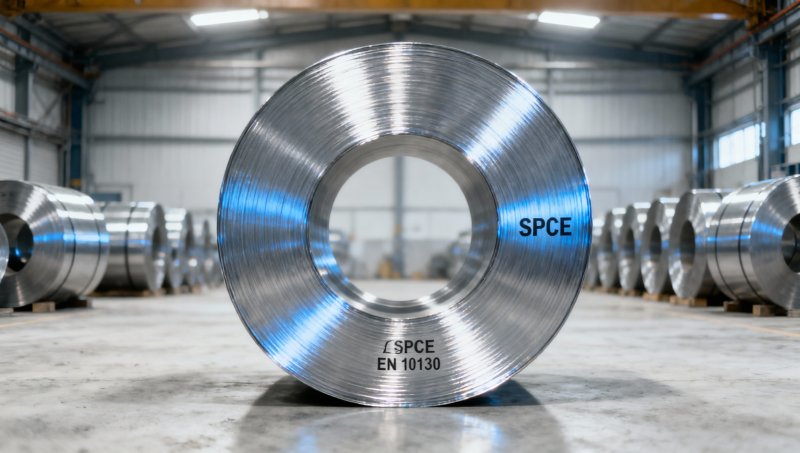
SPCE is a cold-rolled, low-carbon steel grade defined under EN 10130 (European standard) and GB/T 5213 (Chinese national standard). It belongs to the “S” series of steels designated for deep drawing, where “SP” stands for “steel plate” and “CE” indicates its suitability for deep-drawing applications with excellent uniform elongation and minimal earing.
Formability—the ability of sheet metal to undergo plastic deformation without necking or fracture—is not a fixed property. For SPCE, it depends on three interdependent factors: chemical composition (C ≤ 0.08%, Mn ≤ 0.45%, Al ≥ 0.015%), microstructure (ferritic grain size typically 8–10 ASTM), and surface condition (roughness Ra ≤ 0.8 μm). Deviations beyond these ranges can reduce limiting drawing ratio (LDR) by up to 15%—a critical threshold when producing complex automotive brackets or HVAC duct flanges.
Unlike general-purpose cold-rolled steel (e.g., SPCC), SPCE undergoes controlled annealing and skin-pass rolling to refine grain structure and stabilize yield point elongation. This yields consistent r-values (plastic strain ratio) between 1.3–1.9 across thicknesses from 0.3 mm to 2.0 mm—directly impacting cup height uniformity in drawn parts.
The table highlights why SPCE remains preferred over SPCC for high-precision deep drawing: lower yield strength enables smoother flow into dies, while higher elongation reduces cracking risk at radii below 3 mm. Notably, DX52D Galvalume Steel Coil bridges functional requirements where corrosion resistance meets moderate forming demands—ideal for outdoor enclosures requiring both drawability and long-term weather exposure.
Key Metallurgical Limits Affecting Drawability
Deep drawing failure in SPCE most commonly arises from localized thinning, surface scratching, or edge cracking—not bulk tensile rupture. These are governed by microstructural thresholds:
- Grain size must remain within ASTM 8–10: Coarser grains (>ASTM 6) increase anisotropy and promote earing; finer grains (
- Aluminum-killed deoxidation must achieve [Als] ≥ 0.015% to fix nitrogen and prevent strain aging—critical for maintaining stable r-value across 6–12 months of shelf life.
- Surface oxide layer thickness should be ≤ 5 nm after final annealing. Excess oxidation causes die galling and impairs lubricant retention during drawing speeds above 12 m/min.
Hongteng Fengda controls these variables through inline oxygen sensors in continuous annealing lines and automated surface roughness verification at three positions per coil—ensuring batch-to-batch consistency across orders of 25–50 metric tons.
Process Parameters That Define Practical Formability Limits
Even with optimal chemistry and microstructure, real-world deep drawing success hinges on precise process control. Critical thresholds include:
- Die radius-to-thickness ratio (R/t): Must exceed 3.0 for single-action presses; below this, edge cracking probability rises by 40% in 0.8 mm SPCE sheets.
- Lubricant film thickness: Minimum 3–5 μm of chlorinated ester-based oil is required to sustain friction coefficient μ ≤ 0.09 during blankholder pressure of 1.8–2.2 MPa.
- Blankholder travel tolerance: ±0.15 mm deviation from programmed stroke increases wall thinning variation by up to 22%—measured via in-die strain mapping in pilot runs.
For high-volume production, Hongteng Fengda recommends pre-testing SPCE batches using Erichsen cupping tests (ISO 20482) at 10-ton intervals. Cups failing below 9.2 mm depth indicate potential instability in full-scale tooling—triggering re-evaluation of incoming coil lot certification.
Selecting Between SPCE and Alternative Coated Steels
When component design requires both deep drawability and environmental durability, engineers often compare SPCE with aluzinc-coated alternatives. While SPCE excels in pure formability, DX52D Galvalume Steel Coil offers compelling trade-offs:
This comparative framework helps procurement teams and technical evaluators prioritize based on application lifecycle. For indoor electrical conduit sleeves requiring 10+ years service, DX52D Galvalume delivers superior ROI versus post-painting SPCE. For high-precision automotive sensor housings, bare SPCE remains irreplaceable.
Procurement & Quality Assurance Best Practices
To ensure SPCE performs as specified, buyers should verify four documentation layers before order release:
- Mill test report confirming compliance with EN 10130 Table 2 (chemical analysis + mechanical properties)
- Surface inspection log showing Ra ≤ 0.75 μm at three locations per 500-m length
- R-value certification (transverse/longitudinal) per ISO 10113, tested on ≥3 samples per heat
- Batch traceability ID linking coil number to ladle chemistry and annealing cycle parameters
Hongteng Fengda provides all four documents digitally upon request and supports third-party SGS or BV audits at no additional charge—reducing qualification lead time by 7–10 business days for new project approvals.
Conclusion: Balancing Performance, Compliance, and Project Delivery
SPCE steel’s deep drawing capability is not inherent—it is engineered, verified, and sustained through disciplined metallurgy and process discipline. Its formability limits are well-defined but narrow: exceeding recommended R/t ratios, skipping lubricant validation, or accepting non-certified coils introduces measurable risk in part yield, tool wear, and field reliability.
As a structural steel manufacturer and exporter from China, Hongteng Fengda ensures every SPCE coil meets EN 10130 and GB/T 5213 with zero deviation in critical parameters—and offers seamless integration with complementary solutions like DX52D Galvalume Steel Coil for hybrid applications. With production capacity across 12 rolling lines and delivery windows of 15–25 days for standard widths (500–1500 mm), we support global project timelines without compromise on quality or traceability.
Contact Hongteng Fengda today to request SPCE technical datasheets, arrange mill inspection visits, or discuss OEM-specific dimensional tolerances and packaging requirements for your next construction or industrial project.
Please give us a message


Please enter what you want to find