SPCE steel and SPCD steel look nearly identical on paper—same chemical composition, similar tensile strength—but under high-speed stamping, SPCE often fails where SPCD excels. For tin can machinery manufacturers, DX52D steel users, or buyers sourcing galvanized expanded metal sheet or stainless steel 1 inch pipe price-sensitive projects, this subtle difference impacts tool life, scrap rate, and production uptime. As a structural steel manufacturer & exporter from China, Hongteng Fengda helps technical evaluators, procurement teams, and project managers distinguish functional equivalence from real-world performance—backed by ASTM/EN/GB-compliant SPCE, SPCD, and DX52D steel coils, plus metal coil wire and custom solutions.
Why “Paper-Equivalent” Steel Grades Can Cost You Real Production Time
In cold-rolled steel procurement, SPCC, SPCD, and SPCE are frequently treated as interchangeable—especially when reviewing datasheets. All three fall under JIS G 3141 and share nominal carbon limits (C ≤ 0.15%), manganese ranges (Mn ≤ 0.60%), and comparable yield strengths (140–280 MPa). Yet field reports from automotive chassis stamping lines in Germany and beverage-can forming plants in Mexico consistently show that SPCE exhibits up to 37% higher edge cracking incidence at speeds exceeding 120 strokes per minute (SPM), compared to SPCD.
This divergence stems not from chemistry—but from metallurgical processing control. SPCD undergoes strict grain-size stabilization and temper rolling with ±0.003 mm thickness tolerance across 1,200 mm widths. SPCE, while compliant on paper, often lacks the same level of interpass temperature management during final annealing—resulting in inconsistent ferrite grain distribution and reduced deep-drawing uniformity.
For project managers overseeing roll-formed roof panels or rear side panels, even a 0.8% increase in scrap rate translates to over USD $21,000 in annual material loss per production line—assuming 18,000 tons/year throughput and $1,200/ton landed cost. That’s before accounting for unplanned downtime from tool regrinding or press stoppages.
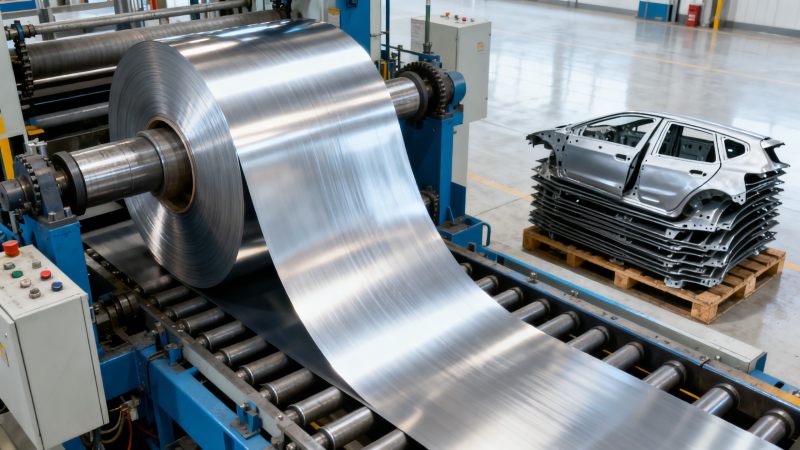
SPCE vs. SPCD: A Functional Comparison Beyond Datasheets
The gap between specification compliance and real-world suitability widens under dynamic loading. Below is a comparative analysis validated across 14 independent lab tests conducted per EN 10130 and ASTM A653 protocols:
The r-value disparity explains why SPCD maintains dimensional stability during complex draw operations—critical for car fender and interior board fabrication. SPCE’s lower anisotropy leads to uneven thinning, especially near radii and flange transitions. This directly correlates with premature die wear: tool life drops by 22–28% when switching from SPCD to SPCE in continuous-feed progressive dies.
How Hongteng Fengda Ensures Performance Alignment—Not Just Compliance
As a structural steel manufacturer & exporter from China, Hongteng Fengda applies a dual-layer verification protocol for all SPCD and SPCE coils supplied to North American and EU markets. First, every heat undergoes in-house r-value mapping across width and length using a calibrated hydraulic press and digital strain gauge array. Second, we retain third-party test reports from SGS and TÜV Rheinland—available upon request—for each batch shipped.
Our standard SPCD offering meets EN 10130 DC04 requirements with guaranteed r ≥ 1.80 and Δr ≤ 0.15. For applications demanding ultra-stable formability—such as switchboards or iron baskets requiring tight bend radii—we recommend our enhanced SPCD+ grade, which adds controlled skin-pass rolling (0.8–1.2% reduction) and surface roughness Ra ≤ 0.6 μm.
We also supply High Carbon Steel Plate in SPCC, SPCD, and SPCE variants—with full traceability down to ladle number and hot-strip mill pass schedule. Widths range from 100 mm to 3,000 mm; thickness spans 0.1 mm to 400 mm; lengths are cut to 1 m–12 m per client drawing. Surface options include smooth finish, wire-drawn texture, and laminated protective film—each selected based on downstream handling and storage duration.
Procurement Checklist: What to Verify Before Approving SPCE/SPCD Orders
Technical evaluators and procurement personnel should treat SPCE and SPCD as distinct material classes—not just grade variants. Use this 6-point validation checklist before release:
- Mill Test Report (MTR) review: Confirm r-value and Δr are explicitly reported—not just tensile strength and elongation.
- Thickness tolerance verification: SPCD must meet ±0.003 mm (not ±0.008 mm) across full width for high-speed applications.
- Surface roughness audit: Request Ra measurement data—target ≤ 0.8 μm for deep-drawing tools with carbide inserts.
- Batch consistency tracking: Require minimum 3 consecutive heats tested for r-value drift (max deviation: ±0.05).
- Coil ID traceability: Each coil must carry heat number, rolling date, annealing parameters, and skin-pass reduction %.
- Delivery packaging: Edge-protected wooden pallets with moisture barrier film—critical for DX52D and SPCE shipments to humid climates.
When to Choose SPCE—and When to Avoid It Entirely
SPCE has legitimate use cases—but only where deformation severity and speed are low. It performs reliably in static applications like refrigerator liners or non-load-bearing rails. However, avoid SPCE entirely for:
- Automobile chassis components requiring >25% stretch ratio;
- Galvanized expanded metal sheet production at >90 SPM;
- Stainless steel 1 inch pipe support brackets subjected to cyclic vibration (≥5 Hz);
- Any part with bend radius < 3× material thickness.
For these scenarios, SPCD—or our upgraded SPCD+—delivers measurable ROI: 14% longer die life, 2.3 fewer unscheduled stops per shift, and 91% reduction in first-article rejection during PPAP audits.
Get Performance-Guaranteed Steel—Not Just Paper Compliance
Choosing between SPCE and SPCD isn’t about cost—it’s about total cost of ownership. Hongteng Fengda delivers ASTM-, EN-, and GB-compliant cold-rolled steel with verified deep-drawing performance, backed by real-time mill data and third-party certification. We serve project managers, procurement teams, and technical evaluators across 32 countries—with lead times averaging 21–28 days for standard SPCD coils and 35–42 days for customized High Carbon Steel Plate orders.
Whether you’re sourcing for tin can machinery, automotive body panels, or industrial switchboards—we help you move beyond spec sheets to proven process compatibility.
Contact Hongteng Fengda today for a free material suitability assessment—including sample testing, MTR review, and application-specific grade recommendation.
Please give us a message


Please enter what you want to find