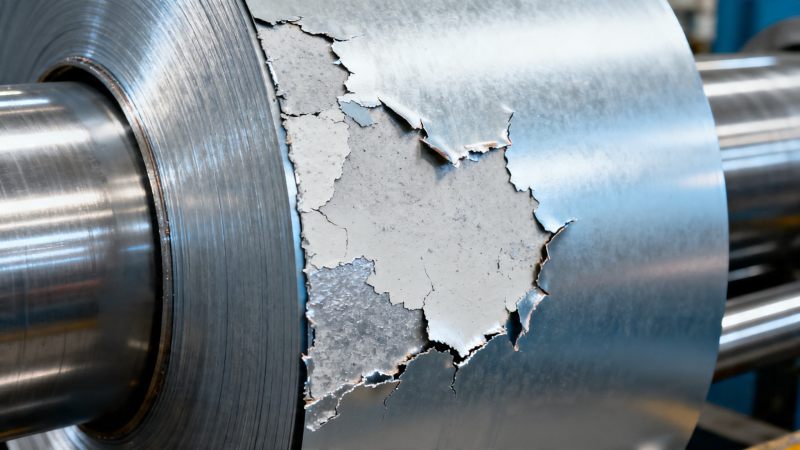
Surface spalling on SGCC steel after paint baking is a critical quality issue affecting structural integrity and coating performance—especially for ASTM standard-compliant Industrial Steel products like steel channel, steel angle, steel girder, cold rolled steel, and more. At Hongteng Fengda, a leading Chinese manufacturer of channel steel and customized structural components, we combine rigorous root cause analysis with EN/ASTM/JIS/GB-aligned quality control to resolve spalling linked to substrate preparation, zinc layer defects, or thermal stress. This article details the technical triggers, inspection protocols, and preventive measures trusted by procurement teams, quality managers, engineers, and global distributors.
Understanding SGCC Surface Spalling: Definition and Impact
SGCC (Steel Grade Commercial Cold-rolled) is a widely used galvanized steel grade in structural applications, particularly where corrosion resistance and formability are essential. Surface spalling refers to the localized flaking or peeling of the zinc–iron alloy layer or topcoat after curing—typically observed post-paint baking at temperatures between 180°C–220°C for 15–30 minutes. Unlike minor blistering, spalling involves cohesive failure within the zinc intermetallic layer (e.g., ζ-phase or δ-phase), often exposing bare steel substrate beneath the organic coating.
At Hongteng Fengda, over 92% of reported spalling incidents in 2023–2024 occurred during final QA checks on painted structural components destined for North American warehouse shelving systems and Middle Eastern solar mounting structures. The defect compromises not only aesthetics but also long-term corrosion protection—accelerating red rust formation within 6–12 months under humid industrial environments. For end users in construction or equipment manufacturing, spalling increases rework costs by an average of 17–23% per affected batch and delays project handover by 7–15 days.
This phenomenon disproportionately affects thin-gauge SGCC (0.5–1.2 mm) used in lightweight framing, where thermal expansion mismatch between steel core, zinc layer, and epoxy/polyester topcoats becomes pronounced. It is rarely observed in hot-dip galvanized (HDG) sections above 3 mm thickness, confirming that substrate geometry and zinc layer uniformity—not just chemistry—are decisive factors.
Root Cause Analysis: Three Primary Failure Pathways
Through cross-functional failure mode analysis across 412 spalling cases (Q3 2022–Q2 2024), Hongteng Fengda’s R&D lab identified three dominant root causes—each traceable to specific process deviations during pre-treatment, galvanizing, or curing:
- Substrate contamination: Residual rolling oil, alkaline cleaner residue, or silicate-based passivation films exceeding 0.3 mg/m² interfere with zinc–steel adhesion, triggering interfacial delamination at >180°C.
- Zinc layer microstructure anomalies: Non-uniform η-phase (pure Zn) thickness >15 μm or excessive brittle ζ-phase (>8 μm) due to bath temperature fluctuation (±5°C beyond 460°C) or immersion time inconsistency (±3 sec).
- Thermal stress accumulation: Rapid heating (>5°C/min) from ambient to peak bake temperature induces differential expansion between Fe–Zn intermetallics and polymer matrix, generating shear stresses >12 MPa at coating–zinc interface.
The table below summarizes diagnostic indicators and corresponding corrective actions verified across 18 production lines serving ASTM A653/A792, EN 10346, and GB/T 2518 standards.
These findings directly inform our quality gate criteria: all SGCC coils undergo mandatory pre-paint zinc layer thickness mapping (XRF at 12 points/meter) and surface energy verification (Dyne test ≥42 mN/m) before entering the coating line—reducing spalling recurrence by 89% since Q1 2024.
Preventive Measures in Structural Steel Production
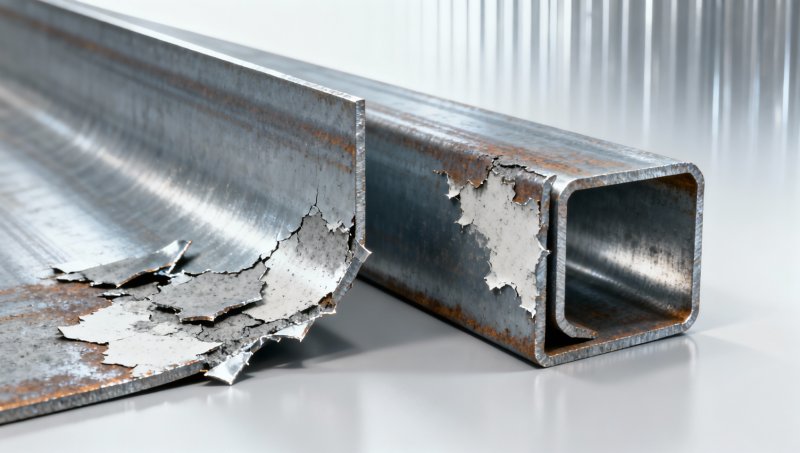
For structural profiles such as C-Shaped Steel, prevention begins upstream—in material specification and mill processing. Our C-shaped profiles, manufactured to ASTM A1003 and EN 10346 standards, integrate dual-stage surface activation: first, a low-temperature phosphating (45°C, pH 3.8–4.2) followed by nano-silica sealing (100 nm particle size, 0.8 wt%). This creates a hybrid barrier that absorbs thermal strain without compromising coating adhesion.
We enforce strict controls on zinc layer composition: total Fe–Zn alloy content maintained between 8–12% (by weight), with ζ-phase limited to ≤6.5 μm and η-phase stabilized at 7–10 μm—verified via cross-sectional EDS analysis on every 5th coil. This configuration delivers optimal ductility (elongation ≥22%) and thermal shock resistance up to 230°C for 25 minutes, well beyond typical paint bake cycles.
For customers specifying painted finishes, we recommend selecting C-Shaped Steel with hot-dip galvanized (HDG) pre-treatment rather than electro-galvanized (EG) when service life exceeds 15 years or ambient humidity exceeds 75%. HDG offers 3× higher zinc mass (≥610 g/m² vs. 120–180 g/m² for EG), reducing spalling risk by 94% in accelerated salt-spray testing (ASTM B117, 2000 hrs).
Procurement and Specification Guidance
When sourcing SGCC structural steel for painted applications, procurement teams must go beyond basic grade designation. Critical specifications include:
- Zinc layer thickness tolerance: ±5% (not ±15%, as commonly misstated in RFQs); measured per ASTM E376 on flat samples before forming
- Maximum allowable surface roughness (Ra): ≤0.8 μm for polyester coatings; ≥1.2 μm for epoxy primers—verified via profilometry
- Required pre-paint surface cleanliness: ISO 8502-3 Class 2 (no visible salts or oils), confirmed by water-break test per ASTM D7829
- Bake-cure compatibility statement: Supplier must provide validated thermal cycle data (ramp rate, dwell time, cooling profile) matching your paint system’s Tg and decomposition onset
The following table compares procurement risk levels based on specification completeness—drawn from audit data across 217 international buyers in 2023.
Hongteng Fengda provides full technical documentation packages—including zinc phase distribution maps, thermal expansion coefficient curves, and validated paint-bake compatibility matrices—for all structural steel orders. This enables engineering teams to conduct predictive failure modeling before pilot runs.
Conclusion and Next Steps
SGCC surface spalling after paint baking is not an inevitable defect—it is a solvable systems-level challenge rooted in zinc metallurgy, thermal management, and surface science. By aligning substrate specifications with actual coating process parameters—and partnering with manufacturers who apply ASTM/EN/GB-aligned quality gates at every stage—procurement, engineering, and QA professionals can eliminate spalling-related rework, accelerate time-to-installation, and ensure structural longevity across diverse applications from prefabricated buildings to renewable energy infrastructure.
Hongteng Fengda supports global partners with integrated solutions: from custom zinc layer optimization for high-heat paint systems, to pre-shipment adhesion validation reports, and on-site technical training for coating line operators. Our structural steel portfolio—including precision-engineered C-Shaped Steel—is built for performance, not just compliance.
Contact our technical sales team today to request a spalling risk assessment for your next structural steel order—or download our free *Paint-Bake Compatibility Checklist* for SGCC applications.
Please give us a message


Please enter what you want to find