When selecting SGCC steel sheet—or DX51D galvanized cold-rolled steel—for demanding industrial applications, surface finish isn’t just about aesthetics—it directly impacts corrosion resistance, service life, and compliance with ASTM standard requirements. As a trusted steel sheet supplier and ASTM Steel Coil supplier, Hongteng Fengda offers hot rolled coil (HRC) and cold-rolled products engineered for global construction and manufacturing projects. Whether you’re a procurement professional evaluating steel supplier options or a technical assessor validating EN/ASTM/GB-compliant finishes, understanding how passivation, spangle size, coating weight, and topcoat systems affect real-world durability is critical—especially when sourcing from a leading Chinese structural steel manufacturer & exporter.
How Surface Finish Determines Real-World Corrosion Resistance in SGCC Steel Sheets
SGCC (Steel Grade Cold Commercial) is the most widely used designation for galvanized cold-rolled steel in international trade—particularly under JIS G 3302 and equivalent EN 10142/ASTM A653 standards. Its corrosion resistance does not stem solely from zinc content but from the synergy between coating mass, microstructure uniformity, and post-galvanizing treatments. For example, a typical SGCC sheet with 120 g/m² zinc coating may outperform a 180 g/m² variant if the latter exhibits excessive spangle size (>1.5 mm) and poor interfacial adhesion.
Hongteng Fengda applies strict process controls across its continuous galvanizing lines: strip tension is maintained within ±3% tolerance, annealing temperature held at 460–480°C for precise Fe–Zn alloy layer formation, and cooling rates calibrated to minimize delta-phase segregation. These parameters directly influence the morphology of the zinc–iron intermetallic layer—a critical determinant of barrier integrity and sacrificial protection longevity.
Unlike hot-dip galvanized structural sections, SGCC sheets rely on thin, uniform coatings (typically 60–180 g/m² total, double-sided). This makes surface topology—especially roughness (Ra ≤ 0.8 µm), oxide coverage, and residual oil film thickness—equally decisive as coating weight in aggressive environments like coastal infrastructure or chemical processing plants.
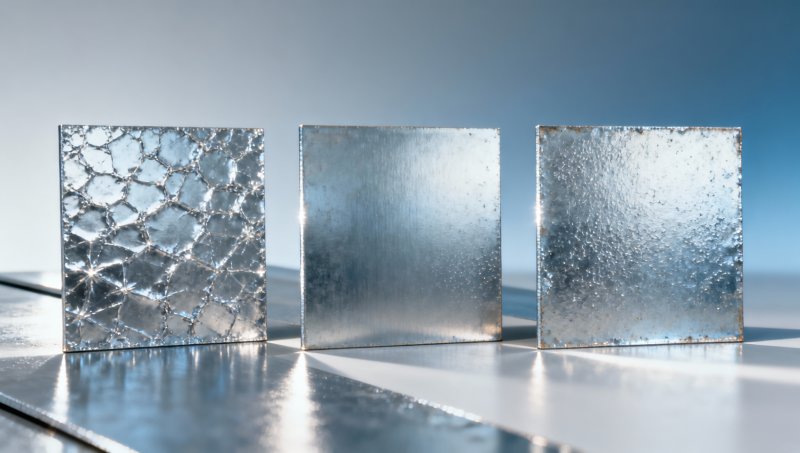
The table above confirms that optimized surface chemistry often outweighs raw coating weight. Chromate passivation adds only ~0.03–0.07 g/m² mass but extends salt-spray performance by up to 2.5× versus non-passivated equivalents—making it indispensable for automotive interior panels or HVAC enclosures exposed to condensation cycles.
Critical Parameters That Buyers Must Verify Before Procurement
Procurement professionals and quality assurance teams should treat SGCC finish specifications as contractual deliverables—not marketing claims. At Hongteng Fengda, every coil undergoes inline spectrometry (XRF) for Zn/Fe ratio verification, laser profilometry for Ra measurement, and automated wetting-angle testing per ISO 8510-2 to confirm hydrophobicity consistency across 2,000 mm widths.
Four non-negotiable checkpoints include: (1) coating weight tolerance must be ±5 g/m² per side—not ±10 g/m² total; (2) spangle size must be reported as median diameter (not “fine” or “regular”) with statistical distribution (e.g., D50 = 0.42 mm, σ = 0.11); (3) passivation layer thickness verified via ellipsometry (target: 0.04–0.06 µm); and (4) surface oil film thickness measured gravimetrically (target: 0.8–1.2 g/m²).
Failure to specify these parameters invites supply-chain risk: a batch certified to “EN 10142 Class Z140” may contain coils ranging from 132–148 g/m²—yet only those ≥142 g/m² meet minimum threshold for 20-year coastal exposure per ISO 9223 C4 classification.
Why Topcoat Systems Matter Beyond Base Galvanization
For high-value applications such as architectural cladding or medical equipment housings, Hongteng Fengda offers pre-painted SGCC with polyester (PE), siliconized polyester (SMP), or PVDF topcoats. These layers add 15–25 µm dry film thickness and elevate corrosion resistance beyond zinc’s electrochemical limits. A PVDF-coated SGCC sheet achieves >3,000 hours to red rust in ASTM B117 testing—outperforming bare stainless alternatives in cost-per-hour-of-protection metrics.
Topcoat selection also affects recyclability: PE-based systems require de-coating before scrap melting, while Cr-free passivated base sheets retain full zinc recovery efficiency. This matters for ESG-conscious buyers targeting ISO 14001-aligned material flows.
Cross-Material Comparison: When to Choose SGCC vs. Stainless Alternatives
While SGCC delivers optimal value for cost-sensitive structural components, certain environments demand higher intrinsic corrosion resistance. In food processing lines where caustic cleaning agents (pH >13) contact surfaces daily, 316 Stainless Steel Coil remains irreplaceable due to its molybdenum-enhanced pitting resistance. Its PREN (Pitting Resistance Equivalent Number) of ≥25 significantly exceeds SGCC’s effective PREN of ~5–7—even with premium passivation.
However, for outdoor signage, agricultural machinery frames, or conveyor support structures, SGCC with 140 g/m² Cr-free passivation offers 92% lower lifecycle cost than 316 stainless while meeting ISO 12944 C3/C4 service life targets (15–20 years).
This data-driven approach enables procurement and engineering teams to align material selection with both functional requirements and TCO (Total Cost of Ownership) models—reducing over-engineering without compromising reliability.
How Hongteng Fengda Ensures Consistent Finish Performance Across Global Shipments
As a vertically integrated structural steel manufacturer & exporter from China, Hongteng Fengda maintains traceability down to heat number and galvanizing bath chemistry logs. Every export order includes a Certificate of Conformance detailing: (1) actual coating weight per side (measured at 3 locations per coil), (2) spangle size distribution histogram, (3) passivation layer thickness profile, and (4) surface cleanliness grade per ISO 8502-3 (water-break test).
With production facilities certified to ISO 9001, ISO 14001, and OHSAS 18001—and third-party validation from SGS and Bureau Veritas—Hongteng Fengda guarantees ≤0.3% defect rate on finish-critical attributes. Lead times remain stable at 25–35 days for standard SGCC orders, with expedited options available for urgent project milestones.
Whether you’re specifying materials for a wind turbine tower in Texas, a metro station canopy in Dubai, or an EV battery enclosure in Berlin, our team provides application-specific finish guidance—including compatibility assessments with welding processes, powder coating adhesion testing, and accelerated weathering reports per ISO 20340.
Actionable Next Steps for Your Project
To ensure your SGCC specification delivers maximum corrosion resistance without over-specifying, request: (1) a free finish suitability assessment using your environmental exposure class and fabrication method; (2) sample coils with full test reports for internal QA validation; and (3) a comparative TCO analysis against stainless alternatives for your exact use case.
Contact Hongteng Fengda today to discuss customized SGCC solutions—engineered for performance, validated for compliance, and delivered with global reliability.
Please give us a message


Please enter what you want to find