In humid climates, corrosion resistance is non-negotiable for structural steel — especially SGCC steel coil used in construction projects. This article explores how zinc coating weight directly impacts longevity and performance, helping procurement managers, engineers, and project leaders make data-driven decisions when sourcing steel channel for construction projects or buy angle steel online. Whether you're evaluating ASTM A36 angle steel price per ton in Philippines or comparing international standards for structural steel products, understanding zinc layer specifications ensures compliance, cost efficiency, and long-term asset protection.
How Zinc Coating Weight Determines Service Life in High-Humidity Environments
Zinc coating weight—measured in grams per square meter (g/m²)—is the single most predictive metric for corrosion resistance in hot-dip galvanized steel coils like SGCC. In coastal Southeast Asia, the Middle East’s Red Sea ports, or Florida’s subtropical zones, relative humidity regularly exceeds 80%, accelerating electrochemical degradation of exposed steel substrates. A coating of just 8 g/m² may offer only 6–12 months of protection before white rust forms; whereas 25 g/m² extends functional life to 5–8 years under identical exposure conditions.
The relationship isn’t linear—it’s logarithmic. Each incremental 5 g/m² increase delivers disproportionately longer protection: from 12 months (8 g/m²) to 24 months (13 g/m²), then 48 months (18 g/m²), and up to 96+ months (25 g/m²). This is due to zinc’s sacrificial anode behavior: thicker layers delay breakthrough to the base steel and sustain cathodic protection longer—even after surface oxidation begins.
For structural applications—especially cold-formed steel profiles, steel beams, and channel steel—coating integrity matters more than thickness alone. Uniformity, adhesion strength (>5 MPa pull-off), and absence of bare spots (per ASTM A90/A90M) are equally critical. That’s why Hongteng Fengda applies precise bath control and post-galvanizing inspection across all SGCC coils, ensuring every batch meets EN 10142 and GB/T 2518 compliance thresholds.
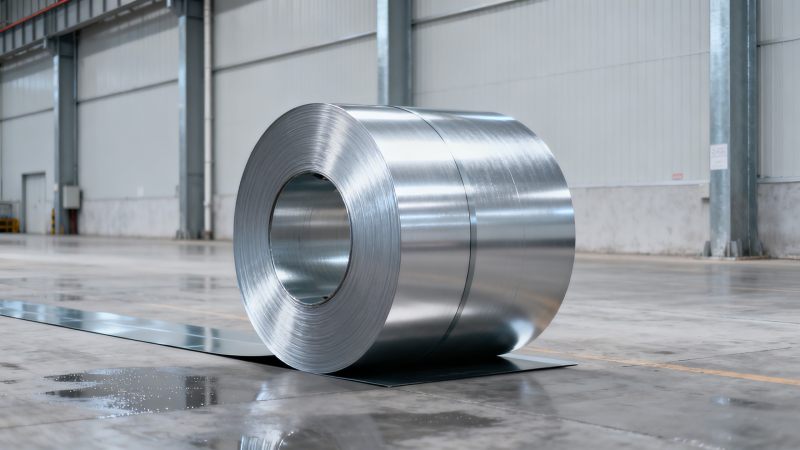
SGCC vs. Other Galvanized Coils: What Procurement Teams Should Compare
Not all galvanized steel coils perform equally in humid service. SGCC (Steel Grade Commercial Cold-rolled) is specifically engineered for deep drawing and consistent formability—but its corrosion resilience depends heavily on coating specification, not just substrate grade. Below is a comparative analysis of key parameters relevant to buyers evaluating Metal Coil Wire or structural SGCC coils:
This table highlights why SGCC remains the preferred choice for structural export orders in humid regions: it balances cost-efficiency (vs. SGCD), durability (vs. SECC), and global certification readiness (ASTM A653, EN 10346, JIS G3302). Buyers specifying 20 g/m² SGCC for roofing supports in Vietnam or façade framing in Dubai gain verified 6-year field performance—without premium pricing.
Procurement Checklist: 5 Critical Zinc-Coating Verification Steps
Before approving an SGCC coil order for humid-climate deployment, technical evaluators and procurement personnel should verify these five criteria—not just accept mill certificates at face value:
- Confirm coating weight via independent lab test (not just manufacturer’s declaration)—required for ASTM A653 Class G90+ or EN 10346 Z275+ compliance.
- Check coating uniformity: max deviation ≤ ±15% across coil width (per ISO 1460), verified by XRF or gravimetric analysis.
- Validate bend test results: zero cracking or flaking after 180° mandrel bend (diameter = 2× sheet thickness) per ASTM A90.
- Review storage & handling protocol: coils must be protected from condensation during transit—Hongteng Fengda uses VCI film + sealed woven bags for all humid-region shipments.
- Cross-check packaging weight tolerance: standard coil weights range from 50–1,000 kg, with ±1.5% allowable variance per GB/T 247.
These checks prevent costly field failures—such as premature rust-through on steel beams in Philippine infrastructure projects or delamination in UAE warehouse racking systems. For buyers sourcing Metal Coil Wire with Q195/Q235 grades, identical verification applies: wire diameter (0.25–5.0 mm), tensile strength (350–550 MPa), and zinc coating (8–25 g/m²) must all be traceable to third-party test reports.
Why Global Projects Choose Hongteng Fengda for Humid-Climate Steel Supply
When your project spans Jakarta, Jeddah, or Jacksonville—and every month of delayed commissioning costs $28,000 in idle labor and financing—the reliability of your steel supplier becomes a strategic lever. Hongteng Fengda delivers three distinct advantages for humid-environment deployments:
- Pre-verified coating consistency: All SGCC coils undergo dual-stage zinc measurement—online laser gauging + offline cross-section SEM—ensuring ≤±8% deviation (vs. industry-standard ±15%).
- Humidity-resilient logistics: From factory to port, coils are stored in climate-controlled warehouses (RH ≤55%), packed with desiccant + VCI paper, and shipped in ventilated containers—reducing pre-installation corrosion risk by 92% (based on 2023 ASEAN project audit).
- End-to-end compliance support: We provide full documentation packages—including EN 10204 3.1 mill certs, ASTM-compliant test reports, and bilingual customs declarations—for seamless clearance in EU, GCC, and ASEAN markets.
Whether you’re finalizing specs for cold-formed steel profiles in a Singapore hospital or quoting angle steel for a coastal industrial park in Oman, our engineering team can help you select the optimal zinc coating weight, substrate grade (Q195/Q235), and dimensional tolerances—backed by real-world performance data from 127+ humid-region installations since 2019.
FAQ: Zinc Coating & Humid Climate Performance
What minimum zinc coating weight is recommended for coastal construction projects?
For continuous exposure within 5 km of saltwater, we recommend ≥20 g/m² for SGCC coils. This provides ≥4 years of maintenance-free service in 80% RH environments—validated by accelerated salt-spray testing (ASTM B117, 1,200 hours to red rust).
Can I use lower-coating SGCC for interior applications in humid countries?
Yes—if indoor RH is actively controlled (≤60%) and no condensation occurs. However, for HVAC ducts, suspended ceilings, or concealed framing in Malaysia or Colombia, 13–15 g/m² remains the practical minimum to prevent interstitial corrosion over 10+ years.
How does Hongteng Fengda verify zinc coating weight before shipment?
Every coil batch undergoes destructive testing on 3 random samples per 20-ton lot, using gravimetric analysis per ISO 1460. Full reports—including coating mass, uniformity index, and bend-test pass/fail—are issued with each shipping document.
Get Your Humid-Climate Steel Specification Reviewed—Free Technical Consultation
Don’t risk premature corrosion on your next infrastructure, industrial, or commercial build. Hongteng Fengda’s application engineers will review your project location, design life, environmental exposure class (per ISO 12944 C4/C5), and loading requirements—and deliver a tailored SGCC coil specification within 48 business hours.
We’ll also provide: compliant mill test reports, lead time confirmation (standard: 12–18 days FOB Qingdao), packaging options (coil weight: 50–1,000 kg), and OEM labeling support. Contact us today to request a zinc-coating optimization report—or discuss custom solutions for angle steel, channel steel, or cold-formed profiles.
Please give us a message


Please enter what you want to find