S355JR Steel: What the Grade Means for Structural Projects
S355JR steel is widely used in structural projects where strength, weldability, and material traceability matter. For technical evaluators comparing acero s355jr specifications, understanding the grade designation is an essential first step: S denotes structural steel, 355 refers to its minimum yield strength in MPa for the applicable thickness range, and JR indicates a specified impact energy at room temperature. This guide explains what these properties mean for material selection, fabrication, and project requirements.
The grade is useful shorthand, but it is not a complete purchase specification. A beam, plate, hollow section and cold-formed profile can all appear in a structural steel schedule, yet different product standards and manufacturing routes may apply. Before accepting a material, the evaluator needs to know not only its nominal grade, but also which standard governs the supplied product and what evidence accompanies it.
Reading the designation in context
S355JR is a non-alloy structural steel grade covered by EN 10025-2, which sets technical delivery conditions for specified hot-rolled products. EN 10025-1 provides general technical delivery conditions. The applicable edition, product form and any project-specific additions should be identified in the purchase documents rather than assumed from the grade name alone.
The number 355 is the minimum specified yield strength, expressed in MPa, for the applicable thickness range. It does not mean that every S355JR product, regardless of thickness, has a 355 MPa minimum. Yield requirements decrease for certain thicker products under the relevant standard. Designers should use the value applicable to the actual product thickness and the governing design rules—not a value copied from a generic grade summary.
JR identifies a Charpy V-notch impact requirement of 27 J at +20 °C under the relevant test conditions. It is a toughness classification, not a promise that the material is suitable for every structure exposed to low temperatures, dynamic loads or fracture-sensitive details. Specimen size, sampling and evaluation are governed by the applicable standard.
A delivery condition may also appear as a suffix, such as +AR or +N. These indicate different rolling or delivery conditions; they should not be treated as decorative additions to the grade. Confirm the ordered condition against the certificate and consider its implications for fabrication and any subsequent heat treatment.
Strength is only one part of the design decision
The attraction of S355JR is straightforward: its specified yield strength can allow a designer to consider smaller sections than would be possible with a lower-strength grade, provided yielding controls the design. In practice, however, member selection may be governed by deflection, buckling, connection resistance, vibration, fatigue or minimum practical thickness. A higher yield strength does not automatically make a lighter section acceptable.
Consider a long floor beam: its strength may be adequate, while serviceability limits on deflection still require a deeper or stiffer section. A compression member may instead be governed by stability. The correct comparison is therefore between complete member designs, including their connections and fabrication requirements, not just between the yield strengths printed on two material data sheets.
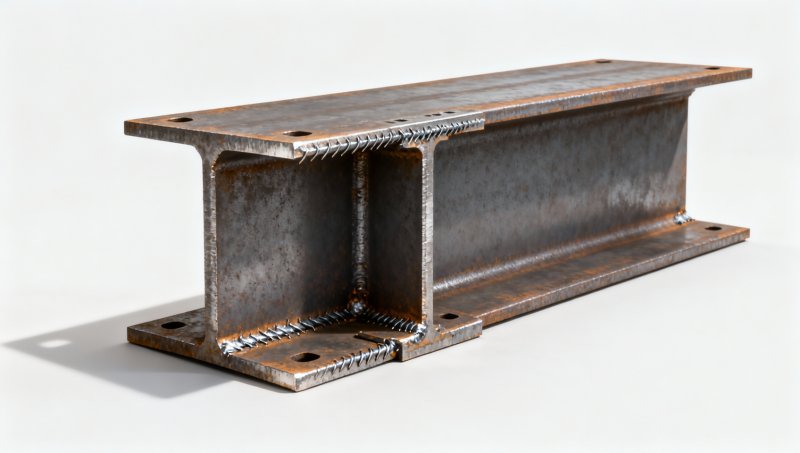
Thickness also matters at the joint. A welded connection involving a heavy flange or a thick end plate may present different restraint and cooling conditions from a connection between lighter members. Where through-thickness stresses or fracture risks are significant, the project may require additional material properties or testing beyond the basic grade designation.
JR, J0 and J2: why the temperature matters
S355JR, S355J0 and S355J2 share the S355 strength designation, but their impact-test temperatures differ. The familiar classifications specify 27 J at +20 °C, 0 °C and −20 °C respectively. The distinction matters when a design specification addresses brittle fracture, particularly for thick, highly restrained or dynamically loaded components.
Do not choose between these grades solely by comparing the lowest expected air temperature with the Charpy test temperature. Material selection can also depend on steel temperature, thickness, stress level, loading rate, detail geometry and the applicable design standard. A J2 designation may be specified where greater low-temperature toughness is needed, but the project engineer must determine the actual requirement.
Likewise, a satisfactory room-temperature impact result does not establish fatigue life. Repeated loading requires a separate assessment of stress ranges, weld details and the relevant fatigue provisions. Substituting a different toughness grade without design approval can therefore close one perceived gap while leaving the governing issue unresolved.
What fabricators need to check before welding
S355JR is generally regarded as suitable for conventional structural welding, but “weldable” does not mean that any procedure is suitable for every joint. Review the actual material chemistry and carbon equivalent, section thickness, restraint, heat input, consumables and workshop conditions when determining the welding procedure. Preheat or interpass controls may be necessary depending on those factors and the applicable fabrication code.
The inspection document is useful here because nominal grade limits are not a substitute for the reported cast analysis. A fabricator should also check whether the project requires qualified welding procedures, welder qualifications, inspection plans or non-destructive testing. These requirements come from the execution specification and relevant standards; they are not automatically defined by the letters S355JR.
Cold forming deserves its own review. Bend radius, product thickness, rolling direction and the severity of deformation affect the risk of cracking. Where a hot-rolled product is subsequently formed into a custom component, agree on the applicable forming limits and inspection requirements before production. A finished cold-formed section should not automatically be described as an EN 10025-2 product without checking the relevant product standard and delivery documentation.
Product form and equivalent grades: common sources of confusion
An order for “S355JR steel” leaves practical questions unanswered. Is the requirement for plate, an angle, a channel or a beam? Which dimensions, tolerances and surface conditions apply? Are holes, weld preparations or cut lengths part of the supply? The answers determine which documents the supplier can provide and how the material will be inspected on arrival.
Hollow sections require particular care. Hot-finished and cold-formed structural hollow sections are commonly specified under their own product standards, such as EN 10210 and EN 10219. Their grade designations, tolerances and technical requirements are not interchangeable simply because a supplier describes them as “S355.” Confirm the precise designation on the drawing and certificate.
Cross-standard substitutions deserve the same caution. An ASTM, JIS or GB grade may have a similar nominal strength, but similarity does not establish equivalence in impact requirements, chemistry, dimensional tolerances, delivery condition or testing. A proposed alternative should be assessed against the complete project specification and approved through the responsible engineering process before it is purchased or fabricated.
Corrosion protection and mixed-material assemblies
S355JR is not a stainless or weathering steel designation. Its corrosion protection must be selected for the exposure and maintenance plan, whether that involves painting, galvanizing or another specified system. Connection geometry matters: water traps, inaccessible surfaces and poorly detailed crevices can make a theoretically adequate coating difficult to maintain.
A project may also combine a carbon-steel frame with corrosion-resistant process piping. For example, 316 Stainless steel pipe may be considered for chemical or industrial service, where its molybdenum content can improve resistance to certain corrosive environments compared with 304. The pipe is a separate material selection, not a substitute for S355JR structural members. Its suitability still depends on the medium, temperature, concentration and applicable piping standard; supports should also be detailed to manage potential galvanic corrosion where dissimilar metals meet in the presence of an electrolyte.
Turning a grade into an inspectable purchase requirement
Traceability begins before the steel leaves the mill. The order should state the required product standard and edition, grade, delivery condition, dimensions, quantities and any supplementary testing. It should also identify the inspection document required under EN 10204, where applicable. A type 3.1 certificate, for example, is validated by the manufacturer’s authorized inspection representative independent of manufacturing; its reported results should be checked against the ordered requirements.
At receipt, the practical question is whether the physical steel can be linked back to the documentation. Review markings, heat or cast identification, dimensions, quantities and any agreed test results. If members are cut into smaller pieces, establish how identification will be transferred or otherwise maintained through fabrication. A certificate without a reliable link to the material provides limited assurance for a traceability-sensitive project.
For exported structural steel, the document review should also cover units, drawing revisions, packing, identification and the destination project’s acceptance requirements. A supplier may work with several international standards, but each item still needs to be ordered and certified to the standard specified for that item. Claimed general compliance is not a replacement for a product-specific certificate.
Hongteng Fengda supplies structural products including angles, channels, beams and customized components from China. For a technical evaluation, the useful next step is to align the drawing and material schedule with the intended product standard, required certificates, fabrication scope and delivery timetable. Where a dimension, grade or documentation requirement cannot be met as written, request the proposed deviation in writing and have it reviewed before production begins.
Please give us a message


Please enter what you want to find