S355JR steel is one of the most practical structural grades for general construction where buyers need a reliable balance of strength, weldability, availability, and cost. In real projects, it works best in building frames, platforms, secondary support systems, stair structures, industrial sheds, and many welded structural assemblies. For engineers, procurement teams, and project managers, the main question is usually not whether S355JR is usable, but whether it is the right choice for the load level, fabrication method, corrosion exposure, and budget target. If selected correctly, it can help control material cost, simplify fabrication, and reduce sourcing risk without sacrificing structural performance.
What is the core value of S355JR steel in construction?
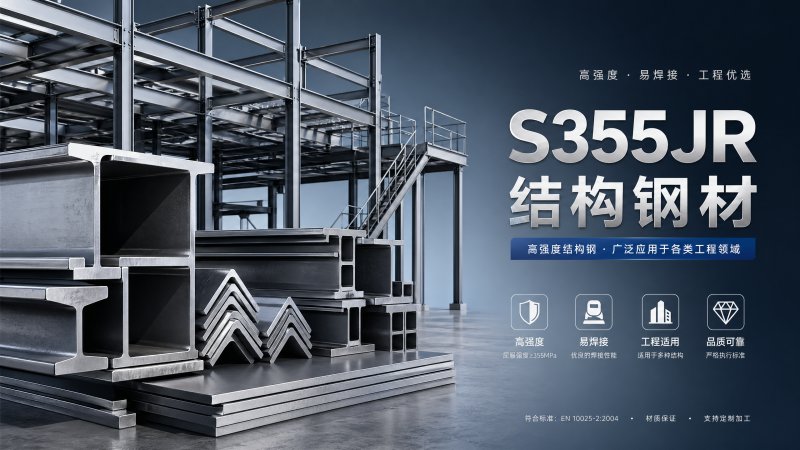
The reason S355JR steel is widely specified in construction is simple: it offers a solid yield strength level for many structural applications while remaining easy to cut, weld, form, and source. That makes it especially attractive for projects that need dependable performance but do not require more specialized high-strength or low-temperature grades.
In practical terms, S355JR is often a strong fit when a project needs:
- Stable structural performance for common building and industrial uses
- Good weldability for fabricated sections and assemblies
- Efficient processing in workshops and steel beam factories
- Reasonable total cost compared with higher-grade alternatives
- Availability in multiple structural forms such as beams, channels, angles, and plates
For many buyers and technical reviewers, this grade sits in the “high utility” range: strong enough for many structural tasks, but not unnecessarily expensive or difficult to fabricate.
Where does S355JR steel work best in construction projects?
S355JR performs best in applications where the structure needs good load-bearing ability, reliable fabrication, and cost-effective procurement. It is commonly used in:
1. Building frames and secondary structural systems
S355JR is widely used for columns, beams, bracing members, and secondary framing in commercial buildings, warehouses, workshops, and agricultural structures. It is especially suitable where standard structural steel sections are used and fabrication efficiency matters.
2. Industrial platforms and equipment support structures
Factories, logistics centers, and processing plants often use S355JR for maintenance platforms, walkways, machinery supports, access stairs, and service structures. These components benefit from its weldability and balanced strength.
3. Roof support and mezzanine systems
When load conditions are moderate to high and the design requires dependable stiffness, S355JR can be used in roof framing members, trusses, and mezzanine supports. It is a practical option when engineers need better structural capacity than lower-strength grades.
4. General welded fabrications
Fabricated assemblies such as base frames, support racks, connection elements, and custom structural components often use S355JR because workshop production is simpler when the material cuts and welds consistently.
5. Bridges and infrastructure support components in non-special environments
For some non-critical or general support roles, S355JR may be selected where project requirements align with its mechanical properties. However, for bridge main members or projects with severe environmental or fatigue demands, engineers often compare it against more specialized grades.
When is S355JR a better choice than other common structural steel grades?
This is one of the most important questions for technical evaluators and procurement teams. S355JR is often preferred when the project needs more strength than mild structural steel but does not justify the added cost or specification complexity of more advanced grades.
It is usually a better choice when:
- The design benefits from higher yield strength to reduce section size or improve load capacity
- The structure includes extensive welding and fabrication
- The project budget is sensitive, but quality and compliance still matter
- The buyer wants a widely recognized EN-standard structural steel grade
- The project is in a normal temperature service environment
On the other hand, it may be less suitable when:
- The structure faces very low service temperatures
- There are unusually high impact toughness requirements
- The project needs enhanced weather resistance or special corrosion performance
- Design codes or end users require another exact grade or regional standard
How should buyers compare S355JR in steel beams, angle steel, and structural sections?
For sourcing teams, choosing the grade is only part of the decision. The actual section type affects cost, fabrication efficiency, and structural performance just as much.
Steel beams
S355JR is commonly supplied in beam sections for frame structures and load-bearing systems. In many projects, the comparison between I beam vs H beam matters more than the grade alone. H beams are often preferred for stronger load distribution and structural stability in larger frames, while I beams may be used where geometry, connection design, or cost optimization supports the choice.
Angle steel
S355JR angle steel is useful for bracing, edge frames, support brackets, lattice members, and connection reinforcement. Buyers often choose it for fabrication flexibility and easier integration into lighter structural systems.
Channels and cold formed profiles
For support frames, purlins, rails, and secondary members, S355JR in channels or customized cold formed profiles can improve both structural consistency and manufacturing efficiency, especially in repeat production or modular construction.
In reinforced concrete construction, structural performance also depends on the right steel bar selection. For projects that need compliant reinforcing materials across different standards, Rebar options such as GB1499.2 HRB400, HRB500, ASTM A615 Grade 60, and BS4449 460B are commonly considered. These carbon steel bars are valued for good formability and weldability, with typical supply lengths of 1–12 m or customized production, helping contractors align structural steel framing with broader building material requirements.
What are the main commercial and technical advantages of S355JR?
For decision-makers, S355JR is attractive not only because of engineering performance, but because it supports better overall project economics.
Balanced cost-performance ratio
It gives many projects enough strength to meet structural demands without moving into unnecessarily expensive material grades. This can improve budget control, especially in medium- to large-scale construction packages.
Good fabrication efficiency
Material that welds and processes well usually saves time in manufacturing. That can reduce workshop delays, rework risk, and hidden fabrication costs.
Broad global sourcing potential
Because S355JR is a well-known structural steel grade, global buyers can often source it in different section forms and specifications. This improves procurement flexibility and lowers supply-chain dependence on a single market.
Compatibility with customized structural production
For projects requiring OEM structural components, pre-fabricated supports, or project-based dimensions, S355JR is often practical for customized production in modern structural steel facilities.
What concerns should engineers, QC teams, and procurement managers check before ordering?
Even when S355JR is the right grade on paper, actual project success depends on specification control. Buyers should review:
- Applicable standard and grade confirmation
- Mechanical property compliance and mill test documentation
- Section dimensions, tolerances, and straightness
- Surface condition and corrosion protection requirements
- Welding procedure compatibility
- Delivery condition and traceability
- Factory production capacity and lead time reliability
For coated or outdoor structural uses, teams should also clarify whether black steel, primed steel, or galvanized products are more suitable. Galvanized structural products can add cost upfront, but in many outdoor or humid environments they reduce maintenance burden and improve long-term value.
How can buyers judge whether a supplier is reliable for S355JR structural steel?
For distributors, contractors, and project owners, supplier capability is as important as material grade. A reliable structural steel manufacturer should be able to provide:
- Clear compliance with major standards such as EN, ASTM, JIS, and GB where relevant
- Consistent quality control across beams, angles, channels, and custom sections
- Stable export experience for international projects
- Support for customized structural steel components
- Dependable lead times and packing suitable for overseas delivery
- Responsive technical and commercial communication
For many overseas buyers, sourcing from a qualified Chinese structural steel manufacturer can be a practical way to control steel beam factory price while still meeting international quality expectations. The key is to evaluate more than unit price: quality consistency, documentation, production stability, and service responsiveness all affect final procurement risk.
Final judgment: is S355JR steel the right fit for your construction project?
S355JR steel works best in construction when the project needs a dependable structural grade for frames, platforms, supports, mezzanines, and general welded assemblies, without moving into more specialized or higher-cost material classes. Its biggest advantage is balance: enough strength for many construction applications, good weldability for fabrication, and strong commercial practicality for global sourcing.
If your project involves standard structural sections, fabricated supports, or cost-sensitive building systems, S355JR is often a very efficient choice. If the service environment is harsher, the temperature requirements are lower, or the design conditions are more demanding, then a closer grade comparison is necessary. In other words, S355JR is not the answer for every structure, but for a large share of general construction work, it remains one of the most useful and commercially sound options available.
Please give us a message


Please enter what you want to find