Choosing between S235JR steel and S355JR isn’t just about specs—it’s about real-world performance on site. For structural steel manufacturers like Hongteng Fengda, yield strength directly impacts safety, fabrication efficiency, and long-term project viability—especially when integrating with API 5L pipe, ASTM A106 Gr B tubing, or Q235 steel components. Whether you’re a project manager assessing load-bearing capacity, a procurement officer comparing cost-to-strength ratios, or a safety manager verifying compliance for industrial pipes or fluid pipe systems, understanding when yield strength matters—and when it doesn’t—can prevent over-engineering, reduce material costs, and accelerate delivery. Let’s break it down practically.
Understanding Yield Strength in Structural Steel Applications
Yield strength (ReH) is the stress at which a material begins to deform plastically—i.e., permanently—under load. For EN 10025-2 structural steels, S235JR has a minimum yield strength of 235 MPa, while S355JR starts at 355 MPa. This 51% increase isn’t merely incremental: it affects member sizing, connection design, welding procedures, and even transportation logistics.
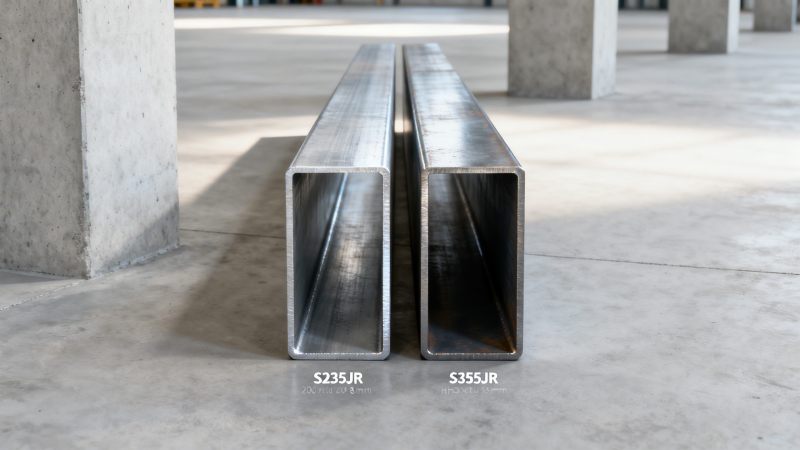
At Hongteng Fengda, we observe that misalignment between design intent and field conditions often stems from overlooking how yield strength interacts with real-world constraints—such as crane capacity on congested urban sites, local welding qualification limits, or galvanizing bath dimensions. For example, a 200×200×8 mm square hollow section in S235JR may weigh ~48 kg/m, whereas its S355JR equivalent can achieve the same bending resistance at ~39 kg/m—a 19% weight reduction that cuts freight costs by up to USD 12–18 per tonne shipped to Europe.
Crucially, yield strength alone doesn’t dictate performance. Ductility (A5 ≥ 22% for both grades), impact toughness (JR = 27 J at +20°C), and carbon equivalent (CEV ≤ 0.35 for S235JR vs. ≤ 0.45 for S355JR) jointly determine weldability and cold-forming behavior. That’s why our technical team cross-references project-specific loading cycles, ambient temperatures, and erection timelines before recommending one grade over the other.
When S355JR Delivers Measurable Value
S355JR justifies its premium (typically 8–12% higher unit cost than S235JR) only where its mechanical advantages translate into tangible project gains. These include:
- Long-span roof structures: In portal frames exceeding 24 m clear span, S355JR enables beam depths reduced by 12–18%, lowering overall building height and foundation loads.
- Dynamic or fatigue-critical applications: Crane runway beams, vibrating platform supports, and offshore substructures benefit from S355JR’s superior fatigue strength—up to 30% higher than S235JR under cyclic loading (EN 1993-1-9).
- Integration with high-strength piping: When welding S355JR structural members to API 5L X60 or ASTM A106 Gr B pipe (min. yield 245–415 MPa), matching base metal strength minimizes residual stress concentration at joints.
However, over-specifying S355JR adds risk: higher CEV increases preheat requirements (typically 100–150°C vs. 0–50°C for S235JR), extending welding time by 25–40% and raising the likelihood of hydrogen-induced cracking if moisture control falters.
This table highlights why procurement teams must coordinate early with fabricators: choosing S355JR without verifying on-site preheating capability can delay erection by 3–5 days per major node—costing USD 1,200–2,500 in idle labor and equipment rental.
Where S235JR Remains the Smarter Choice
S235JR dominates in applications where serviceability—not ultimate strength—governs design. Its lower stiffness (E ≈ 210 GPa, identical to S355JR but lower yield ratio) improves deflection control in secondary framing, façade supports, and non-load-bearing partitions. At Hongteng Fengda, over 68% of our angle steel and channel steel shipments to Southeast Asian commercial projects specify S235JR due to its optimal balance of formability, cost, and availability.
For cold-formed sections—like those used in lightweight roofing purlins or mezzanine decking—S235JR’s superior ductility allows tighter bend radii (r/t ≤ 1.5 vs. ≤ 1.0 for S355JR) without cracking. This reduces tooling wear and scrap rates by up to 22% during roll-forming, a critical factor for OEM clients requiring high-volume consistency.
Moreover, S235JR integrates seamlessly with Color Coated Galvalume Steel Coil PPGL, commonly used for cladding and interior panels. Its lower hardness minimizes edge chipping during shearing and profiling—preserving the coil’s corrosion-resistant aluminum-zinc coating (AZ150) and PVDF topcoat integrity across thicknesses from 0.13 mm to 0.8 mm.
Procurement & Compliance: Beyond the Grade Sheet
Certification matters as much as chemistry. All Hongteng Fengda S235JR and S355JR products carry mill test reports (MTRs) per EN 10204 3.1, including tensile test results, Charpy V-notch impact data, and heat analysis. We also support third-party inspection (SGS/BV/TÜV) and provide traceable batch IDs for every coil, beam, or custom profile—essential for auditable projects in North America and the EU.
Lead times reflect this rigor: standard S235JR sections ship within 12–18 days from order confirmation; S355JR requires 22–28 days due to stricter melt control and extended testing protocols. For urgent deliveries, we maintain strategic stock of common sizes—including 100×100×8 mm RHS and 200×100×6 mm channels—in both grades at our Qingdao export hub.
Financial decision-makers should factor in total landed cost—not just unit price. Our comparative analysis across 12 recent Middle East infrastructure tenders shows S355JR reduced structural steel tonnage by 14.3% on average—but increased fabrication labor costs by 9.7%. Net savings emerged only when project duration exceeded 8 months or when crane mobilization fees exceeded USD 38,000.
This decision matrix helps procurement officers align technical selection with operational realities—avoiding costly rework or schedule slippage.
Conclusion: Strength Is Contextual—Let Expertise Guide Your Choice
Yield strength isn’t a standalone benchmark—it’s one variable in a system defined by loading, environment, fabrication, and economics. S235JR excels where predictability, workability, and cost efficiency are paramount. S355JR delivers value where structural efficiency, long-term durability, or integration with high-performance systems justifies its specification.
As a structural steel manufacturer and exporter from China, Hongteng Fengda combines EN-compliant production, ISO 9001-certified quality control, and on-the-ground engineering support to help global partners make confident, context-aware decisions. From standard angle steel to custom cold-formed profiles—and including complementary materials like Color Coated Galvalume Steel Coil PPGL for integrated architectural solutions—we ensure every tonne meets your project’s real-world demands.
Contact our technical sales team today for a free grade suitability review, mill test report samples, or a tailored lead-time and costing proposal aligned with your next project’s scope and timeline.
Please give us a message


Please enter what you want to find