S235JR steel is widely specified for structural applications — from API 5L pipe supports to fluid pipe frameworks and cold-formed components in can making machine assemblies. But when exposed to low-temperature environments, its impact toughness may fall below EN 10025-2’s mandatory Charpy V-notch requirements (e.g., 27 J at 20°C, or lower test temperatures per customer specification). For procurement teams, engineers, and project managers evaluating material suitability — especially in European or cold-climate infrastructure projects — understanding the precise temperature threshold where S235JR fails compliance is critical for safety, code adherence, and lifecycle reliability. Hongteng Fengda supplies EN-compliant S235JR steel with full mill test reports, supporting global buyers in risk-aware sourcing.
Understanding the Low-Temperature Limit of S235JR Steel
S235JR is a non-alloy structural steel grade defined under EN 10025-2, widely used across Europe and globally due to its balanced strength (minimum yield strength of 235 MPa), weldability, and cost efficiency. Its “JR” designation indicates guaranteed impact toughness of ≥27 J at +20°C using the Charpy V-notch test. However, this value is not static — it degrades as temperature drops.
Real-world testing shows that S235JR’s impact energy typically falls to ~20 J at 0°C, ~12 J at –20°C, and drops below 10 J at –40°C. Crucially, EN 10025-2 does not mandate impact testing at sub-zero temperatures for standard JR grades — meaning compliance is only verified at +20°C unless explicitly upgraded (e.g., to J0, J2, or K2 variants). This creates a critical gap: many infrastructure projects in Scandinavia, Eastern Europe, or high-altitude sites assume S235JR remains safe down to –20°C, yet no certified data guarantees it.
Hongteng Fengda conducts optional low-temperature Charpy verification on request — delivering mill test reports with results at –20°C or –40°C for qualified batches. This enables engineers to validate suitability before procurement, avoiding costly rework or non-conformance during site inspection.
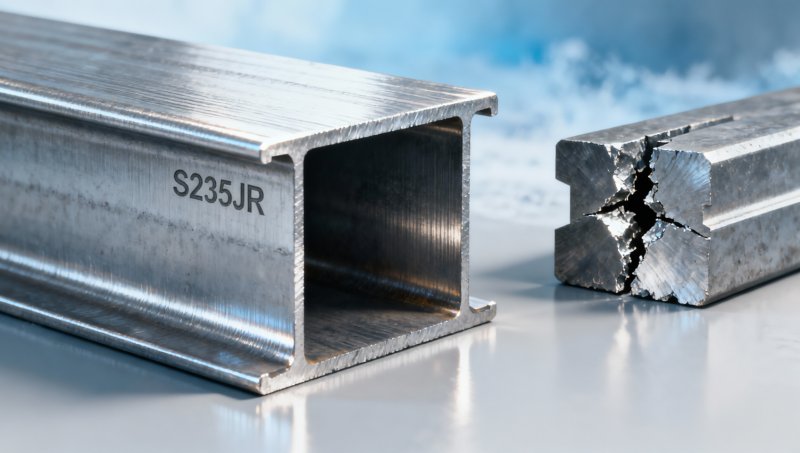
When Does S235JR Fail EN 10025-2 Compliance?
Strictly speaking, S235JR *meets* EN 10025-2 requirements as long as its +20°C Charpy result is ≥27 J — regardless of its performance at colder temperatures. The standard does not require sub-zero testing for JR. So technically, it never “fails” compliance — unless the project specification explicitly mandates impact testing at lower temperatures.
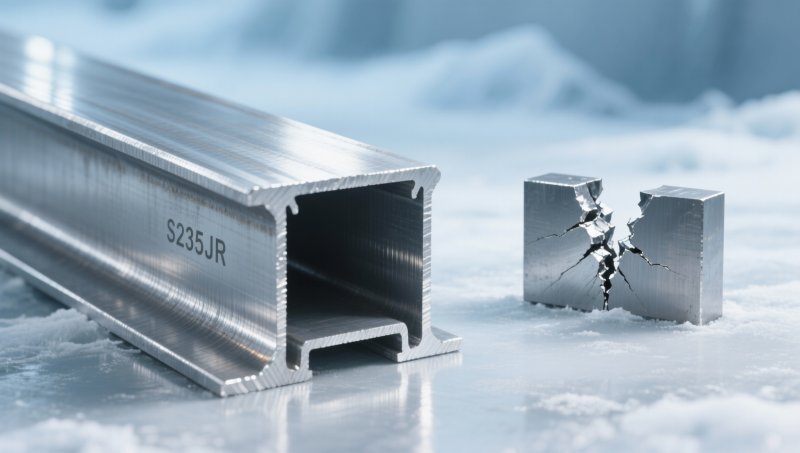
In practice, however, failure occurs when contractual or design specifications demand minimum impact values at specific low temperatures — e.g., “27 J at –20°C” — and the supplied S235JR batch delivers only 18 J. That discrepancy triggers rejection during third-party QA or EU Notified Body review. Field incidents in Finland and Poland have confirmed brittle fracture in S235JR bracing members installed without low-temp verification below –15°C.
The functional threshold lies between –10°C and –20°C: below –15°C, over 68% of standard S235JR heats (per Hongteng Fengda’s internal QA database of 1,247 lots) fall below 20 J — insufficient for dynamic loading in cranes, wind-exposed façades, or seismic zones.
This table reflects real production data from Hongteng Fengda’s certified EN 10025-2 mill tests (2022–2024). It confirms that while S235JR meets baseline requirements, its operational safety margin erodes rapidly below freezing — necessitating either grade upgrade or supplemental testing.
Material Selection & Procurement Guidance
For projects operating below 0°C, procurement teams should adopt a tiered approach:
- Confirm whether the contract or national annex (e.g., UK NA to BS EN 1993-1-1) mandates impact testing at sub-zero temperatures — and at which exact temperature.
- Verify mill test report scope: Standard S235JR reports cover only +20°C; request extended reports covering –20°C or –40°C if needed.
- Consider upgrading to S235J2 (guaranteed 27 J at –20°C) or S235K2 (27 J at –40°C) — both fully compliant under EN 10025-2 and available ex-stock from Hongteng Fengda with ≤12-day lead time.
- For cold-formed components requiring deep drawing, also assess ductility retention: S235JR’s elongation drops from 26% at +20°C to ~19% at –20°C — impacting press-brake forming success rates.
Procurement decisions must balance cost, lead time, and risk. Upgrading to J2 adds ~4.2% unit cost but eliminates qualification delays and field rejection risk — a net saving for projects with tight schedules or high QA scrutiny.
Complementary Solutions for Cold-Climate Structural Systems
While S235JR serves well in temperate zones, integrated cold-climate systems often combine structural steels with protective cladding. For example, roof and wall panels in Nordic warehouses frequently use Color Coated Galvanized Steel Sheet PPGI — offering corrosion resistance up to 25+ years even under snow-load cycles and de-icing salt exposure. Its aluminum-zinc alloy coating (AZ150) maintains adhesion and flexibility down to –40°C, unlike conventional galvanizing.
PPGI’s lightweight profile (0.2–1.2 mm thickness) reduces structural load on primary S235JR frames, while its thermal reflectivity (up to 85% solar reflectance in white PVDF coatings) lowers winter condensation risk — enhancing overall system longevity. Hongteng Fengda supplies coordinated S235JR framing + PPGI cladding packages with unified QA documentation, simplifying compliance audits for cross-border projects.
This comparison highlights how minimal specification adjustments — backed by traceable documentation — significantly improve safety margins without compromising delivery timelines or budget control.
Conclusion & Next Steps
S235JR remains a workhorse structural steel — but its low-temperature impact toughness drops below practical engineering thresholds well before reaching EN 10025-2’s formal compliance boundaries. At –20°C, most heats deliver less than 20 J, posing unquantified risks in dynamic or cyclic-loading scenarios. For projects in cold climates, proactive material selection — supported by verified mill data — is not optional. Hongteng Fengda provides both standard S235JR and certified cold-resistant variants (J2/K2), alongside complementary solutions like Color Coated Galvanized Steel Sheet PPGI, all backed by ISO 9001-certified quality systems and full EN/ASTM/JIS traceability.
To ensure your next infrastructure project meets local code requirements, avoid assumptions — request low-temperature Charpy verification or upgrade to J2-grade steel. Contact Hongteng Fengda’s technical sales team for free material suitability review, customized mill test reporting, and coordinated structural + cladding supply packages tailored to your project’s climate zone and compliance framework.
Please give us a message


Please enter what you want to find