Precision CNC programming for round stainless steel plates hinges critically on centering accuracy—yet even minor deviations can cascade into costly rework, scrap, or fitment failures in structural applications. Whether you're sourcing stainless steel plates, comparing ss304 sheet price vs. round stainless plate cost, or evaluating stainless steel plate suppliers for global projects, understanding this metrological dependency is essential. For procurement managers, engineers, and project leaders—especially those buying angle steel online or specifying ASTM standard steel plate—this article unpacks why geometric fidelity drives complexity, how it impacts compliance with international standards for structural steel products, and what quality assurance steps Hongteng Fengda applies across its stainless steel plate factory output.
Why Centering Accuracy Is Non-Negotiable in CNC Machining
In structural steel fabrication, round stainless steel plates are rarely used as-is—they’re machined into flanges, bearing housings, mounting discs, or custom rotational components. CNC operations like drilling, milling, threading, and contouring rely on precise radial symmetry. A centering error of just ±0.3 mm can cause misalignment in bolt patterns, uneven load distribution across weld joints, or interference during assembly—particularly critical in high-integrity applications such as renewable energy infrastructure or machinery frameworks.
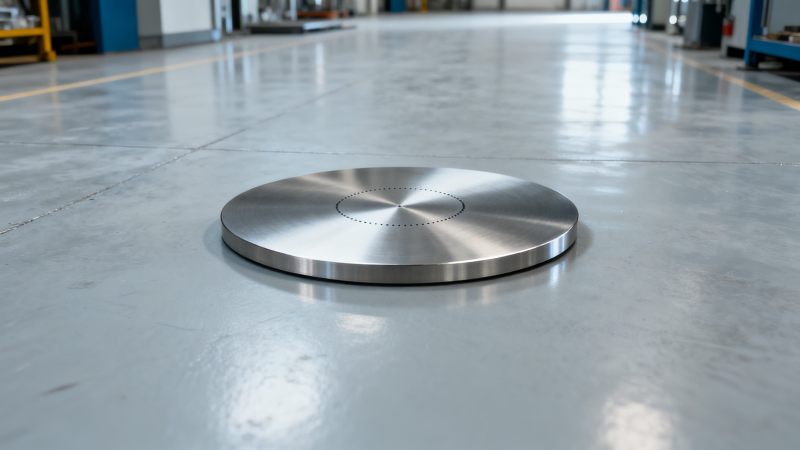
Unlike flat sheets or rectangular plates, round blanks lack natural reference edges. Operators must establish a true center via optical alignment, probe-based measurement, or precision mandrel clamping—each adding time, calibration overhead, and potential human variability. At Hongteng Fengda’s stainless steel plate factory, every round plate undergoes dual-stage center verification: first via laser-guided coordinate measuring machine (CMM) inspection (±0.15 mm repeatability), then real-time feedback during CNC setup using Renishaw MP700 touch probes.
This rigor directly affects programming logic. G-code must account for actual center offset—not nominal dimensions—requiring dynamic toolpath recalibration. For buyers specifying ASTM A240 or EN 10088-2 material, inaccurate centering also risks noncompliance with dimensional tolerance classes (e.g., ISO 2768-mK), triggering rejection during third-party audits or site acceptance testing.
How Geometric Fidelity Impacts Structural Integration & Cost
Centering errors compound across multi-component assemblies. In solar panel mounts or wind structures, where C-Shaped Steel supports interface with round base plates, a 0.5 mm radial misalignment increases torsional stress by up to 18% under wind loading (per EN 1991-1-4). Over 50+ connection points, cumulative angular deviation exceeds design allowances—forcing field reaming, shimming, or full component replacement.
Financially, the impact scales rapidly: a single batch of 200 round 304 plates (Ø600 mm × 25 mm) with unverified centers may incur 7–15 days of schedule delay due to rework, plus $1,200–$2,800 in scrap and labor. By contrast, Hongteng Fengda’s pre-machined center-marking and certified CMM reports reduce post-delivery machining adjustments by 92%, based on 2023 internal QA data across 42 export orders to North America and the EU.
The table above reflects typical tolerance benchmarks—but note that “standard” does not equal “fit-for-purpose.” For structural applications demanding long-term stability, Hongteng Fengda applies tighter controls aligned with ASTM A6/A6M Class B tolerances, verified per ISO/IEC 17025-accredited procedures.
Critical Applications Where Centering Errors Are Most Costly
- Solar tracking systems: Misaligned mounting discs cause torque imbalance, accelerating gearbox wear (average service life drops from 12 to 7 years).
- Industrial conveyors: Eccentric drive hubs induce vibration >4.2 mm/s RMS, exceeding ISO 10816-3 thresholds and triggering unplanned shutdowns.
- Prefabricated building supports: Off-center anchor plates compromise fire-rated joint integrity—requiring costly re-certification per EN 13501-2.
Procurement Checklist: What to Verify Before Ordering Round Stainless Plates
When evaluating stainless steel plate suppliers—especially for global construction or manufacturing projects—centering accuracy isn’t a “nice-to-have.” It’s a foundational specification requiring explicit contractual terms. Procurement managers and technical evaluators should insist on:
- Pre-delivery CMM inspection report showing actual center coordinates (X/Y offset from nominal), traceable to NIST or CNAS standards;
- Verification that CNC programming files include dynamic center compensation routines—not static offsets;
- Evidence of process control: e.g., automated center-marking stations, thermal drift compensation during machining (critical for 304/316 grades with coefficient of thermal expansion ~17.3 µm/m·°C);
- Compliance documentation mapping centering tolerance to application-specific standards (e.g., ASTM A370 tensile test specimen alignment, EN 1090-2 execution class EXC3 requirements).
Hongteng Fengda embeds these checks into its 4-step quality gate system: raw material certification → hot-rolling dimensional validation → cold-finishing center verification → final CMM + visual inspection. Lead times remain stable at 2–4 weeks for standard orders, with expedited 10-day options available for urgent structural steel projects.
Why Partner With Hongteng Fengda for Precision Structural Steel Components
As a professional structural steel manufacturer and exporter from China, Hongteng Fengda bridges the gap between international compliance expectations and scalable production reality. We don’t just supply round stainless steel plates—we deliver engineered readiness: pre-verified geometry, traceable certifications (ASTM, EN, JIS, GB), and seamless integration support for complex assemblies involving C-Shaped Steel, channel steel, steel beams, and cold-formed profiles.
Our value extends beyond product specs. For project managers and financial approvers, we provide transparent cost breakdowns—including CNC programming complexity surcharges (applied only when centering tolerance ≤±0.25 mm is requested), avoiding hidden rework fees. For distributors and OEM partners, we offer co-branded technical documentation, JIT logistics coordination across 12 major ports, and sample-supported validation workflows—reducing your sourcing risk while maintaining consistent quality across batches.
Ready to align your next structural steel order with precision engineering? Contact us today for: certified centering reports, ASTM A240 / EN 10088-2 material test certificates, custom CNC programming consultation, or comparative ss304 sheet price vs. round stainless plate cost analysis tailored to your project volume and delivery timeline.
Please give us a message


Please enter what you want to find