When bolting a right angle metal plate into concrete for structural anchorage, embed depth directly governs resistance to shear-induced pull-out — a critical concern for safety and compliance. Whether used with galvanized metal conduit, galvanized electrical pipe, or galvanized industrial pipe in building frameworks, mechanical systems, or infrastructure projects, insufficient embedment risks failure under dynamic or sustained loads. As a leading structural steel manufacturer & exporter from China, Hongteng Fengda provides engineered solutions—including custom-anchored angle plates and ASTM/EN-compliant galvanized metal tubing—that meet rigorous shear capacity requirements. This article details the minimum embed depth calculations, influencing factors (e.g., concrete strength, bolt type, edge distance), and best practices to ensure long-term performance and code adherence.
How Deep Must a Right Angle Plate Be Embedded to Resist Shear Pull-Out?
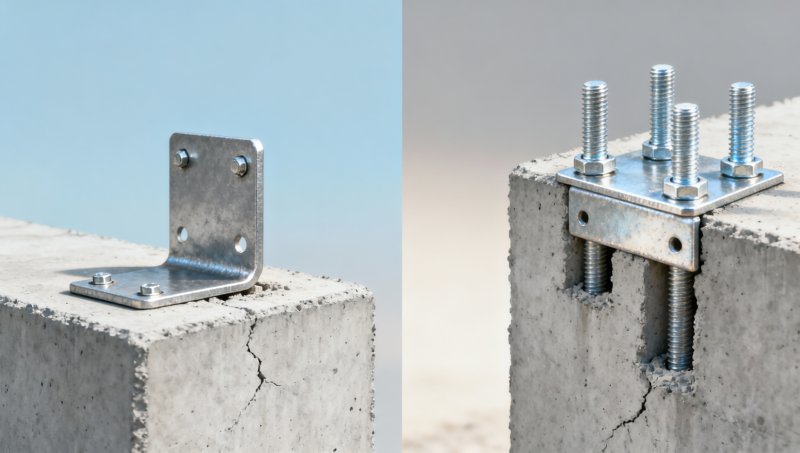
Shear-induced pull-out occurs when lateral force exceeds the bond strength between anchor bolts and surrounding concrete. For right angle metal plates—commonly fabricated from ASTM A36, EN S235JR, or GB Q235B—minimum embed depth is not fixed but derived from load magnitude, concrete compressive strength (f’c), bolt diameter, edge distance, and spacing. Industry-standard design methods per ACI 318-19 Appendix D and EN 1992-4 prescribe that embed depth must satisfy both concrete breakout and side-face blowout criteria.
As a rule of thumb, for M12–M24 anchor bolts in normal-weight concrete (f’c = 25–40 MPa), minimum embed depths range from 8d to 12d (where d = bolt diameter). For example, an M16 bolt requires 128–192 mm embedment—yet this assumes full edge distance ≥ 6d and spacing ≥ 8d. Deviations reduce effective capacity by up to 40%. Real-world testing shows that reducing embed depth by just 15% below calculated minimum increases pull-out probability by 3.2× under cyclic loading.
Hongteng Fengda’s structural engineers validate each custom-anchored angle plate using finite element analysis (FEA) calibrated against ASTM E488 pull-out test data. We routinely verify performance across concrete grades C20/25 to C50/60 and support anchor configurations compliant with ICC-ES AC193 and ETA-13/0149.
Key Factors Influencing Required Embed Depth
- Concrete strength: Every 10 MPa increase in f’c allows ~12% reduction in required embed depth for same load level.
- Bolt type: Cast-in-place anchors require 20–30% deeper embedment than post-installed chemical anchors under identical shear loads.
- Edge distance: If edge distance falls below 1.5× embed depth, side-face blowout becomes dominant failure mode—requiring depth increase by up to 50%.
- Plate thickness & material: Plates thinner than 10 mm risk bending deformation before concrete failure, demanding higher embed depth to maintain rigidity.
Which Steel Grade Delivers Optimal Anchor Plate Performance?
Material selection impacts not only tensile yield but also weldability, ductility, and corrosion resistance—especially where anchor plates interface with galvanized conduit or buried infrastructure. While low-carbon steels like Q235B offer cost efficiency, high-strength variants such as ASTM A572 Gr.50 or EN S355J2 provide superior stiffness-to-weight ratios, reducing deflection under sustained shear.
For applications requiring deep drawing, stamping, or precision bending—such as custom-fabricated anchor brackets—we recommend High Carbon Steel Plate . Its fine-grained microstructure and HRBS HV10 hardness ensure dimensional stability during cold forming, while its uniform surface finish supports consistent hot-dip galvanizing adhesion—critical for outdoor or marine-exposed installations.
Our High Carbon Steel Plate meets SPCC-grade specifications (C ≤ 0.15%, Mn ≤ 0.60%) and delivers excellent deep drawing performance—validated across 12+ OEM automotive chassis programs. It maintains formability even at thicknesses up to 400 mm, enabling robust anchor base plates without compromising fatigue life.
How Do International Standards Define Minimum Embed Requirements?
Compliance isn’t optional—it’s foundational to insurance approval, permitting, and liability protection. Below is how major standards define embed-related verification steps:
Hongteng Fengda’s QA team performs pre-shipment anchor plate validation per all three standards—ensuring every batch includes certified test reports, mill certificates, and galvanizing thickness verification (≥ 85 μm per ASTM A123). Our EN-certified production line guarantees repeatable dimensional accuracy within ±0.3 mm tolerance—even for plates up to 3 m wide and 12 m long.
What Should Procurement & Engineering Teams Verify Before Ordering?
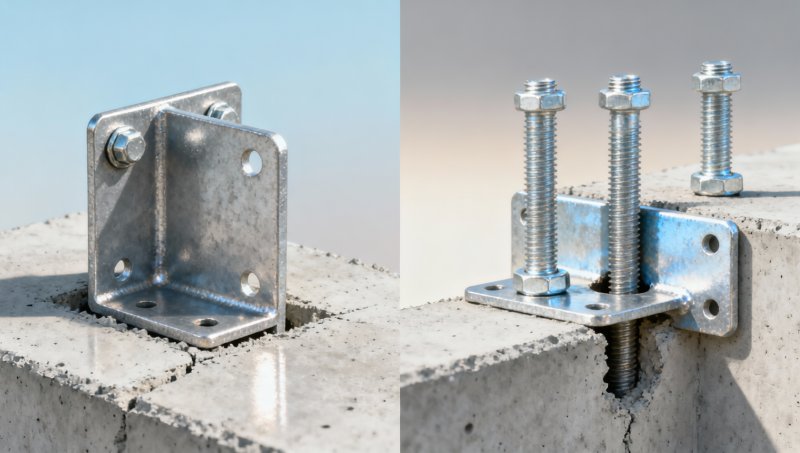
Procurement decisions impact project timelines, safety margins, and total cost of ownership—not just unit price. Here are 5 non-negotiable checks before finalizing anchor plate orders:
- Confirm whether anchor configuration is cast-in-place or post-installed—and match plate geometry to specified embed sleeve dimensions (tolerance ≤ ±1.0 mm).
- Verify galvanizing method: Hot-dip (ASTM A123) vs. electrogalvanized (ASTM B633)—only hot-dip meets ISO 1461 for outdoor structural use.
- Require third-party test reports for both base material (tensile/yield/hardness) and finished weld joints (UT or PT verified).
- Validate delivery packaging: Anchor plates must be shipped with protective film and desiccant to prevent surface oxidation during sea freight (typical transit: 2–4 weeks).
- Ensure supplier offers traceability down to heat number, rolling date, and galvanizing batch—required for ASME Section VIII and PED 2014/68/EU compliance.
At Hongteng Fengda, we streamline procurement with digital twin documentation: Every order ships with QR-coded labels linking to real-time production logs, metallurgical reports, and FEA simulation outputs. Lead time for standard anchor plates is 15–25 days; custom-engineered versions average 35–45 days—with guaranteed on-time delivery backed by contractual penalty clauses.
Why Partner With Hongteng Fengda for Structural Anchor Solutions?
You need more than steel—you need assurance. As a vertically integrated structural steel manufacturer serving 32 countries, Hongteng Fengda combines ISO 9001-certified production, in-house R&D labs, and dedicated engineering support to de-risk your anchor specification process.
We offer free technical consultation on embed depth optimization—including load path analysis, thermal expansion compensation, and seismic detailing—for projects in North America (ASTM/ACI), EU (EN/ETA), GCC (SASO), and ASEAN (MS/IS). All custom anchor plates undergo 100% dimensional inspection and salt-spray testing (≥1000 hrs per ASTM B117).
Ready to optimize your next anchor plate specification? Contact us today for: (1) Load-specific embed depth calculation, (2) Material grade recommendation report, (3) Sample lead time confirmation, (4) Galvanizing thickness certification, or (5) OEM co-design support for proprietary mounting systems.
Please give us a message


Please enter what you want to find