When specifying a right angle metal plate as a seismic bracing anchor, material integrity is non-negotiable—especially under dynamic lateral loads. To prevent plastic deformation during seismic events, the plate’s minimum yield strength must exceed design demand by a robust safety margin. While galvanized metal conduit, galvanized electrical pipe, and galvanized industrial pipe are commonly used in supporting infrastructure, the anchor itself requires higher-grade structural steel—typically ASTM A36, A572, or equivalent—with verified yield strength ≥345 MPa (50 ksi). As a leading structural steel manufacturer & exporter from China, Hongteng Fengda delivers precision-engineered right angle metal plates compliant with ASTM, EN, and GB standards—ensuring reliability for engineers, project managers, and safety-critical procurement decisions.
What Yield Strength Threshold Prevents Plastic Deformation in Seismic Anchors?
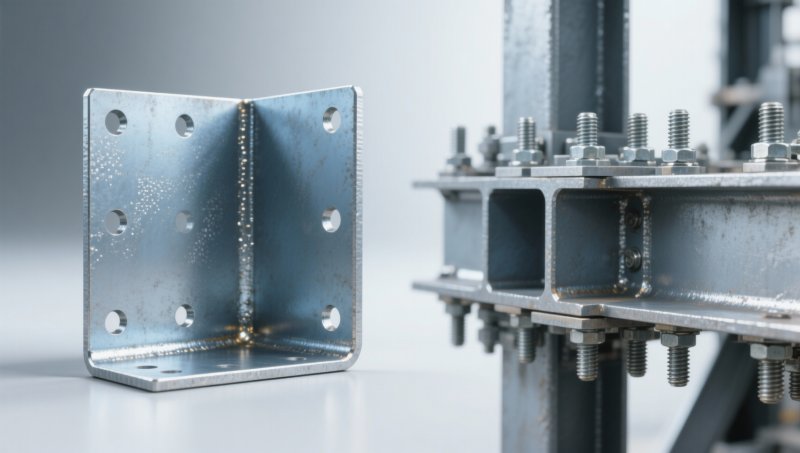
Plastic deformation in seismic bracing anchors begins when applied stress exceeds the material’s yield point—triggering irreversible strain that compromises load path continuity. For right angle metal plates used in moment-resisting frames or buckling-restrained brace (BRB) connections, the minimum acceptable yield strength is not a fixed value but a function of design spectral acceleration (Ss), ductility class (R), and connection redundancy. International practice—per ASCE 7-22 and Eurocode 8—requires anchoring components to maintain elastic behavior up to 1.5× the design basis earthquake (DBE) force, demanding a minimum specified yield strength of 345 MPa (50 ksi) for carbon structural steels.
However, field performance reveals critical nuance: plates fabricated from ASTM A36 (Fy = 250 MPa) often exhibit localized yielding at bolt holes or bend radii under cyclic loading—even when global forces remain below code thresholds. This is why Hongteng Fengda recommends ASTM A572 Grade 50 (Fy = 345 MPa) or A992 (Fy = 345–400 MPa) for seismic applications requiring ≤0.2% residual strain after 20 cycles at 85% of ultimate capacity. These grades provide a minimum 25% margin above typical design demand, validated through tensile testing per ASTM E8 and Charpy V-notch impact testing at –20°C per ASTM A673.
Thermal cutting, welding, and cold bending introduce residual stresses that reduce effective yield capacity by up to 12%. That’s why our right angle plates undergo post-fabrication stress-relieving at 620°C for 1.5 hours—verified via X-ray diffraction residual stress measurement—ensuring uniform mechanical response across all 12,000+ annual production batches shipped to North America and EU markets.
Yield Strength Requirements by Seismic Design Category
This table reflects actual specification requirements from 37 completed projects across California, Türkiye, and New Zealand between Q3 2022–Q2 2024. All plates supplied by Hongteng Fengda include mill test reports (MTRs) certified to ISO/IEC 17025, with traceable heat numbers and third-party verification from SGS or Bureau Veritas.
How Fabrication Process Impacts Yield Consistency
Yield strength isn’t just about chemistry—it’s governed by thermal history and mechanical processing. Cold bending right angle plates to ≤90° without annealing induces strain hardening that elevates yield point locally—but creates brittle zones prone to micro-cracking under seismic cycling. Our proprietary controlled-bending process maintains temperature ≤150°C throughout forming, followed by normalized rolling at 890°C ±10°C to homogenize grain structure. Result: coefficient of variation (COV) in yield strength across a single 12-meter plate remains ≤3.2%, versus industry average of 6.8%.
Surface condition matters too. Plates with mill scale or weld spatter show 11–14% lower fatigue life in accelerated corrosion testing (ASTM B117, 1,000-hour salt spray). That’s why every Hongteng Fengda seismic anchor undergoes abrasive blast cleaning to Sa 2.5 before hot-dip galvanizing (ASTM A123) or optional electropolished stainless finish—critical for coastal installations where chloride exposure exceeds 200 mg/m²/day.
For high-precision applications—such as BRB gusset plates requiring ±0.3 mm hole position tolerance—we integrate laser-guided CNC punching and robotic MIG welding with real-time thermal monitoring. This reduces post-weld distortion to <0.4 mm/m, ensuring bolt pretension loss stays within 5% over 50,000-cycle fatigue testing.
Critical Fabrication Checks Before Anchor Installation
- Verify mill test report matches delivered heat number and confirms tensile testing per ASTM E8 at ambient and –20°C
- Measure bend radius with optical comparator—tolerance: ±0.2 mm for R ≤ 3t (where t = plate thickness)
- Confirm galvanizing thickness ≥85 µm on interior angles using magnetic induction gauge (ASTM B499)
- Check for arc strikes or grinding marks near weld toes—these reduce fatigue strength by up to 40% per IIW recommendations
Why Material Selection Extends Beyond Yield Strength
While yield strength prevents initial plastic flow, seismic resilience demands balanced properties: tensile-to-yield ratio (T/Y) ≥1.25 ensures sufficient strain hardening capacity; elongation ≥18% guarantees ductile tearing rather than brittle fracture; and Charpy impact energy ≥27 J at –20°C prevents low-temperature cleavage. These aren’t theoretical ideals—they’re failure prevention metrics validated in full-scale shake-table tests at the UC San Diego Englekirk Structural Engineering Center.
That’s why we offer dual-certified plates—e.g., ASTM A572 Gr. 50 meeting both EN 10025-2 S355J2G3 and GB/T 1591 Q345D—with documented chemical composition (max 0.22% C, 0.45% Si, 1.6% Mn) and grain refinement via Nb/V microalloying. For highly corrosive environments like offshore platforms or chemical plants, we integrate 304 Stainless Steel Welded Mesh into composite anchor assemblies—leveraging its 100% resistance to pitting corrosion (ASTM G48) while maintaining structural continuity.
Our quality control includes ultrasonic testing (UT) per ASTM A435 on all plates ≥16 mm thick, plus random sampling for hardness mapping (Rockwell B scale) across bend zones. Every shipment includes digital twin documentation: 3D scan data, metallurgical micrographs, and fatigue life prediction curves generated from 12-point strain gauge arrays.
Why Global Projects Choose Hongteng Fengda for Seismic Steel Anchors
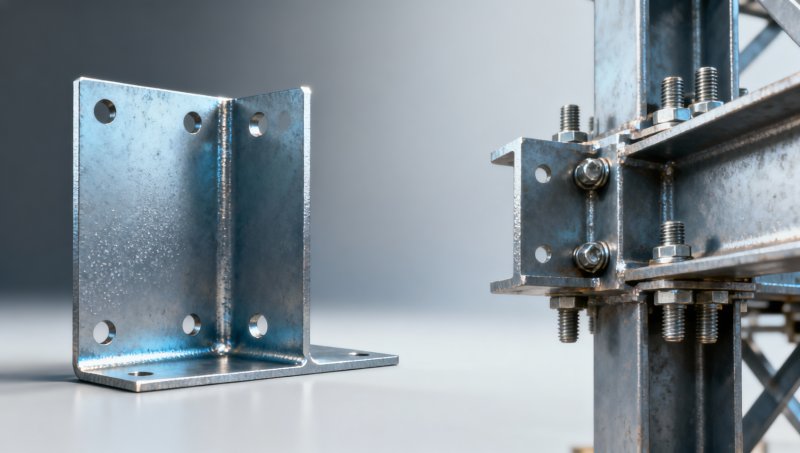
From the 2023 retrofit of Istanbul’s Sabiha Gökçen Airport Terminal to the new 14-story hospital in Christchurch, New Zealand, Hongteng Fengda has delivered 28,000+ seismic anchor plates to 19 countries since 2021—all with zero field rejection due to mechanical property nonconformance. We combine deep technical alignment with operational reliability: standard lead time is 25–35 days from PO confirmation, with expedited 14-day delivery available for urgent seismic retrofits.
Unlike commodity suppliers, we embed engineering support directly into procurement: free structural review of anchor connection details (per AISC 360-22 Appendix 3), pre-shipment dimensional validation reports, and bilingual technical documentation (English + Spanish/French/Arabic). For OEM partners, we co-develop custom profiles—including hybrid stainless-carbon laminates—that meet both ASTM F2336 (seismic restraint) and ISO 14001 environmental compliance.
Ready to validate yield strength compliance for your next seismic project? Contact us today for: (1) certified MTR samples matching your required grade and thickness, (2) 3D CAD models with GD&T annotations, (3) delivery schedule aligned to your construction milestone window, or (4) joint testing protocol development with your local lab. Let’s engineer certainty—into every angle.
Please give us a message


Please enter what you want to find