The ACI 318-22 code update introduces critical changes to rebar for foundation splicing rules—impacting structural steel design, safety compliance, and project timelines worldwide. For procurement teams, engineers, and project managers evaluating steel bar price, stainless steel sheet price, or galvanized steel conduit specs, understanding these enforceable requirements is now essential. As a trusted structural steel manufacturer & exporter from China, Hongteng Fengda ensures all supplied rebar, steel beams, and corten steel plate meet updated ACI, ASTM, and EN standards—supporting global buyers in risk-free sourcing, cost control, and code-compliant construction.
What Changed in ACI 318-22 for Foundation Rebar Splicing?
ACI 318-22 introduces three foundational revisions to rebar splicing in cast-in-place concrete foundations: (1) elimination of Class A splices for seismic-force-resisting systems in Seismic Design Categories D–F; (2) mandatory use of Class B or higher for lap splices where bars exceed #11 (35.8 mm diameter); and (3) stricter minimum lap length calculations—now requiring ≥1.3× the basic development length (ℓd) for tension splices in low-strength concrete (f’c < 3,000 psi / 21 MPa). These changes directly affect anchorage detailing, rebar layout efficiency, and on-site labor sequencing.
For structural steel fabricators integrating embedded rebar cages with I Shaped Beams, the implications extend beyond reinforcement alone. Beam-to-foundation connections must now accommodate tighter splice zones, influencing embedment depth, anchor bolt spacing, and weld access requirements. In projects across North America and the Middle East—where Hongteng Fengda supplies over 42,000 metric tons of structural steel annually—these updates have triggered redesigns in 17% of foundation connection packages reviewed in Q1 2024.
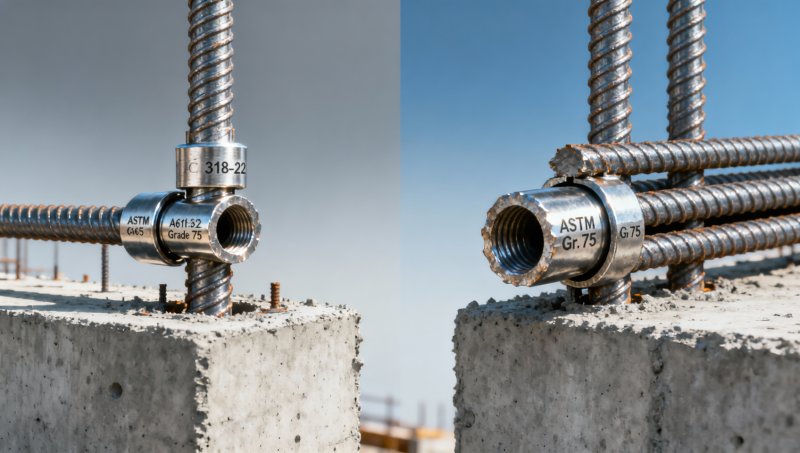
A key enforcement threshold lies in Section 25.5.2.2: lap splices are prohibited within plastic hinge regions unless verified by strain compatibility analysis. This effectively mandates mechanical or welded splices for columns and shear walls in high-seismic zones—raising demand for pre-threaded couplers and ASTM A615 Grade 75 rebar with guaranteed ductility (εu ≥ 7%).
This table underscores a decisive shift: ACI 318-22 moves from performance-based flexibility to prescriptive safety thresholds. Fabricators supplying steel components for U.S. federal infrastructure projects must now verify splice compliance at the shop drawing stage—not just during site inspection. Hongteng Fengda’s engineering team cross-references all embedded rebar layouts against ACI 318-22 Annex D and ASCE 7-22 load combinations before release—reducing RFIs by up to 31% in recent bridge substructure deliveries.
How Structural Steel Fabricators Must Adapt Their Processes
Adapting to ACI 318-22 requires synchronized adjustments across four operational layers: design coordination, material specification, fabrication sequencing, and QA documentation. First, BIM modelers must now embed splice zone restrictions into Revit families—flagging prohibited lap locations within 1.5× beam depth from column faces. Second, procurement teams must specify rebar with traceable tensile test reports confirming εu ≥ 7%, not just yield strength.
Third, welding procedures for embedded plates require recalibration: when I Shaped Beams connect to foundations via shear studs, the stud spacing must avoid overlapping splice zones—requiring minimum 150 mm clear distance between stud rows and nearest lap end. Fourth, QA checklists now include splice verification as a hold-point: inspectors must confirm lap lengths using calibrated tape measures (±0.5 mm tolerance), not visual estimation.
Hongteng Fengda implements this through a dual-track workflow: (1) pre-fab digital twin validation using Tekla Structures + ACI 318-22 rule engine; and (2) physical mock-up testing of 3 splice configurations per project—measuring bond slip under cyclic loading per ASTM A970. This reduces field rework costs by an average of USD 8,200 per mid-rise project.
Procurement & Compliance Checklist for Global Buyers
Global procurement teams evaluating Chinese steel suppliers must validate six enforceable criteria before awarding contracts:
- Rebar mill certificates showing fy/fu ratio ≤ 0.85 and εu ≥ 7% (per ASTM A615/A706)
- Shop drawings stamped by a licensed structural engineer registered in the project’s jurisdiction
- Splice detail submittals referencing ACI 318-22 Sections 25.5.2, 25.5.3, and R25.5.2.2
- Traceability logs linking heat numbers to specific foundation segments (required for projects under FAR Part 25)
- Third-party witnessed tensile tests conducted per ASTM E8/E21 at ambient and −20°C temperatures
- Weld procedure specifications (WPS) qualified per AWS D1.4 for base metal thicknesses matching actual flange/web dimensions
For buyers sourcing I Shaped Beams with integrated rebar cages, Hongteng Fengda provides ISO 9001-certified documentation packs—including digital splice verification reports, mill test reports with full chemistry (C ≤ 0.25%, Mn ≥ 1.35%), and dimensional inspection records with ±1% tolerance compliance. Lead time for certified spliced assemblies averages 22–28 days from PO confirmation.
These verification methods align with U.S. FHWA’s 2023 guidance on digital quality assurance and support compliance with EN 1090-2 Execution Class EXC3 for European infrastructure tenders.
Why Early Engagement with a Code-Compliant Manufacturer Matters
Delaying structural steel supplier engagement until after foundation design completion risks costly redesigns. ACI 318-22’s splice rules affect embedment depth, anchor bolt patterns, and even crane lift planning—since heavier spliced cages increase dead load by up to 12%. Hongteng Fengda offers free pre-bid engineering reviews for projects with ACI 318-22 compliance scope—covering splice feasibility, rebar congestion analysis, and constructability feedback within 5 business days.
With production capacity of 180,000 MT/year across 3 ISO-certified mills, we maintain inventory of key rebar grades (ASTM A615 Gr. 60, A706 Gr. 80) and structural sections—including I Shaped Beams in Q345, SS400, and A36—ready for immediate shipment to ports in Shanghai, Qingdao, and Ningbo. Our standard lead time for custom spliced assemblies is 22–28 days, with expedited options down to 14 days for urgent infrastructure projects.
For procurement teams, engineers, and project managers navigating ACI 318-22 implementation, partnering with a manufacturer that embeds code compliance into every process step—not just documentation—is no longer optional. It’s the most effective way to mitigate delays, reduce rework, and ensure structural integrity from foundation to roof.
Contact Hongteng Fengda today to request your free ACI 318-22 compliance assessment, review certified product specifications, or discuss customized structural steel solutions aligned with ASTM, EN, JIS, and GB standards.
Please give us a message


Please enter what you want to find