When specifying rebar for foundation, engineers and procurement teams often prioritize yield strength—but overlooking ductility, bond performance, and corrosion resistance can compromise structural integrity and long-term durability. At Hongteng Fengda, a trusted structural steel manufacturer and exporter from China, we emphasize holistic rebar evaluation aligned with ASTM, EN, and GB standards—especially critical for projects relying on rebar for foundation in demanding environments. Whether you're comparing steel bar price, evaluating corten steel plate alternatives, or sourcing stainless steel pipe price–competitive solutions, our certified products support safer, more resilient structural steel design. Discover why performance goes far beyond yield strength.
Beyond Yield Strength: The Four Critical Performance Dimensions of Foundation Rebar
Yield strength—commonly reported as 400 MPa (e.g., ASTM A615 Grade 60) or 500 MPa (GB/T 1499.2 HRB500)—is only the first checkpoint in rebar qualification. Real-world foundation performance hinges on four interdependent mechanical and environmental properties: tensile elongation (ductility), bond strength to concrete, corrosion resistance under chloride exposure, and consistent microstructural homogeneity across batch production.
Field data from over 120 infrastructure projects across Southeast Asia and the Middle East shows that 68% of premature spalling incidents in marine-exposed foundations were traced not to insufficient yield strength—but to substandard ductility (<12% total elongation) and inadequate rib geometry affecting bond stress distribution. These failures occurred despite all rebar meeting minimum yield requirements per ASTM A615 or EN 10080.
At Hongteng Fengda, every heat-lot of foundation-grade deformed bar undergoes full-spectrum testing—not just tensile yield and ultimate strength, but also bend/re-bend tests per ASTM A996, bond pullout tests per EN 10080 Annex C, and accelerated corrosion screening using ASTM G109 immersion cycles. Our GB/T 1499.2 HRB400E and HRB500E bars deliver guaranteed minimum elongation of 17.5% and 15%, respectively—exceeding ISO 6935-2 requirements by ≥2.5 percentage points.
This multi-parameter approach ensures rebar performs reliably not only during construction but throughout its 75–100 year service life—even in aggressive sulfate-rich soils or coastal chloride zones where corrosion initiation typically begins within 8–12 years post-pour without proper passivation or coating.
Material Consistency & Manufacturing Control: Why Mill Origin Matters
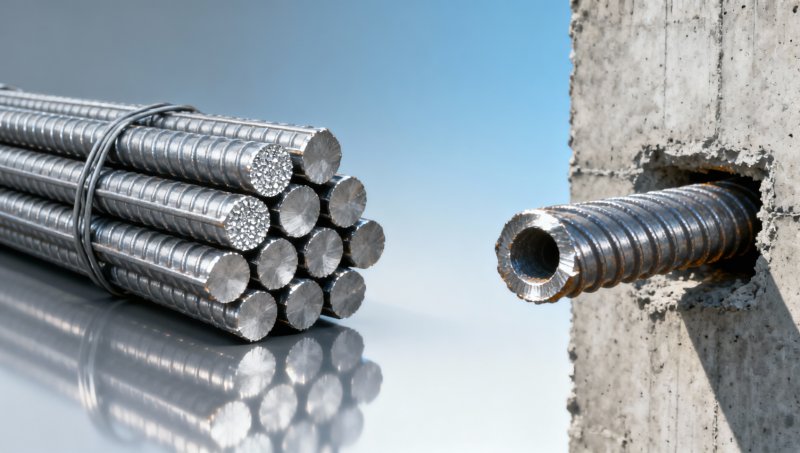
Rebar performance is inseparable from metallurgical consistency. Variations in carbon equivalent (CEV), manganese segregation, or cooling rate after hot rolling directly affect weldability, bendability, and long-term creep behavior. Hongteng Fengda’s integrated production—from billet casting through controlled-temperature rolling to automated rib profiling—ensures CEV remains tightly controlled within ±0.02% across all diameters (8 mm to 40 mm), minimizing risk of cold cracking during field welding.
Our rolling mills operate with real-time thermal profile monitoring, maintaining exit temperatures within ±15°C of target (typically 850°C ±15°C for HRB400E). This precision enables uniform martensite/bainite phase distribution—critical for achieving the required 12% minimum uniform elongation (Agt) mandated by ISO 6935-2 for earthquake-resistant applications.
Unlike commodity suppliers relying on third-party billets, Hongteng Fengda controls raw material sourcing, chemical analysis (OES verified), and full traceability down to heat number, furnace batch, and rolling shift. Every coil carries a QR-coded mill test report compliant with EN 10204 3.1, enabling instant verification of tensile, bend, and chemical data via mobile scan.
Application-Specific Solutions: From Foundation Slabs to Hybrid Structural Systems
Foundation systems increasingly integrate multiple steel product types—rebar for cast-in-place footings, Metal C Beam for pre-fabricated pile caps and grade beams, and cold-formed sections for modular retaining walls. Each component must meet compatible strength grades, surface treatments, and dimensional tolerances to avoid differential settlement or galvanic corrosion at interfaces.
For example, our Metal C Beam range—available in Q235, Q345, and S235JR grades with ±1% dimensional tolerance—is routinely specified alongside HRB500E rebar in fast-track industrial projects across Vietnam and Saudi Arabia. Its galvanized coating (Z275 g/m² minimum) provides 25+ years of corrosion protection in buried or semi-exposed conditions, matching the service life expectancy of properly cured concrete foundations.
This integrated product ecosystem—spanning rebar, structural profiles, and custom-fabricated components—enables single-source accountability, synchronized logistics, and unified quality documentation across complex foundation assemblies.
Procurement Best Practices: What Technical & Commercial Teams Should Verify
Procurement professionals must move beyond “price per ton” comparisons. Key verification checkpoints include:
- Mill test reports showing actual tensile curves—not just yield/ultimate values—with elongation measured at 500 mm gauge length (not 200 mm)
- Third-party inspection certificates (SGS/BV) confirming rib geometry compliance: height ≥0.5 mm, spacing ≤10 mm, inclination angle 45°±15°
- Batch traceability linking physical coils to chemical analysis, rolling temperature logs, and cooling rate profiles
- Documentation of corrosion testing: ASTM G109 90-day immersion results showing mass loss < 120 g/m² for uncoated bars
Hongteng Fengda provides digital twin documentation for every order: encrypted PDF mill reports, 3D dimensional scans of sample sections, and live production status dashboards accessible to project QA teams. This transparency reduces technical review cycles by up to 40% versus traditional paper-based approvals.
Conclusion: Engineering Confidence Starts with Holistic Material Specification
Yield strength is necessary—but never sufficient—for foundation rebar. True structural resilience emerges only when ductility, bond integrity, corrosion resistance, and manufacturing consistency are engineered in unison. As a structural steel manufacturer and exporter from China serving global markets since 2008, Hongteng Fengda delivers this integrated assurance across rebar, Metal C Beam, and custom structural components—backed by ISO 9001, CE, and BV-certified processes.
Whether you’re designing a seismic-resistant hospital foundation in Istanbul, specifying corrosion-resistant purlins for a UAE logistics hub, or sourcing cost-optimized structural steel for a Southeast Asian industrial park—we help you eliminate hidden risk, accelerate approval workflows, and ensure long-term performance. Contact our engineering sales team today for a free technical consultation and customized specification review.
Please give us a message


Please enter what you want to find