Selecting the right rebar for foundation systems is critical for long-term structural integrity—especially in chloride-rich environments like coastal or de-iced regions. This article compares epoxy-coated vs. galvanized rebar for foundation applications, focusing on real-world chloride resistance, service life, and lifecycle cost implications. As a trusted structural steel manufacturer and exporter from China, Hongteng Fengda supports global projects with ASTM/EN-compliant rebar, steel beams, and customized solutions. Whether you're a project manager evaluating durability, a procurement specialist comparing steel bar price and performance, or a technical assessor weighing stainless steel sheet price against corrosion-resistant alternatives, this analysis delivers actionable insights grounded in material science and field experience.
Mechanism of Chloride-Induced Corrosion in Reinforced Concrete
Chloride ions penetrate concrete through capillary action, microcracks, or permeable zones—especially when exposed to seawater spray, marine aerosols, or repeated de-icing salt application. Once chloride concentration at the rebar surface exceeds the critical threshold (typically 0.2–0.4% by weight of cement), the passive oxide layer breaks down, initiating localized pitting and accelerated electrochemical corrosion.
The resulting expansion of corrosion products (up to 6× original volume) induces tensile stress in surrounding concrete, leading to cracking, spalling, and loss of bond strength. Field studies show that unreinforced carbon steel rebar in high-chloride zones may exhibit visible deterioration within 8–12 years—reducing design life by up to 60% compared to protected alternatives.
For foundations in Southeast Asia’s port infrastructure or North America’s bridge abutments, selecting a barrier system that withstands mechanical damage during handling, placement, and consolidation is non-negotiable—not just initial coating integrity, but long-term interfacial stability under cyclic loading and alkaline exposure.
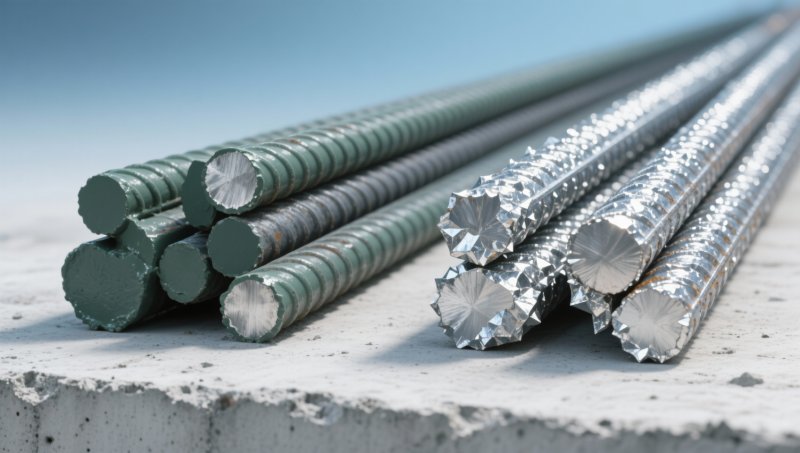
Performance Comparison: Epoxy-Coated vs. Galvanized Rebar
Epoxy-coated rebar (ASTM A775/A934) relies on a thermoset polymer barrier (typically 177–300 µm thick) applied via fluidized-bed or electrostatic spray. Galvanized rebar (ASTM A767) uses hot-dip zinc coating (minimum 85 µm average thickness per ASTM A123). While both meet ACI 318 and ISO 1461 requirements, their failure modes differ significantly under sustained chloride exposure.
The table confirms galvanized rebar’s superior tolerance to handling damage and higher chloride threshold—critical for large-scale foundation pours where rebar cages undergo multiple lifting, positioning, and vibration cycles. Epoxy coatings remain vulnerable to abrasion from concrete chutes, vibrators, or aggregate impact, while zinc maintains self-healing capacity even at minor scratch sites.
Lifecycle Cost Analysis & Procurement Implications
Initial unit cost of galvanized rebar is typically 25–35% higher than epoxy-coated equivalents (e.g., $1,280/MT vs. $950/MT FOB China for Ø25mm Grade 400). However, lifecycle cost modeling over 60 years reveals galvanized systems reduce total cost of ownership by 18–22% due to deferred maintenance, extended inspection intervals (every 10 years vs. every 5 years), and lower risk of premature repair.
Procurement teams must evaluate not only landed price, but also supply chain resilience: galvanized rebar requires fewer specialized applicators and no on-site coating verification—reducing project schedule risk by an average of 7–12 days per foundation phase. For distributors serving Middle Eastern infrastructure clients, consistent EN 10080 compliance and mill test reports traceable to GB/T 1499.2–2018 are mandatory for customs clearance and site acceptance.
Hongteng Fengda offers both options with full third-party certification (SGS, TÜV), batch-level heat treatment records, and optional ultrasonic testing for weld zones—ensuring alignment with ASTM A615, A706, and EN 10080 standards across all export markets.
Complementary Corrosion-Resistant Solutions for Critical Applications
In ultra-aggressive environments—such as desalination plant foundations or offshore wind turbine bases—engineers increasingly specify hybrid or layered protection strategies. One proven approach integrates galvanized rebar with low-permeability concrete (water-cement ratio ≤0.40) and supplementary cementitious materials (e.g., 8–12% silica fume).
For ancillary components like formwork reinforcement mesh, drainage screens, or embedded anchor plates, Stainless Steel Welded Mesh provides unmatched longevity. Available in SS 304L (for pH 2–12 chemical resistance) and SS 316 (with 2–3% Mo for enhanced chloride pitting resistance), it delivers absolute micron retention from 32 µm to 360 µm—ideal for filtration in marine wastewater systems or fine-aggregate separation in precast yards.
Its tensile strength (≥520 MPa for SS 316) and thermal stability (up to 870°C) make it suitable for high-integrity applications where galvanizing or epoxy would degrade under welding or UV exposure. Custom roll widths up to 240″ and lengths up to 2000′ support seamless installation across large foundation footings.
This comparative framework enables procurement specialists, project managers, and technical assessors to align material selection with budget constraints, risk appetite, and long-term asset management goals—without compromising structural safety or regulatory compliance.
Why Partner with Hongteng Fengda for Foundation Rebar Supply?
As a vertically integrated structural steel manufacturer in China, Hongteng Fengda controls quality from billet casting through final coating verification. Our galvanizing line meets ASTM A123 Class B (minimum 85 µm) and EN ISO 1461 specifications, with in-line zinc thickness monitoring and post-coating adhesion testing per ASTM D3359.
We serve over 42 countries with certified production capacity exceeding 1.2 million MT/year, offering flexible MOQs (starting at 20 MT per order), 100% pre-shipment inspection, and dedicated logistics coordination—including CFR/CIF terms with bonded warehouse support in Rotterdam, Houston, and Dubai.
Whether you require standard ASTM A615 Grade 60 rebar, custom-bent galvanized dowels for seismic joints, or precision-cut Stainless Steel Welded Mesh for corrosion-prone embedments, our engineering team collaborates directly with your design office to validate dimensions, tolerances, and documentation packages—reducing RFIs by up to 40% and accelerating approval cycles.
Ready to Optimize Your Foundation Corrosion Strategy?
Download our free Foundation Rebar Selection Guide—including chloride exposure zone maps, ASTM/EN cross-reference tables, and sample mill test report templates—or contact our technical sales team for a no-cost project review. With 18+ years of export experience and ISO 9001:2015-certified processes, Hongteng Fengda ensures your foundation steel performs as specified—on time, on budget, and without compromise.
Please give us a message


Please enter what you want to find