Choosing the right rebar for retaining wall construction directly affects structural stability, crack control, and long-term drainage performance. For technical evaluators, understanding bar placement, load resistance, and compatibility with wall design standards is essential to reducing failure risks and improving project reliability. This article outlines the core reinforcement and drainage basics that support safer, more efficient retaining wall systems.
What Technical Evaluators Need to Confirm First
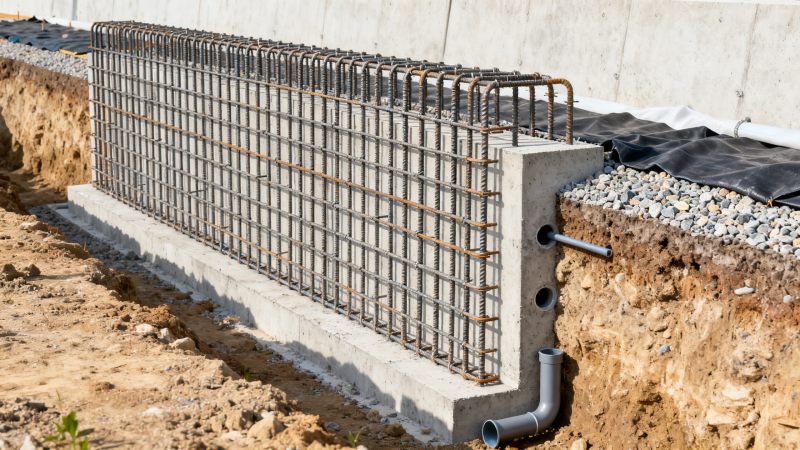
When people search for rebar for retaining wall, they usually want practical guidance on whether reinforcement is sufficient for lateral earth pressure, surcharge loads, water buildup, and service life.
For technical evaluators, the key issue is not simply bar size. The real question is whether the wall system, reinforcement layout, and drainage design work together safely.
A retaining wall can fail even when concrete strength looks acceptable. Common triggers include poor bar placement, inadequate cover, weak toe or heel zones, and hydrostatic pressure behind the wall.
So the first judgment is straightforward: reinforcement must be reviewed together with wall geometry, backfill conditions, drainage measures, and the applicable design code, not as an isolated material item.
Why Rebar Matters So Much in a Retaining Wall
Unlike plain concrete, reinforced concrete can resist both compressive and tensile stresses. In retaining walls, tensile demand develops because lateral soil pressure causes bending in the stem and base slab.
The soil side and exposed side of the wall do not experience the same stress pattern. That is why main reinforcement must be placed where tension is expected under design loading.
For cantilever retaining walls, the stem often behaves like a vertical cantilever fixed at the base. Depending on loading direction, the earth-facing side commonly requires critical vertical reinforcement.
The base slab also needs careful review. The heel and toe zones may experience different bending moments, so the location and continuity of bars must match structural analysis.
Rebar also helps control shrinkage and temperature cracking. While these cracks may seem secondary, they can become long-term durability and water-ingress pathways if not properly limited.
Core Loads That Should Guide Rebar Selection
Technical assessment should start with loads, because bar diameter and spacing only make sense when tied to actual force demand. The retaining wall must resist more than soil weight alone.
Active earth pressure is usually the primary design load, but surcharge from traffic, stored materials, nearby foundations, or equipment can increase bending and shear significantly.
Water pressure is often underestimated. If drainage is poor, hydrostatic pressure may rise quickly behind the wall and exceed the structural margin that the original reinforcement was intended to provide.
In some projects, seismic loading also changes reinforcement demand. Dynamic pressure can increase stem bending and require stricter detailing, anchorage, and crack-control provisions.
Frost effects, expansive soils, and differential settlement can further complicate behavior. Evaluators should therefore confirm whether geotechnical assumptions and structural detailing were coordinated from the start.
Where Rebar Placement Usually Makes or Breaks Performance
Many retaining wall issues come from incorrect placement rather than incorrect specification. Even suitable bars cannot deliver design capacity if spacing, anchorage, or cover are not maintained on site.
In the wall stem, vertical main bars generally carry the primary flexural tension. Horizontal bars support crack distribution, restraint effects, and cage stability during fabrication and concrete placement.
At the base, reinforcement needs close attention around the stem-base connection. This joint transfers moment and shear, making development length and bar continuity especially important.
Bar spacing should balance strength, concrete flow, and crack control. Overly wide spacing can increase crack width, while overly congested cages can create voids and reduce concrete consolidation quality.
Concrete cover must suit exposure conditions. Insufficient cover raises corrosion risk, while poorly controlled placement tolerances may reduce effective depth and weaken actual flexural resistance.
How Drainage Directly Affects Reinforcement Demand
Drainage is not a separate convenience feature. It is a structural risk-control measure, because retained water sharply increases lateral pressure and can turn an acceptable reinforcement design into an unsafe one.
Standard drainage elements may include free-draining backfill, perforated drain pipes, filter fabric, gravel layers, and weep holes. Their function is to prevent pressure accumulation and soil migration.
Without filtration, drainage paths may clog over time. Once that happens, the wall begins resisting water pressure in addition to earth pressure, often causing cracking, movement, or progressive overstress.
For technical reviewers, one useful principle is this: if drainage reliability is uncertain, reinforcement should not be judged independently from that uncertainty because service conditions may shift dramatically.
Long-term wall durability depends on both systems. Drainage limits demand; reinforcement supplies resistance. Treating only one side of the equation usually produces misleading confidence.
Key Checks for Crack Control and Long-Term Durability
Retaining walls are exposed to moisture cycles, temperature change, and often aggressive ground conditions. This makes crack width control and corrosion protection just as important as nominal strength.
Fine cracks are not always structurally critical, but they can allow water and chlorides to reach steel. Over time, corrosion expansion may widen cracks and reduce bond between concrete and reinforcement.
Technical evaluators should review bar spacing, cover thickness, concrete quality, exposure class, and construction joints. These factors strongly influence durability, even when initial load calculations seem adequate.
Attention should also be given to detailing near openings, corners, and abrupt geometry transitions. Stress concentrations often develop there, making local cracking more likely without supplemental reinforcement.
A good retaining wall specification therefore combines structural adequacy with serviceability discipline. Walls that merely pass strength checks may still underperform if crack control is neglected.
How to Evaluate Bar Grade and Size Without Oversimplifying
It is common to focus on higher strength grades, but stronger steel does not automatically produce a better retaining wall. Suitability depends on ductility, detailing, bending requirements, and fabrication conditions.
Bar diameter should be chosen with section thickness, spacing limits, and congestion risks in mind. Larger bars can reduce bar count, but may also complicate placement and crack distribution.
For some applications, moderate-yield reinforcement remains practical because it offers a useful balance of strength, workability, and cost. This is especially relevant in repetitive standard retaining wall sections.
As an example, HPB300 Rebar is used in load-bearing, structural, and stirrup scenarios within concrete works where ease of processing and moderate cost are important considerations.
With a standard yield strength of no less than 300 MPa and available sizes from 6 mm to 50 mm, it can fit selected retaining wall details, ties, or auxiliary reinforcement depending on design requirements.
Evaluators should still verify code alignment, detailing needs, and project location standards such as ASTM, EN, JIS, or GB before accepting any rebar grade for a retaining wall package.
Common Failure Risks That Good Reviews Should Catch Early
The most expensive retaining wall problems often begin with ordinary oversights. These include missing drainage layers, insufficient development length, bar displacement during pouring, and underestimated surcharge loads.
Another frequent issue is assuming a standard wall detail can be reused across very different soil conditions. Changes in retained height, groundwater level, or backfill type can alter reinforcement demand substantially.
Poor construction control can also invalidate an otherwise sound design. If bars are misplaced, lapped incorrectly, or left with inadequate cover, the installed wall may not match design assumptions.
Drainage failures are especially dangerous because they remain hidden until distress appears. By the time cracking, leaning, or seepage is visible, structural reserve may already be reduced.
Technical evaluators create value by identifying these coordination gaps before procurement and construction. Early review is usually far cheaper than remediation after backfill is placed.
A Practical Review Framework for Technical Decision-Making
For efficient evaluation, start with four linked questions: what loads act on the wall, where does tension occur, how is water removed, and do the details preserve design intent during construction?
Then confirm wall type, retained height, soil parameters, surcharge assumptions, groundwater condition, and seismic requirement. These inputs establish whether the reinforcement concept is fundamentally reasonable.
Next, examine bar grade, size, spacing, lap length, anchorage, cover, and joint detailing. Focus on the stem, heel, toe, and stem-base connection where structural sensitivity is highest.
After that, review drainage components together with maintenance assumptions. A well-designed drain pipe is not enough if backfill grading or filter compatibility is likely to cause clogging.
Finally, compare all details with the governing standards and fabrication capability. The best specification is one that can be produced consistently, inspected clearly, and installed without avoidable deviation.
What Makes a Retaining Wall Rebar Plan Reliable in Procurement Terms
From a sourcing perspective, reliability means more than material availability. Evaluators should also consider dimensional consistency, certification, traceability, and whether the supplier can support required standards.
For international projects, compatibility with ASTM, EN, JIS, or GB may influence approval speed and downstream documentation. This matters when the project team includes cross-border designers, contractors, and inspectors.
Manufacturing quality control is also important because retaining wall reinforcement often requires predictable bending, stable mechanical properties, and dependable delivery schedules to avoid site disruption.
When reviewing supplier options, technical teams should ask whether standard sizes, OEM processing, and project-specific packaging can reduce field handling errors or improve installation efficiency.
That procurement discipline supports better construction outcomes. In retaining wall work, many performance problems begin long before pouring concrete, often during specification and material coordination stages.
Conclusion
The right rebar for retaining wall construction is not defined by strength alone. It is defined by how well reinforcement, wall geometry, drainage, detailing, and construction quality function as one system.
For technical evaluators, the most useful approach is integrated review. Check load assumptions, confirm tension zones, validate drainage reliability, and assess durability details before approving bar selection.
When these basics are handled correctly, retaining walls are more likely to resist movement, limit cracking, and maintain long-term service performance. That is the real benchmark of a sound reinforcement decision.
Please give us a message


Please enter what you want to find