When designing reinforced concrete members, rebar for column is not just a detail—it directly affects load transfer, stability, and long-term safety. Compared with rebar for beam applications, column bar placement demands stricter control over spacing, cover, and alignment. For engineers, buyers, and project teams, understanding why placement matters can reduce construction risks, improve compliance, and support better structural performance.
In steel and construction supply chains, this topic also matters beyond design drawings. Contractors need predictable installation quality, procurement teams need materials that match specifications, and quality managers need practical inspection points that can be verified on site. For projects involving industrial buildings, infrastructure, commercial structures, or prefabricated components, poor column reinforcement layout can lead to costly rework, delays of 3–10 days, and higher compliance risks during inspection.
For global buyers working with structural steel and related construction materials, a reliable supplier is expected to do more than ship products. Hongteng Fengda, a structural steel manufacturer and exporter from China, supports international projects with stable production, standard-based quality control, and customized steel solutions aligned with ASTM, EN, JIS, and GB requirements. That supply-side discipline is especially relevant when projects depend on dimensional consistency, installation coordination, and strict quality documentation.
Why Column Rebar Placement Has a Greater Structural Impact
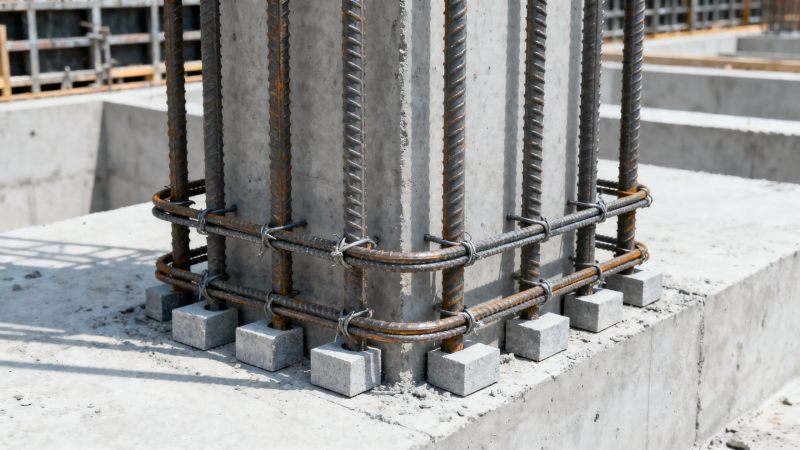
A column primarily carries axial load, but in real buildings it also resists bending, shear, and second-order effects caused by eccentric loading and frame movement. That means rebar for column work must be positioned with much tighter discipline than many site teams initially expect. Even a 10–20 mm shift in bar location can reduce effective cover, affect confinement efficiency, or create congestion that interferes with concrete compaction.
Unlike beam reinforcement, where bars are often arranged mainly to resist tensile zones, column bars must work as a balanced cage. The vertical bars, ties, lap zones, and clear spacing all contribute to how the member handles compression and lateral restraint. If the bar cage is misaligned, the column may still be poured, but its actual performance can deviate from the design intent in ways that are difficult to see after concrete placement.
For technical evaluators and project managers, three factors usually control performance most directly: concrete cover, clear bar spacing, and tie confinement. Typical design practice may require cover in the range of 25–40 mm depending on exposure conditions, while spacing must allow proper concrete flow around the steel cage. If spacing becomes too tight, honeycombing risk increases, especially in congested joints or heavily reinforced transfer columns.
Key Differences Between Column and Beam Reinforcement
The difference is not just orientation. In beams, reinforcement usually follows expected tension paths and anchorage requirements. In columns, rebar layout affects stiffness, buckling resistance of longitudinal bars, and confinement of the concrete core. This is why inspections often focus on cage geometry before pouring, not only on bar diameter and quantity.
- Columns depend on symmetrical or near-symmetrical bar distribution to maintain balanced load transfer.
- Tie spacing, often tighter near joints or end zones, controls bar restraint and confinement under stress.
- Misplaced bars can reduce clear cover and increase corrosion risk over a service life of 20–50 years.
- Congested cages can slow installation, increase labor hours, and reduce concrete placement quality.
For procurement and site execution teams, these differences mean that “correct quantity delivered” is not enough. Dimensional consistency, bend accuracy, and packaging that protects fabricated reinforcement during transport are also part of quality assurance.
The table below highlights how placement errors typically affect structural behavior, inspection outcomes, and project execution.
The practical conclusion is straightforward: placement quality changes how the column behaves, not just how it looks on a drawing. That is why technical review, fabrication accuracy, and field inspection should be treated as one continuous control process rather than separate tasks.
Critical Placement Rules Engineers and Site Teams Should Not Ignore
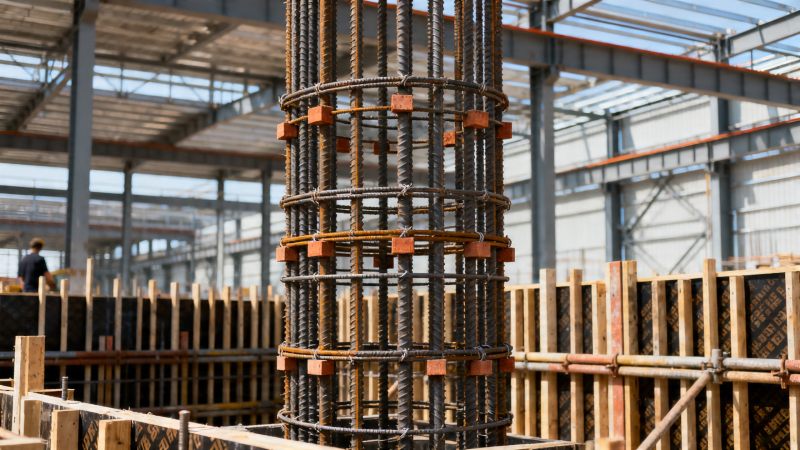
Most column reinforcement problems come from execution gaps rather than design concepts. Bars may be cut correctly, but cages can still fail inspection if lap zones are misplaced, ties are not closed properly, or spacers are missing. In many projects, a pre-pour inspection of 20–30 minutes per column group can prevent rework that would otherwise affect crane time, labor sequencing, and concrete placement planning.
For users and operators on site, four controls are especially important: verify bar diameter, confirm centerline alignment, check cover blocks or spacers, and measure tie spacing at critical zones. In seismic or high-load applications, confinement near beam-column joints may be significantly tighter than in the mid-height region, so using a single spacing rule across the full column is a common mistake.
Another overlooked issue is lap splice location. When too many splices are concentrated in one zone, the local steel congestion increases and construction quality drops. Design documents often define staggered splicing or restricted splice regions for this reason. Buyers and project coordinators should therefore verify not only the bar grade and size, but also whether shop fabrication supports the intended installation sequence.
A 5-Point Field Verification Checklist
- Measure cover at no fewer than 4 faces of the cage before formwork closure.
- Check vertical bar spacing against drawings with tolerance targets such as ±5 mm to ±10 mm where applicable.
- Confirm tie hook orientation and closure details at corners and intermediate bars.
- Review lap splice length and location before concrete delivery is scheduled.
- Inspect plumbness and temporary fixing to prevent movement during pouring and vibration.
These steps are simple, but they directly affect acceptance quality. For large industrial or commercial projects, standardizing this checklist across 3 project stages—fabrication, pre-installation, and pre-pour—usually improves consistency more than relying on visual checks alone.
Material and Accessory Compatibility
Although carbon steel reinforcing bars are the core material in most concrete columns, compatible supporting materials are also used in processing environments, architectural zones, and equipment-related structures. For example, stainless steel plate may be specified for auxiliary fabrication, protective panels, cladding supports, or corrosion-sensitive industrial details. In such cases, 304 Stainless Steel Plate is often selected for its balanced corrosion resistance, workable strength, and broad standard compliance.
Typical technical references for this material include tensile strength of ≥520 MPa, yield strength of ≥275 MPa, elongation of about 55–60%, hardness of ≤183HB or ≤100HRB, and elastic modulus around 193 GPa. Available thickness commonly ranges from 0.3 mm to 200 mm, with standard widths such as 1000 mm, 1219 mm, 1500 mm, and 2000 mm. Finishes like 2B, BA, NO.1, and HL help match different industrial or architectural requirements.
For procurement teams, the value is not that stainless steel replaces reinforcement in standard concrete columns, but that the right steel product mix supports the wider project system. This is particularly relevant in food industry, chemical plants, transportation equipment, and other facilities where both reinforced concrete structures and corrosion-resistant steel components are used in one project package.
Common Failure Risks Caused by Poor Column Bar Placement
Column reinforcement errors rarely fail all at once. More often, they weaken the margin of safety, shorten durability, or create hidden defects that appear later as cracking, spalling, or poor inspection outcomes. For quality control personnel and safety managers, the key is to identify which errors are cosmetic and which directly affect structural behavior. Incorrect cover, displaced cage geometry, and inadequate tie confinement belong to the second category.
One major risk is insufficient concrete consolidation due to reinforcement congestion. If clear spacing does not allow aggregate and grout to pass effectively, voids can form around bars. In heavily reinforced columns, especially at beam-column joints, this can lead to local weakness that is difficult to repair without demolition or jacket strengthening. The cost impact may be several times higher than the original preventive inspection effort.
Another risk is long-term corrosion. If the specified cover is reduced by 10 mm or more in exposed environments, moisture and aggressive agents can reach the steel earlier. While the exact service-life effect depends on climate and concrete quality, the practical message is clear: small placement deviations can translate into major maintenance exposure over 10, 20, or 30 years.
Risk Matrix for Project Teams
The table below helps technical and commercial teams prioritize which issues require immediate correction before pouring.
This matrix is useful for procurement reviewers as well. If a supplier provides bars with inconsistent bending accuracy, unclear tagging, or packaging that allows deformation in transit, the site risk increases before installation even begins. Good sourcing therefore supports good placement.
Frequent Misunderstandings
- Assuming that passing a quantity check means the reinforcement cage is acceptable.
- Treating column and beam bar placement as interchangeable execution tasks.
- Ignoring transport-related distortion in prefabricated or pre-tied cages.
- Focusing only on steel grade while overlooking spacing, cover, and fit-up accuracy.
For distributors, agents, and project owners, understanding these failure patterns improves communication with fabricators, site supervisors, and third-party inspectors. It also reduces disputes tied to responsibility after a nonconformance is discovered.
How Buyers and Project Managers Can Evaluate Steel Supply for Reinforcement Accuracy
In B2B construction purchasing, material compliance is only one part of the decision. A reinforcement-related supply package should also be evaluated for dimensional repeatability, traceability, production capacity, and response speed when drawings change. For multinational projects, this is especially important because design revisions can affect bar schedules, cutting lengths, or bundled delivery sequencing with only 7–14 days of notice.
Hongteng Fengda supports global construction and industrial buyers with structural steel products, customized processing, and standard-based quality control across ASTM, EN, JIS, and GB frameworks. While the article focuses on rebar for column placement, the broader procurement lesson is that successful projects rely on supply partners who understand both material standards and execution realities. Stable lead time, consistent dimensions, and export-ready documentation all reduce downstream coordination risk.
For enterprise decision-makers and finance approvers, the right supplier is not always the one offering the lowest unit price. A lower quote can become more expensive if it leads to site delays, repeated inspections, or preventable scrap. Evaluating the total cost of quality often requires looking at four dimensions together: compliance, delivery reliability, fabrication consistency, and communication efficiency.
Procurement Evaluation Table
The following table can be used as a practical screening reference during supplier comparison or internal approval review.
This type of evaluation helps distributors, contractors, and owners compare suppliers on operational value, not only on price per ton. It is particularly useful when the project includes a mix of structural steel, fabricated profiles, and customized components that must arrive in the correct installation sequence.
Recommended Decision Steps
- Confirm applicable design and material standards before quotation review.
- Request dimensional tolerance and inspection documentation for fabricated items.
- Match delivery batches to the project schedule rather than ordering all materials at once.
- Review export packing, marking, and traceability details for international shipments.
- Align technical review, procurement approval, and site receiving inspection in one workflow.
When these steps are followed, reinforcement placement quality becomes easier to control because the supply chain supports the construction sequence instead of working against it.
Practical FAQ for Engineers, Buyers, and Site Supervisors
Because rebar for column placement affects multiple departments, many project teams ask similar technical and purchasing questions. The answers below are intended to support design review, material planning, and field control in a practical way.
How is column rebar placement checked before concrete pouring?
A standard pre-pour check usually includes bar size verification, cover measurement, tie spacing confirmation, splice location review, and cage plumbness inspection. On medium-sized projects, this review may take 15–30 minutes per inspection zone, but it can save several hours or even days of corrective work after a failed pour or failed QA inspection.
What are the most common causes of nonconformance?
The most common causes are missing spacers, incorrect tie spacing, cage movement during formwork closure, and excessive splice congestion. In some cases, transport deformation of preassembled cages is also a factor. These issues are often preventable with better fixing methods, clearer bundling marks, and a simple 5-point inspection routine.
Is lower-cost material sourcing always a problem?
Not necessarily. Cost control is essential in steel procurement, but lower price should be balanced against dimensional consistency, standards compliance, and delivery reliability. A price difference of 2–5% may be acceptable if the supplier reduces rework risk, improves documentation quality, and supports stable lead time for phased deliveries.
When should customized steel solutions be considered?
Customized solutions are worth considering when the project includes non-standard connection details, mixed-material requirements, export documentation needs, or repetitive fabricated components that benefit from controlled production. This is common in industrial buildings, equipment support structures, transportation-related facilities, and OEM-oriented steel packages.
Rebar for column placement is a construction detail with direct consequences for safety, durability, compliance, and project cost. Accurate spacing, correct cover, reliable tie confinement, and controlled cage alignment all matter because they influence how the column actually performs in service. For buyers and project leaders, the lesson is equally clear: good structural results depend on both correct design execution and dependable steel supply support.
With experience in structural steel manufacturing and export, Hongteng Fengda helps global customers manage material consistency, customized requirements, and international standard compliance across construction and industrial applications. If you need support for structural steel sourcing, customized components, or project-based supply planning, contact us now to get a tailored solution, discuss technical details, and explore more practical steel solutions for your next project.
Please give us a message


Please enter what you want to find